



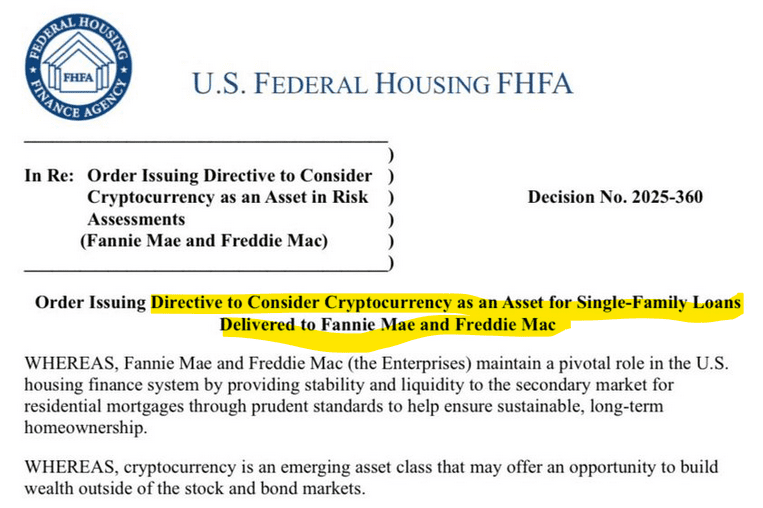
On June 25, 2025, a landmark decision by the U.S. Federal Housing Finance Agency (FHFA), under Director William J. Pulte, ordered Fannie Mae and Freddie Mac to prepare for recognizing cryptocurrency—specifically highlighted by Michael Saylor as Bitcoin—as a reserve asset for mortgage approvals. This directive, rooted in President Donald Trump’s vision to establish the U.S. as the “crypto capital of the world,” marks a pivotal shift in financial policy. This briefing analyzes the political environment driving this change, the immediate market reaction, and the anticipated impacts on the cryptocurrency sector, offering investors critical insights into this transformative development.
Political Environment
The political landscape underpinning this decision reflects a dramatic pivot from the Trump administration’s earlier skepticism toward cryptocurrency. In 2021, Trump dismissed Bitcoin as a “scam” on Fox Business, favoring the U.S. dollar’s global dominance. However, following his 2025 inauguration and a strategic courtship by the crypto industry—evidenced by millions in campaign donations and lobbying—Trump has embraced a pro-crypto agenda.
Key moves include appointing Paul Atkins, a crypto advocate, to lead the U.S. Securities and Exchange Commission (SEC), and Howard Lutnick, linked to crypto-friendly financial entities, as Commerce Secretary. The January 2025 executive order establishing a Strategic Bitcoin Reserve, utilizing seized government-held Bitcoin, further signals this shift. This housing policy aligns with broader deregulation efforts, including the Department of Labor’s rescission of Biden-era 401(k) crypto warnings and the Justice Department’s closure of its crypto enforcement team. Critics, including congressional Democrats and ethics watchdogs, warn of potential conflicts of interest given Trump’s personal crypto ventures, yet the administration frames this as a bold step to modernize finance and stimulate housing markets.
Market Reaction
The FHFA announcement on June 25, 2025, elicited a robust positive response in the cryptocurrency market. Contrary to initial volatility concerns, Bitcoin did not dip but maintained strong momentum, oscillating around $107,000 as of 09:03 AM CEST on June 26, 2025, according to real-time data from CoinMarketCap. This stability reflects growing investor confidence in the policy’s long-term implications, bolstered by Bitcoin’s recent all-time high of $109,071.86 in January 2025 following Trump’s reserve hints. Altcoins also saw gains, with Ether up 4% to $2,350, Solana rising 6% to $185, and XRP gaining 3% to $0.62, indicating broader market optimism.
Equity markets responded favorably, with Strategy (formerly MicroStrategy), holding $63 billion in Bitcoin, surging 9% in after-hours trading on June 25, reinforcing its status as a crypto proxy following its rebranding to Strategy in February 2025. The total crypto market capitalization climbed 5% to $3.3 trillion, per CoinMarketCap, signaling a bullish sentiment. Analysts attribute this resilience to the directive’s alignment with institutional adoption trends, though some caution that sustained growth depends on regulatory clarity.
Expectations for Crypto Sector Impacts
This recognition positions Bitcoin as a legitimate collateral asset, potentially unlocking $12 trillion in the U.S. housing market, where Fannie Mae and Freddie Mac guarantee half of all mortgages. Short-term, expect increased institutional adoption, with firms like ProCap Financial (merging with $1 billion in Bitcoin assets) and Strategy (previously MicroStrategy) leading the charge. The policy could boost Bitcoin’s price toward $100,000 by year-end if regulatory clarity emerges, though volatility risks remain due to untested economic models—peer-reviewed studies on crypto’s long-term stability as collateral are notably absent.
Altcoins may benefit if the FHFA extends recognition beyond Bitcoin, though their inclusion hinges on regulatory compliance with U.S.-regulated exchanges. Risks include potential market corrections if housing demand falters or if political pushback intensifies, with 2025 election cycles looming. Long-term, this could catalyze a global shift, pressuring other nations to follow suit, enhancing Bitcoin’s “digital gold” status but challenging traditional banking models.
Expectations for Crypto Sector Impacts
This recognition positions Bitcoin as a legitimate collateral asset, potentially unlocking $12 trillion in the U.S. housing market, where Fannie Mae and Freddie Mac guarantee half of all mortgages. Short-term, expect accelerated institutional adoption, with firms like ProCap Financial (merging with $1 billion in Bitcoin assets) and Strategy leading the charge. The policy could propel Bitcoin’s price toward $115,000 by year-end if regulatory frameworks solidify, though volatility risks persist due to the lack of peer-reviewed studies on crypto’s long-term stability as collateral.
Altcoins may see increased inclusion if the FHFA extends recognition beyond Bitcoin, contingent on compliance with U.S.-regulated exchanges. Risks include potential market corrections if housing demand weakens or if political opposition mounts, especially with 2025 election cycles approaching. Long-term, this could trigger a global domino effect, enhancing Bitcoin’s “digital gold” status and challenging traditional banking paradigms.
Investment Considerations
- Opportunities: Allocate to Bitcoin (BTC) and Strategy (MSTR) for direct exposure, with a 5-10% portfolio weighting. Consider diversified crypto ETFs for broader market access. Monitor Solana (SOL) and Ether (ETH) for upside if altcoin inclusion expands.
- Risks: Hedge with U.S. Treasury bonds or gold to mitigate volatility. Watch for regulatory reversals or housing market slowdowns.
- Actionable Insight: Engage financial advisors to assess crypto integration into mortgage-backed securities, a nascent but high-growth area.
Conclusion
Bitcoin’s recognition as a reserve asset by the U.S. housing system is a watershed moment, driven by a pro-crypto political shift and poised to reshape the $12 trillion mortgage market. While short-term volatility is expected, the long-term trajectory favors institutional adoption and price appreciation. Investors should act decisively, balancing opportunity with prudent risk management, as this policy could redefine the global financial landscape by 2026.