

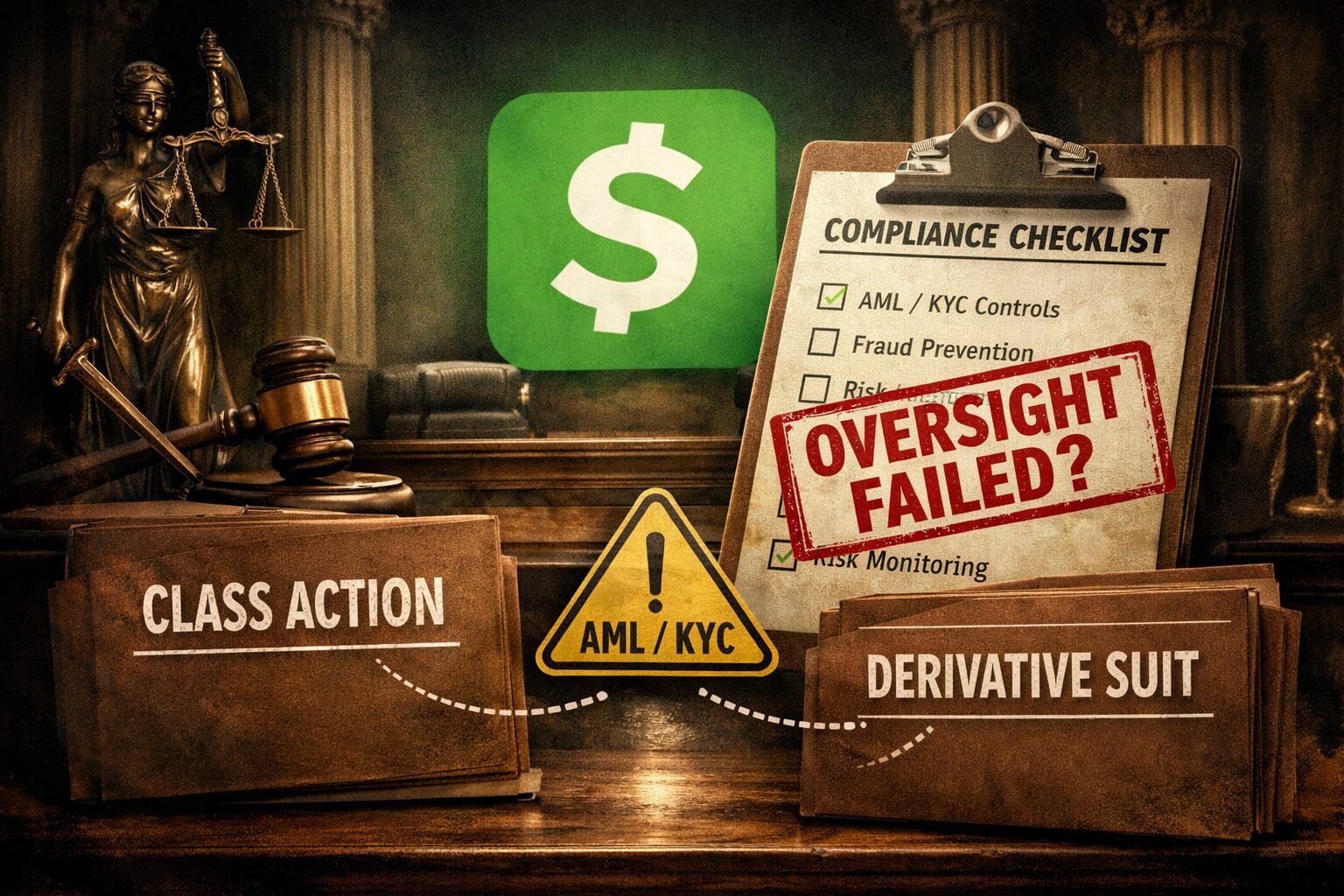
A federal judge in California has refused to dismiss two lawsuits accusing the U.S. fintech Block Inc. (Square/Cash App) and senior leadership of compliance-related misstatements and oversight failures. The rulings keep an investor class action and a separate shareholder derivative case on track—turning Block’s compliance narrative into a courtroom test of corporate governance, controls, and accountability.
Key Facts
- Court / Judge: U.S. District Court, Northern District of California; Judge Noël Wise denied a motion to dismiss in the securities class action.
- Class action theory: Investors allege materially misleading statements/omissions about Cash App’s compliance programming (and user metrics), followed by enforcement actions and a major stock decline.
- Derivative suit theory: Shareholders claim Block’s executives and board breached fiduciary duties by allowing allegedly lax customer due diligence and weak safeguards—effectively failing to supervise compliance.
- Demand futility: The court accepted allegations that pre-suit demand on the board would have been futile because a majority faced a substantial likelihood of liability / lacked independence (as pleaded).
- Regulatory backdrop: Block previously agreed to $80M with 48 state regulators (AML program deficiencies) and $40M with NYDFS plus an independent monitor (BSA/AML/KYC gaps).
- Consumer protection pressure: CFPB said Block failed for years on fraud controls and customer service practices on Cash App and ordered redress and remediation.
Short Analysis
This is not a “paperwork” dispute. The class action centers on whether Block’s public posture about Cash App’s compliance capacity and operational integrity was materially misleading to investors over the pleaded class period—raising classic securities-fraud questions about disclosure, internal controls, and what management knew (or should have known).
The derivative case is the governance blade: it targets the board’s oversight duty—i.e., whether directors meaningfully monitored compliance risk in a fast-scaling fintech with known exposure to fraud, AML/KYC failures, and enforcement attention. If these claims survive discovery, they can become a compliance “X-ray”: board minutes, escalation pathways, SAR/transaction monitoring resourcing, and the reality behind “we take compliance seriously” messaging.
Call for Information
Do you have internal documents, audit findings, whistleblower evidence, or first-hand experience regarding Cash App’s AML/KYC controls, fraud handling, escalation practices, or board-level reporting? Share information securely via Whistle42.com—anonymity-friendly submissions are welcome.