



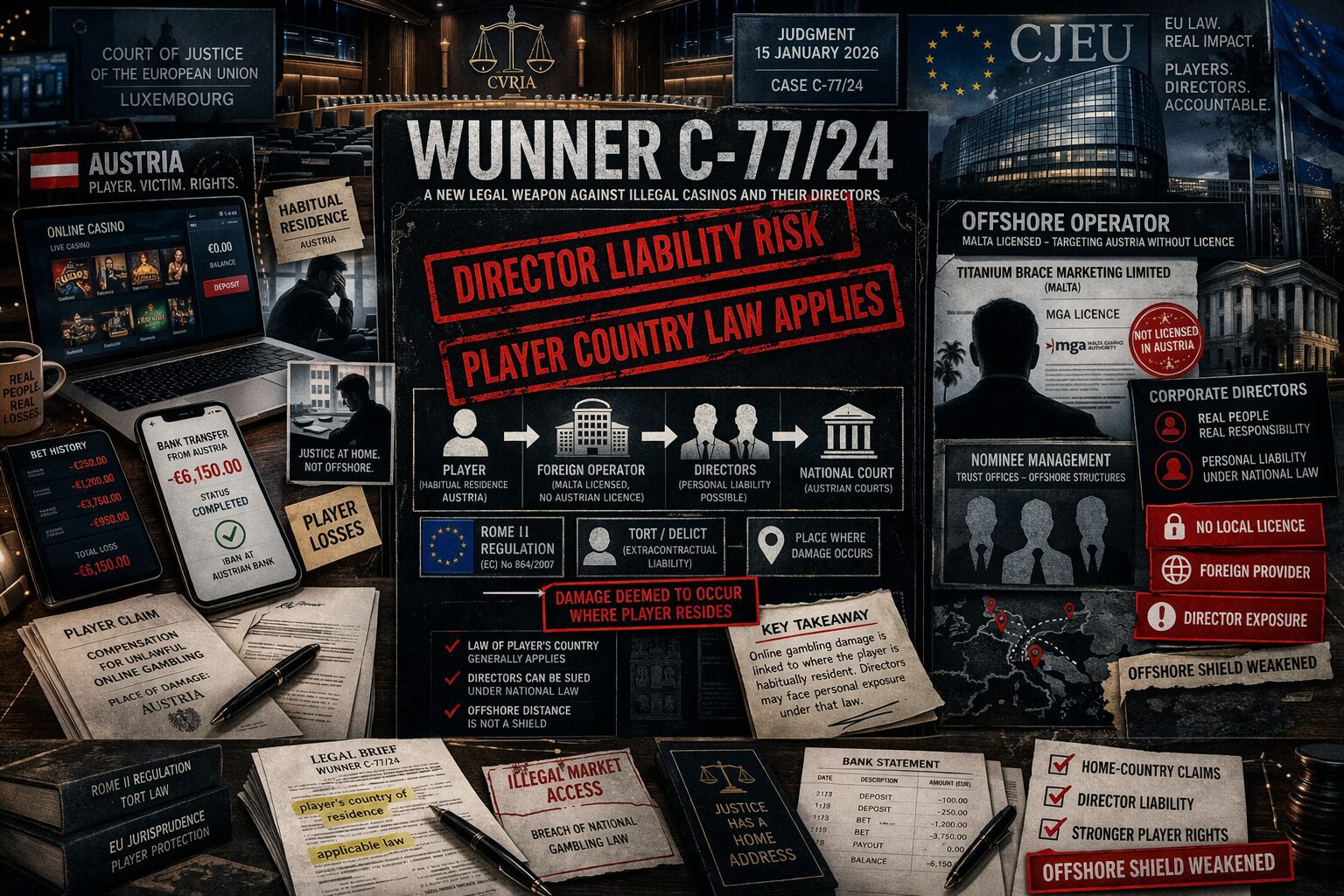
The CJEU’s January 2026 ruling in Wunner (C-77/24) could become a turning point in Europe’s fight against illegal online casinos. The Court held, as a general rule, that a player may rely on the law of their own country of residence when bringing a tort claim against the directors of a foreign gambling operator that lacked the required national licence. For the illegal casino sector, that materially increases director-level exposure. For players, it strengthens the path to pursue claims at home rather than being pushed into offshore or foreign-law battles.
Key Findings
- In Wunner (C-77/24), the CJEU held that a player may, as a general rule, rely on the law of their country of residence when suing the directors of a foreign gambling provider that did not hold the licence required in that country.
- The Court said the relevant damage is generally deemed to occur in the Member State where the player is habitually resident.
- The action against directors is treated as a tort or delict claim under the Rome II Regulation, not as a company-law issue excluded from that framework.
- The underlying facts involved an Austrian player suing the directors of Titanium Brace Marketing Limited, a Maltese gambling provider licensed in Malta but not in Austria.
- The CJEU did not decide the directors’ ultimate liability; it interpreted EU law, and the national court remains responsible for deciding the case.
Why the Wunner Judgment Matters
The Wunner judgment is not just another technical conflict-of-laws ruling from Luxembourg. For the illegal online casino sector, it may become one of the most important legal developments in recent years. The reason is simple: it reduces the protective value of offshore or foreign corporate distance when a casino targets players in a country where it lacks the required licence.
For years, the sector has relied on structural fragmentation. Operators were incorporated in one jurisdiction, licensed in another, directed from elsewhere, and marketed across Europe into states with stricter national gambling rules. Wunner cuts into that model by stating that, in claims against directors for unlawful gambling offers, the legal center of gravity is generally the player’s country of residence.
The Facts Behind the Case
The case arose from an Austrian player’s claim against the two directors of Titanium Brace Marketing Limited, a Maltese provider of online games of chance. Titanium held a Maltese gambling licence, but it did not hold the licence required in Austria. The player argued that the gambling contract was null and void and that, under Austrian law, the directors were personally liable for Titanium’s illegal offer of online gambling in Austria.
The directors challenged both jurisdiction and applicable law. They argued that the relevant place of damage was Malta and that Maltese law, not Austrian law, should apply. The Austrian Supreme Court referred the issue to the CJEU.
What the Court Actually Held
The CJEU said that the Rome II Regulation applies to this kind of action because it concerns a non-contractual obligation arising out of tort or delict. The Court also said that this type of director-liability claim is not excluded as a pure matter of company law, because the alleged liability arises from an obligation external to the company’s internal affairs.
That is the first key point. The second is even more important: the law that generally applies is the law of the country where the damage occurs, and in this context the damage must be deemed to occur in the Member State where the player is habitually resident. In the actual case, that meant Austria.
The Court added one qualification: where all the circumstances show that the tort is manifestly more closely connected with another country, the court seised may depart from the general rule. But the starting point remains the player’s home country.
Why This Is Dangerous for Illegal Casino Directors
This judgment is especially relevant for directors, nominee managers, trust-office appointees, and governance-layer figures in the illegal gambling sector. It suggests that their exposure cannot automatically be neutralized by the jurisdiction of incorporation or by the operator’s foreign licence. If the operator was targeting players in a country where it lacked the required national licence, national law in the player’s home country may become the governing law for tort claims against the directors.
That does not mean every director is automatically liable. The CJEU did not decide liability. But it did make clear that actions against directors are legally viable within the Rome II framework and that the place of damage is generally where the player resides and suffers the loss. That is a serious shift in litigation risk.
What It Means for Players
For players, Wunner is a significant strategic advantage. It strengthens the argument that they can pursue claims under the law of their own country instead of being forced into the operator’s preferred foreign-law forum. In practical terms, this makes recovery actions more realistic in regulated jurisdictions where the domestic licensing framework is central to the legality analysis.
The Court’s reasoning is particularly important for online gambling because digital gambling is hard to locate physically. The CJEU addressed that directly and said that, given the nature of online games of chance, they must be regarded as having taken place where the player is habitually resident.
Why It Matters for FinTelegram’s Research
This ruling fits directly into FinTelegram’s work on illegal casinos, payment rails, platform providers, and trust-office structures. In many of these cases, the key question is no longer just whether an operator lacked a national licence. The sharper question is who directed the operator, who enabled the offer, and which individuals may now face claims under the law of the player’s country. That is where Wunner becomes highly relevant. This final point is an analytical implication drawn from the judgment’s logic.
For networks that rely on layered management structures in Malta, Curaçao, Cyprus, or other hubs, Wunner increases the significance of directors and formal management entities. In that sense, it is not merely a player-rights case. It is also a warning to the governance layer of Europe-facing illegal casino operations. This too is an inference from the ruling’s reasoning rather than an express holding.
Summary Box
Case: C-77/24, Wunner.
Date: 15 January 2026.
Core holding: A player may generally rely on the law of their country of residence when suing directors of a foreign gambling provider that lacked the required local licence.
Legal basis: Rome II Regulation on non-contractual obligations.
Why it matters: It increases exposure for illegal casinos’ directors and strengthens domestic recovery paths for players.
Conclusion
The Wunner ruling sends a clear signal to the illegal online casino sector. Where a casino targets players without the licence required in their country, the legal consequences do not automatically remain offshore. The player’s home country matters. The player’s law matters. And the directors behind the operator may face personal tort exposure under that law.
For players, that is an opening. For illegal casinos and their directors, it is a warning.
Request For Information
If you worked for an illegal casino, payment processor, platform provider, affiliate network, trust office, or nominee-director structure serving Europe-facing gambling schemes, contact us securely via Whistle42.
If you are a player who lost money to a casino that targeted your country without the required national licence, send us your documents, payment records, account correspondence, and legal filings. Your information may help expose the people and structures behind the operator.