

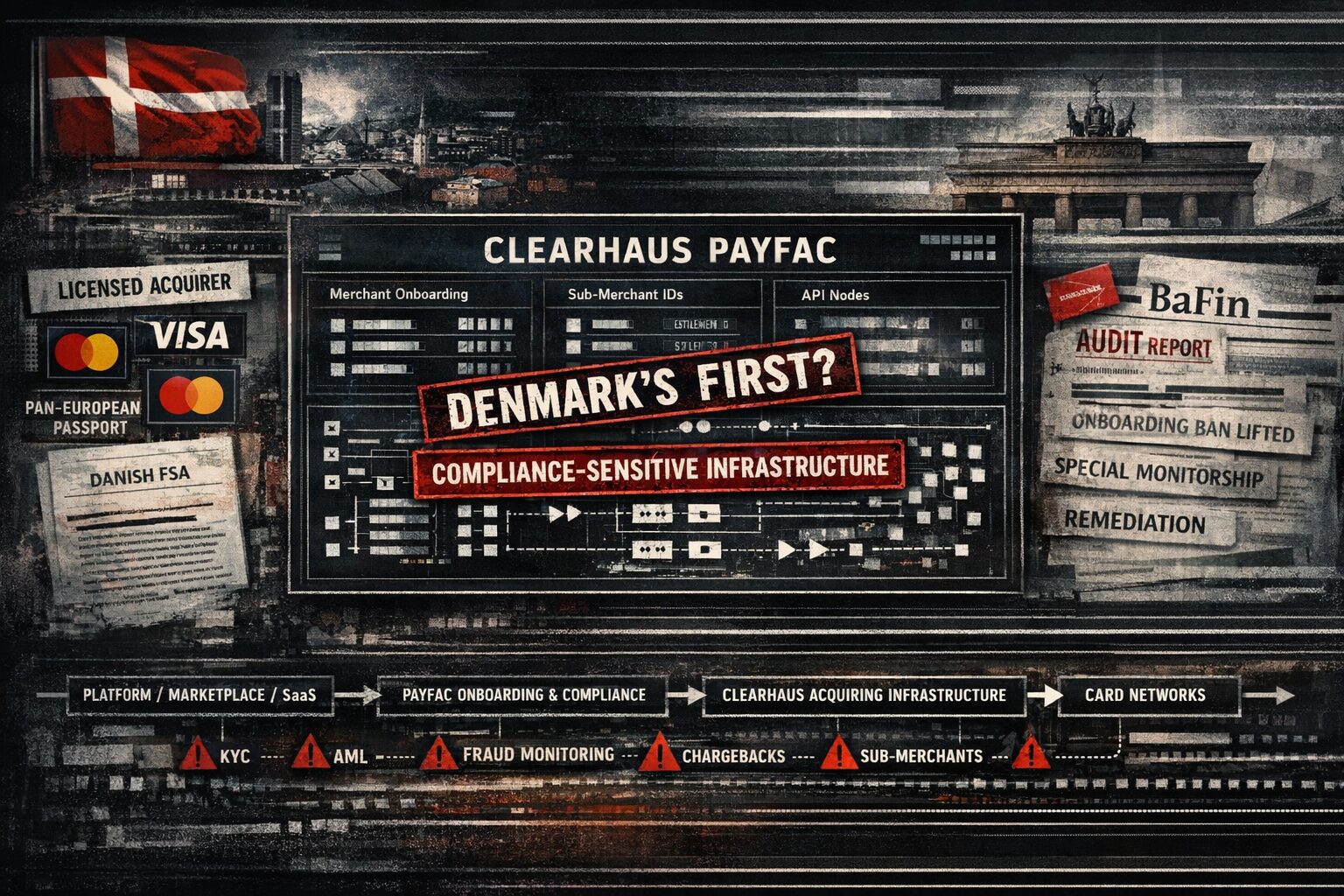
Clearhaus, the Danish acquirer owned by Unzer, says it has become the first Danish acquirer to launch a Payment Facilitator (PayFac) solution. The move is strategically important: it lets regulated platforms embed card acquiring directly into their own products while Clearhaus stays in the background as the licensed acquirer. But in the FinTelegram view, the launch also raises a familiar question: when payment infrastructure becomes more deeply embedded and operational control is distributed, who ultimately owns the compliance risk?
Key Findings
- Clearhaus is now openly marketing a PayFac model in which licensed platforms handle sub-merchant onboarding, KYC/AML, ongoing monitoring, and first-line fraud/chargeback handling, while Clearhaus provides the underlying acquiring rails.
- Clearhaus is a Danish payment institution licensed by the Danish FSA, with pan-European passporting, and is a principal member of Visa and Mastercard. Its own site says it reached 42,000 customers in January 2026.
- Clearhaus has been part of Unzer since the 2021 acquisition of Clearhaus and QuickPay, a deal Unzer framed as making the group a “fully integrated payment service provider.”
- Unzer currently presents itself as serving more than 85,000 merchants across Europe with around 750 employees in eight offices.
- FinTelegram has previously reported critically on Unzer’s financial turbulence, BaFin scrutiny, and AML-related deficiencies. Unzer later announced that BaFin had ended the special monitorship and fully lifted the onboarding ban at Unzer E-Com in October 2024.
Report
The press release sent to FinTelegram is more than a product announcement. It signals a structural step in the Nordic and wider European acquiring market: Clearhaus is moving beyond classic merchant acquiring and into a PayFac architecture designed for regulated platforms, marketplaces, SaaS providers, and other embedded-finance operators.
According to Clearhaus’s own PayFac materials, the model is aimed at licensed entities such as financial institutions or EMIs that want to integrate acquiring directly into their own products. In this setup, the platform controls the merchant lifecycle, including onboarding and compliance, while Clearhaus provides the licensed acquiring infrastructure in the background. Clearhaus also says the model supports Visa and Mastercard acceptance, recurring payments, merchant-level reporting, automated settlement and reconciliation, configurable payouts, and connectivity to more than 30 payment gateways.
That is commercially significant. Embedded payments has been one of the dominant trends in European fintech, and the PayFac model is attractive because it shortens merchant onboarding, keeps the platform at the center of the customer relationship, and avoids forcing every sub-merchant into a separate acquiring contract. Clearhaus explicitly says sub-merchants can be onboarded under the PayFac’s own processes and receive their own MIDs without separate acquiring agreements.
From a compliance perspective, however, the most important line in the Clearhaus materials is not the commercial one but the risk allocation: the PayFac takes on full compliance responsibility for KYC, AML, risk assessment, ongoing monitoring, and first-line fraud and chargeback handling. Clearhaus remains the licensed acquirer, but the operational compliance burden shifts materially toward the platform layer.
That distinction matters. In theory, the model creates a clean separation of roles. In practice, it can also create a layered-risk environment in which acquiring, onboarding, platform governance, and merchant behavior are spread across multiple actors. In FinTelegram’s compliance view, such models can be efficient and legitimate, but they also demand unusually strong control frameworks, especially where platforms touch sectors with elevated AML, fraud, sanctions, or consumer-protection risk.
Clearhaus: Not A Newcomer, But A Growing Acquiring Infrastructure Player
Clearhaus is not an unknown startup improvising its way into PayFac. It says it is authorised by the Danish Financial Supervisory Authority, passported across Europe, and a principal member of both Visa and Mastercard. Its corporate timeline states that it onboarded its first customer in 2015, was acquired by Unzer in 2021, announced POS acquiring in May 2025, and hit 42,000 customers in January 2026.
The company has also widened its scope beyond pure e-commerce acquiring. In February 2026, Clearhaus announced expansion into physical-store payments in Denmark, and in 2025 it framed this as part of a broader “Unified Commerce” strategy under Unzer.
This makes the PayFac launch look less like a one-off feature and more like part of a broader build-out: online acquiring, in-store acceptance, and now embedded platform acquiring.
The Unzer Context: Growth, Integration, And A Troubled Regulatory Backstory
FinTelegram has covered Unzer critically before, and that context should not be ignored when assessing any new group-level strategic rollout.
Unzer acquired Clearhaus and QuickPay in early 2021, saying the transaction would make the group a fully integrated PSP. Later that year, Robert Bueninck became CEO as Unzer pushed to integrate multiple acquisitions and scale its European footprint.
But the growth story was followed by regulatory and financial stress. FinTelegram’s prior coverage highlighted Unzer’s severe 2022 losses, restructuring pressure, and earlier regulatory scrutiny. The Unzer tag page on FinTelegram also points readers to reporting on BaFin action in 2022 and more recent reporting tied to the broader “Operation Chargeback” environment.
On the regulatory side, Unzer itself acknowledged in August 2022 that BaFin had completed a special audit of Unzer E-Com GmbH, identified findings particularly in onboarding and AML processes for the period examined, imposed a temporary pause on new customer acceptance at that subsidiary, and appointed a special commissioner.
Unzer later said that, as of October 2024, BaFin had ended the special monitorship and fully lifted the onboarding ban at Unzer E-Com.
That later remediation is relevant and should be noted fairly. But so is the earlier fact pattern: Unzer’s controls were serious enough to trigger special supervisory intervention. For FinTelegram readers, that means new strategic products launched within the group deserve not just commercial attention, but close scrutiny around governance, merchant acceptance standards, and effective risk oversight.
Why The PayFac Model Deserves Careful Monitoring
The PayFac model is not inherently problematic. It can improve onboarding speed, simplify merchant operations, and create better payment integration for legitimate businesses. But it also concentrates power at the platform layer.
The key compliance question is straightforward: how strong are the controls of the licensed PayFac that stands between the merchants and the acquiring rails?
If a platform is doing the onboarding and first-line compliance, then the quality of its KYB/KYC, merchant due diligence, ongoing monitoring, fraud handling, and escalation protocols becomes decisive. That is especially true in sectors where platform operators may be commercially incentivised to maximize merchant growth while the underlying acquirer is structurally one step removed from day-to-day merchant contact.
In other words, embedded finance can reduce friction for legitimate commerce — but it can also reduce friction for problematic merchant activity if governance is weak. That is why FinTelegram generally views PayFac structures as compliance-sensitive infrastructure, not just product innovation.
FinTelegram Assessment
Clearhaus’s new PayFac offer is commercially logical and strategically consistent with Unzer’s broader “unified commerce” push. Clearhaus appears to bring real acquiring infrastructure, regulatory standing in Denmark, and scale across Europe.
However, because Clearhaus is part of Unzer, the launch cannot be viewed in isolation from the group’s recent history. Unzer has already shown how quickly growth, integration pressure, onboarding, and AML governance can become regulatory flashpoints. Even if major remediation has since taken place, the lesson remains valid: payment infrastructure groups do not get judged only by product innovation, but by the resilience of their controls.
For regulators, partners, and merchants, the Clearhaus PayFac rollout should therefore be watched through two lenses at once: commercial innovation on one side, compliance execution on the other.
Whistleblowers, platform insiders, merchants, and compliance professionals with information about Clearhaus, Unzer, or PayFac onboarding practices are invited to contact FinTelegram via Whistle42.