



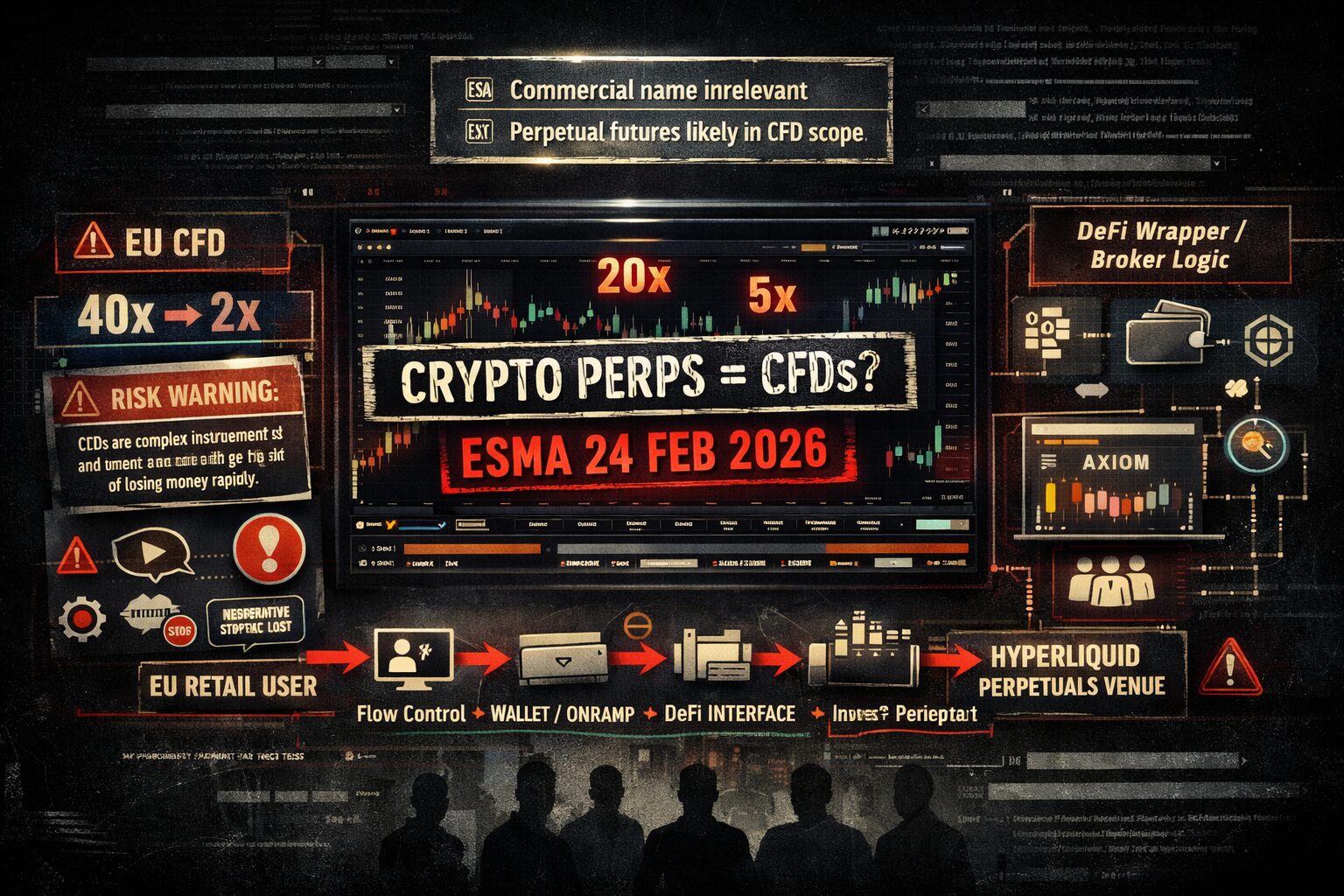
ESMA’s February 2026 public statement is a watershed moment for the DeFi-perps segment. The EU regulator has now made explicit what many compliance analysts long suspected: derivatives marketed as “perpetual futures” or “perpetual contracts” are likely to fall within the EU’s existing CFD product-intervention perimeter when they provide leveraged exposure and are not exclusively physically settled. That matters directly for Hyperliquid, which offers perpetual derivatives with leverage of up to 40x and, according to FinTelegram’s earlier testing, remains accessible from EU jurisdictions without KYC or effective perimeter controls. In short, the label may be DeFi, but the regulatory logic is moving back toward the old broker world.
Key Findings
- ESMA said on 24 February 2026 that derivatives marketed as “perpetual futures” or “perpetual contracts” are likely to fall within the scope of the EU’s existing national CFD product-intervention measures where they meet the CFD definition.
- ESMA also said the commercial name is irrelevant, that funding-rate mechanisms and voluntary safeguards such as insurance funds do not change the classification analysis, and that firms must assess these products under MiFID II and investor-protection rules.
- Under the long-standing EU CFD framework, crypto CFDs for retail clients are subject to a 2:1 leverage cap, margin close-out, negative balance protection, a standardised risk warning, and a ban on incentives.
- Hyperliquid’s own documentation says its perpetuals are derivatives without expiration, support per-wallet cross or isolated margin, cover 100+ assets, and offer leverage ranging from 3x to 40x.
- Hyperliquid’s contract specifications also state there are “no address-specific restrictions,” a statement that sits uncomfortably beside ESMA’s insistence on narrow target markets, appropriateness checks, and compliant distribution strategies for complex leveraged derivatives.
- FinTelegram previously documented that EU residents could fund, swap, and trade Hyperliquid perps without KYC, geo-blocking, or deposit limits, and separately argued that Hyperliquid functions more like a foundation-controlled trading venue than a credibly permissionless protocol.
- FinTelegram’s AXIOM review also showed how broker-like DeFi front ends can package Hyperliquid perpetuals into a branded retail interface with up to 50x leverage and direct fee capture.
- Finance Magnates correctly identified the practical significance of ESMA’s move: if crypto perpetuals are treated as CFDs in the EU, the implications for leverage, distribution, and retail targeting are profound.
Compliance Analysis
ESMA Has Now Closed The Naming Loophole
The most important development is not political rhetoric but legal framing. ESMA’s February 2026 statement says that derivatives marketed as perpetual futures or perpetual contracts are likely to fall within the scope of the existing national CFD product-intervention measures where they meet the relevant definition. ESMA is explicit that the assessment must be made irrespective of the product’s commercial name. It adds that a derivative giving exposure to an underlying value that is not exclusively physically settled would likely fall within scope, and that features such as a funding-rate mechanism, negative balance protection, or insurance funds are not relevant to that classification analysis.
That is a major perimeter signal for the entire crypto-perps sector. It means that the old trick of changing the label while preserving the economic substance is losing credibility in Europe. In FinTelegram terms: this is the same perimeter game, but with new rails.
Why This Matters For Hyperliquid
Hyperliquid is not a theoretical case. Its own documentation describes perpetuals as derivative products without expiration that rely on funding payments. It supports per-wallet cross or isolated margin, lists 100+ perpetual assets, and allows leverage that varies by asset from 3x to 40x. Its contract-specifications page also says there are “no address-specific restrictions.” Those are not the hallmarks of a narrow, professionally controlled derivatives distribution model for EU retail clients. They look far closer to a globally accessible high-leverage derivatives venue.
That tension becomes sharper when read against ESMA’s statement. ESMA says leveraged derivatives require a very careful target-market assessment, are expected to have a narrow target market, require an appropriateness assessment in non-advised services, and raise conflicts-of-interest concerns where products are issued or traded within the same group ecosystem. ESMA also says such perpetual derivatives are packaged investment products for PRIIPs purposes, meaning a KID is needed when they are distributed to retail clients.
In other words, the EU framework is moving in the exact opposite direction from the “connect wallet and start trading” logic that has fuelled the growth of crypto perpetuals.
The Old CFD Logic Is Back
This is where the comparison with the binary-options and CFD era becomes more than rhetorical. ESMA’s 2018 intervention measures for CFDs were adopted precisely because retail distribution of leveraged speculative products had become a major investor-protection problem. Those measures included leverage limits from 30:1 down to 2:1 depending on the asset class, margin close-out, negative balance protection, a ban on incentives, and standardised risk warnings. For cryptocurrencies, the cap was 2:1.
Finance Magnates highlighted the practical consequence immediately after ESMA’s February 2026 statement: if crypto perpetuals are treated as CFDs, then the EU retail model for these products becomes drastically narrower than the high-leverage offshore-style norm. Its related coverage also framed the issue in the context of a market measured in the tens of trillions, while academic commentary from Cornell noted that cumulative crypto perpetual volume since 2020 had already surpassed $60 trillion.
That is precisely why FinTelegram views this as a core DeFi compliance issue, not a niche product-classification debate. When a massive, fast-growing leveraged market collides with investor-protection rules built for CFDs, the perimeter question becomes strategic.
Summary Table: CFDs vs Crypto Perpetual Futures
Investor and Regulatory Comparison
| Characteristic | CFDs | Crypto Perpetual Futures | Investor Perspective | Regulatory / Compliance Perspective |
|---|---|---|---|---|
| Basic product logic | A CFD is a derivative giving long or short exposure to price movements in an underlying, typically cash-settled. ESMA’s CFD definition focuses on economic exposure rather than branding. | Crypto perpetuals are typically marketed as derivatives without expiry that provide ongoing leveraged exposure to crypto prices, usually via margin and a funding-rate mechanism. Hyperliquid’s docs describe perpetuals exactly in those terms. | For investors, both products are primarily speculation tools rather than spot ownership. | ESMA’s February 2026 statement makes clear that perpetuals can fall within the CFD perimeter if they meet the functional definition. |
| Commercial label | Historically marketed openly as CFDs. | Often marketed as “perpetual futures” or “perpetual contracts.” | Investors may perceive perpetuals as something materially different from CFDs because of the crypto-native branding. | ESMA says the commercial name is irrelevant; firms must assess the substance of the instrument under MiFID II and CFD rules. |
| Settlement logic | Typically cash-settled or capable of cash settlement. | Perpetuals often avoid traditional expiry and use mark prices plus funding flows rather than physical delivery. ESMA says a derivative not exclusively physically settled would likely fall within the CFD measures unless excluded. | Investors may not care whether settlement is “cash” or “funding-rate based” if the economic result is leveraged price exposure. | ESMA explicitly says that funding-rate mechanisms do not change the classification analysis. |
| Expiry | CFDs do not have a classic futures expiry profile in the retail-broker model. | Perpetuals are specifically designed to have no expiry date. Hyperliquid states its contracts are derivatives without expiration. | No expiry makes perpetuals easier and more “casino-like” for continuous retail speculation. | Lack of expiry does not remove them from the CFD perimeter if the functional criteria are met. |
| Leverage | In the EU retail context, leverage is capped under the CFD intervention regime; crypto CFDs are limited to 2:1. | Hyperliquid states that leverage on its perpetuals ranges from 3x to 40x depending on the asset. | Higher leverage is commercially attractive to retail users but sharply increases liquidation and loss risk. | This is one of the clearest tensions: EU CFD rules sharply restrict retail leverage, while crypto perpetual venues often market much higher leverage. |
| Margin model | Margin is integral to CFDs, with EU rules requiring margin close-out protection. | Hyperliquid documents both cross and isolated margin for perpetuals. | Margin makes both products highly sensitive to volatility and liquidation cascades. | ESMA highlights leverage and margin trading as core risk factors in target-market and investor-protection analysis. |
| Risk controls | EU retail CFD rules require leverage limits, mandatory risk warnings, margin close-out, negative balance protection, and a ban on incentives. | Crypto-perps venues may offer voluntary protections, insurance funds, or negative-balance-style language, but ESMA says such safeguards do not alter the classification analysis. | Investors may wrongly assume that venue-level safeguards make the product “regulated enough.” | ESMA says voluntary protections are not a substitute for compliance with the underlying product-intervention framework. |
| Target market | Under MiFID II product-governance logic, leveraged derivatives should have a narrow target market. | Hyperliquid’s model appears globally accessible, and its docs say there are “no address-specific restrictions.” | Retail investors experience these products as open-access speculation tools. | ESMA warns that mass marketing to inexperienced investors is inconsistent with a narrow target market. |
| Appropriateness assessment | Required when complex derivatives are distributed on a non-advised basis to retail clients in the EU. | Many DeFi-perps environments are designed for immediate wallet-based access, often without classic appropriateness workflows. | Retail investors may enter a high-risk derivatives environment without any meaningful suitability friction. | ESMA explicitly reminds firms that an appropriateness assessment is needed for complex derivatives in non-advised services. |
| Disclosure regime | Retail distribution of CFDs in the EU comes with standardized warnings and conduct requirements. | ESMA says perpetual derivatives are packaged investment products, so a PRIIPs KID is needed when distributed to retail clients. | Investors in crypto perpetuals often do not receive a disclosure package comparable to traditional retail derivatives distribution. | This is a major compliance issue for EU-facing distribution of crypto perpetuals. |
| Conflicts of interest | Traditional broker-CFD models have long raised execution and principal-risk conflicts. | ESMA flags a prominent conflict where derivatives are issued by a group entity or traded on a group venue and then pushed to clients. | Investors may not see how venue, issuer, front end, and fee capture can align against them. | This point is especially relevant in vertically integrated DeFi ecosystems and front ends built around a single venue. |
| Regulatory narrative | Clearly recognized as regulated leveraged derivatives in the EU retail perimeter. | Often presented as innovative DeFi-native instruments outside legacy broker logic. | Investors may assume “DeFi” means a different, freer, or less intermediated risk model. | ESMA’s message is that naming and crypto-native mechanics do not change the core regulatory analysis. |
| FinTelegram compliance view | CFDs are the historical benchmark for leveraged retail-perimeter analysis. | Crypto perpetuals, especially where offered through DeFi-style access layers, increasingly look like CFDs in new technical packaging. | For investors, the economic reality may be closer to the old CFD world than the DeFi narrative suggests. | For regulators and compliance analysts, the perimeter test is shifting decisively toward substance over form. |
Short Takeaway
From an investor-protection perspective, the core difference between CFDs and crypto perpetuals is often less significant than the marketing suggests: both deliver leveraged exposure to price movements without true spot ownership, and both can generate rapid retail losses. From a regulatory perspective, ESMA’s February 2026 statement makes the key point explicit: where crypto perpetuals function like CFDs, they should increasingly be treated like CFDs, regardless of the DeFi or futures-style branding.
Hyperliquid’s Structure Still Looks More Like A Venue Than A Pure Protocol
FinTelegram has already argued that Hyperliquid should not be treated as a credibly permissionless DeFi scheme. In earlier reporting, we documented EU access to perpetuals without KYC, geo-blocking, or deposit limits. We also argued that Hyperliquid’s foundation-controlled infrastructure, concentrated validator structure, and discretionary intervention powers make it look functionally closer to a centrally steered trading venue than to a neutral autonomous protocol.
ESMA’s new statement strengthens that compliance view. If the commercial name is irrelevant, if funding mechanisms do not change the analysis, and if the decisive issue is the substance of the derivative and the way it is distributed, then Hyperliquid’s DeFi branding no longer answers the core regulatory question. The real question becomes whether EU clients are being given access to what are, in substance, CFD-like leveraged derivatives without the controls, restrictions, and disclosures the EU framework requires.
AXIOM Shows How The Hyperliquid Risk Gets Retail-Packaged
The AXIOM case makes the issue even more urgent. FinTelegram recently showed that AXIOM packages Hyperliquid-powered perpetuals inside a branded retail-facing interface, advertises leverage up to 50x, and imposes its own 0.01% fee per transaction. That is exactly how a foundational derivatives venue can become part of a wider broker-like distribution stack: front-end branding, fiat onboarding, wallet orchestration, and a simplified user journey for leveraged trading.
So the Hyperliquid issue is not only about Hyperliquid itself. It is also about the growing ecosystem of DeFi brokers and DeFi gateways building retail-facing businesses on top of Hyperliquid’s derivatives rail. Once that happens, the perimeter problem becomes larger, not smaller.
FinTelegram’s View
FinTelegram’s working conclusion is that ESMA has now provided compliance analysts with a much clearer lens: many crypto perpetuals are no longer best understood as exotic DeFi novelties. They increasingly look like leveraged retail derivatives that belong in the same investor-protection conversation that once transformed the treatment of CFDs and binary options in Europe. Hyperliquid is one of the clearest test cases for that shift.
Summary Compliance Statement
ESMA’s February 2026 statement materially strengthens the case that crypto perpetuals offered to EU retail clients should be analysed through the existing CFD perimeter, not merely through DeFi marketing language. Hyperliquid’s own documentation describes leveraged perpetual derivatives with no expiration, funding-rate mechanics, broad asset coverage, and leverage up to 40x, while FinTelegram’s earlier reporting documented EU access without KYC or effective gating. In our view, that combination creates a serious MiFID II / CFD investor-protection issue. And where front ends such as AXIOM package Hyperliquid perps into simplified retail journeys, the old broker logic reappears in a new technical wrapper.
Call To Whistleblowers
If you have information about Hyperliquid, AXIOM, their EU-facing access controls, target-market assessments, appropriateness workflows, product-governance discussions, PRIIPs/KID analysis, or the way perpetuals are distributed to retail users, contact FinTelegram confidentially via Whistle42. We are particularly interested in internal compliance memos, legal assessments, geo-blocking logic, wallet and routing evidence, and discussions around how crypto perpetuals are classified under MiFID II and the CFD framework.