


Company Overview
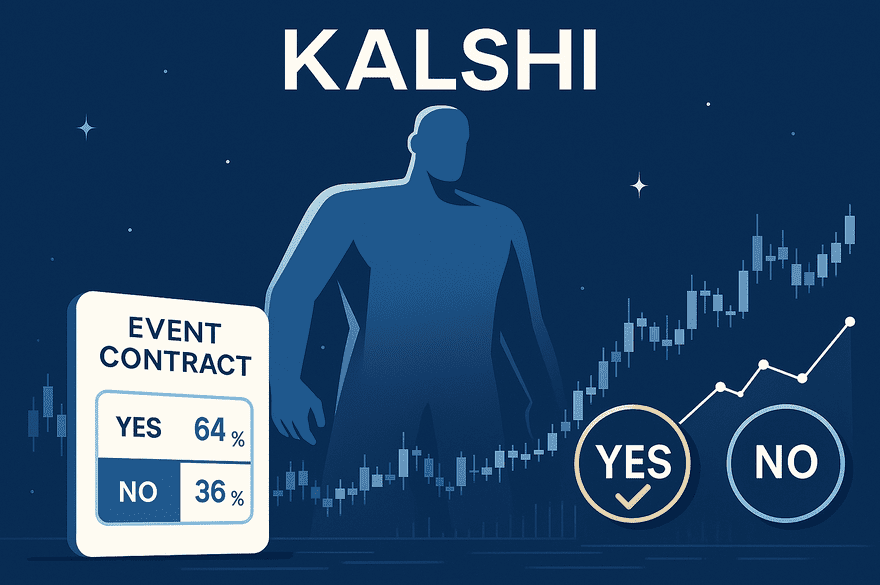
Kalshi (website) is a federally regulated prediction market platform in the US founded in 2018 by MIT graduates Tarek Mansour (CEO) and Luana Lopes Lara (COO). Both founders bring extensive experience from quantitative trading roles at firms like Citadel and Goldman Sachs. The management team includes Eliezer Mishory (Chief Regulatory Officer), Rebecca Peters, and Brian Quintenz (Board Member). As the first CFTC-regulated exchange for event contracts, Kalshi enables users to trade on binary outcomes of future events—such as elections, economic indicators, or weather—with contracts paying $1 for correct predictions.
Prediction Market Segment Analysis
Market Mechanics:
- Prediction markets allow direct trading on event outcomes, unlike indirect exposure through stocks or futures.
- Prices reflect aggregated probability estimates, serving as real-time sentiment indicators.
Regulatory Landscape:
- Federal: Kalshi operates as a CFTC-designated Contract Market (DCM), subject to strict oversight.
- State Challenges: Multiple states (e.g., Nevada, Illinois) issued cease-and-desist orders, arguing event contracts resemble gambling.
- Legal Precedent: An October 2024 court injunction upheld Kalshi’s right to offer political contracts, weakening CFTC opposition.
Business Model
Kalshi employs a maker-taker fee structure:
- Takers (immediate traders) pay fees (0.07%–7%), scaled inversely to contract probability (e.g., 5.6% fee for 20%-probability contracts).
- Makers (liquidity providers) pay no fees and earn rebates up to 1%.
Revenue is solely transaction-based; Kalshi takes no market positions.
Financial Position & Valuation
- June 2025 Funding: $185M Series C led by Paradigm at a $2B post-money valuation.
- Total Funding: $415M to date, targeting engineering expansion and new market structures.
- Revenue Metrics: 83x 2025 revenue multiple, justified by scaling potential.
Opportunities
- Market Expansion:
- Sports betting integration ($30B market) via single-game contracts.
- Data monetization of predictive signals for institutional clients.
- Regulatory Tailwinds:
- Favorable rulings could solidify Kalshi’s U.S. dominance over offshore rivals.
- Strategic Partnerships:
- Robinhood collaboration (March 2025) broadens retail access.
- Bitcoin/USDC deposits attract crypto-native users.
Risks
- Regulatory Fragmentation:
- State-level litigation could increase compliance costs.
- Event Dependency:
- Volume relies heavily on elections/sports; diversification into iGaming is nascent.
- Competition:
- Polymarket: Banned in U.S. but leads in open interest ($600M vs. Kalshi’s $113M).
- TradeX/PredictRAM: Niche competitors with less regulatory clarity.
Competitive Positioning
| Metric | Kalshi | Polymarket (Primary Rival) |
|---|---|---|
| Regulatory Status | CFTC-regulated, U.S.-operational | Banned in U.S. since 2022 |
| Valuation | $2B (June 2025) | $1B (Seeking $200M round) |
| Volume | $113M open interest | $600M open interest |
| Edge | Legal U.S. access, banking integration | Crypto-native, global reach |
Tokenization
Kalshi does not have a proprietary token. It uses USD for settlements and accepts Bitcoin/USDC deposits via ZeroHash infrastructure. Regulatory classification aligns with traditional financial instruments, avoiding crypto-asset scrutiny.
Investment Outlook
Kalshi dominates U.S. prediction markets through regulatory compliance, scalable fee economics, and institutional data potential. Near-term catalysts include sports-market penetration and favorable CFTC rulings. Risks center on state-level litigation and volume volatility. At a $2B valuation, Kalshi trades at a premium justified by its first-mover moat and addressable market expansion. Investors should monitor Q3 2025 CFTC litigation outcomes and sports-contract adoption metrics.