


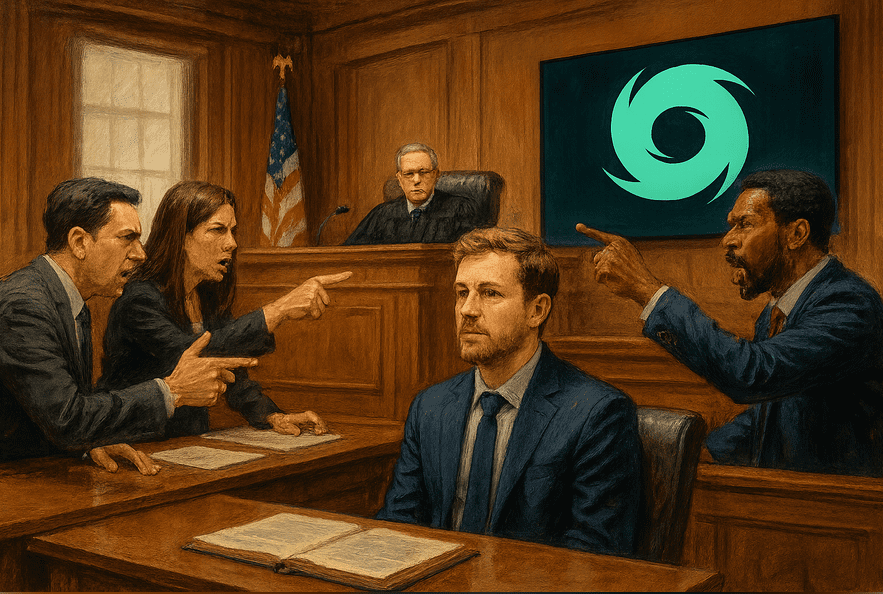
As Roman Storm sits in a Manhattan courtroom facing 45 years in prison, one question haunts the cybersecurity world: When did software development become money laundering?
Storm’s trial for allegedly helping launder $1 billion through Tornado Cash—a cryptocurrency privacy tool—represents the most dangerous prosecutorial overreach in cybercrime history. His co-developer, Alexey Pertsev, is already serving 64 months in a Dutch prison for the same “crime”: writing open-source code.
The Precedent That Terrifies Developers
The prosecution’s logic is chilling in its simplicity: if you create software that criminals later use, you’re a criminal too. Never mind that Tornado Cash was designed for legitimate privacy protection. Ignore that the developers couldn’t control how others used their decentralized protocol once deployed. The mere fact that North Korea’s Lazarus Group exploited their tool for money laundering makes Storm and Pertsev co-conspirators, prosecutors argue.
This reasoning would criminalize the inventors of cars, phones, and the internet itself.
Dutch Judge Henrieke Slaar revealed the prosecution’s true agenda when she declared: “Tornado Cash in its nature and functioning is a tool intended for criminals.” This statement exposes fundamental ignorance about privacy technology and sets a terrifying precedent for any developer creating tools that protect user anonymity.
Selective Enforcement Reveals Prosecutorial Bias
Why target privacy-focused cryptocurrency developers while ignoring traditional banks that process vastly more criminal proceeds? JPMorgan Chase paid $2.9 billion in fines for facilitating Jeffrey Epstein‘s operations, yet no executives faced criminal charges for “money laundering.”
The answer is obvious: prosecutors are using these cases to signal that cryptocurrency privacy tools are inherently suspicious, even as privacy advocates argue such tools are essential for human rights activists, journalists, and dissidents worldwide.
The Technical Reality Prosecutors Ignore
Tornado Cash operated through immutable smart contracts—automated code that executes without human intervention once deployed. Storm and his co-founders literally could not control who used their protocol or prevent specific transactions. Prosecuting them is like charging the inventor of email for spam or holding car manufacturers liable for bank robberies.
The prosecution’s claim that the developers “maintained control” reveals either deliberate misrepresentation or dangerous technical illiteracy among law enforcement officials.
International Inconsistency Exposes Legal Chaos
While Dutch courts convicted Pertsev, a U.S. appeals court ruled the opposite way, finding that blockchain applications cannot be sanctioned under existing law. The U.S. Treasury quietly removed Tornado Cash from its sanctions list in March 2025, admitting the legal framework was flawed.
This regulatory schizophrenia destroys legal certainty and terrorizes developers worldwide.
The Real Criminals Walk Free
As Storm faces potential life imprisonment for writing code, the actual money launderers—North Korean state hackers who have stolen over $6 billion in cryptocurrency—operate with impunity. Instead of targeting the Lazarus Group’s infrastructure and enablers, prosecutors are criminalizing the privacy tools that millions use legitimately.
What’s Really at Stake
These prosecutions aren’t about stopping cybercrime—they’re about eliminating financial privacy entirely. If developers can be imprisoned for creating tools that protect anonymity, who will dare build the next generation of privacy technology?
The chilling effect is already visible: developers are abandoning privacy projects, and crypto companies are implementing surveillance systems that would make authoritarian regimes proud.
The Tornado Cash trials represent a choice: Do we criminalize privacy to catch criminals, or do we protect the tools that keep dissidents, journalists, and ordinary citizens safe from surveillance?
Storm’s fate will determine whether we live in a world where writing code is a fundamental right—or a federal crime.