


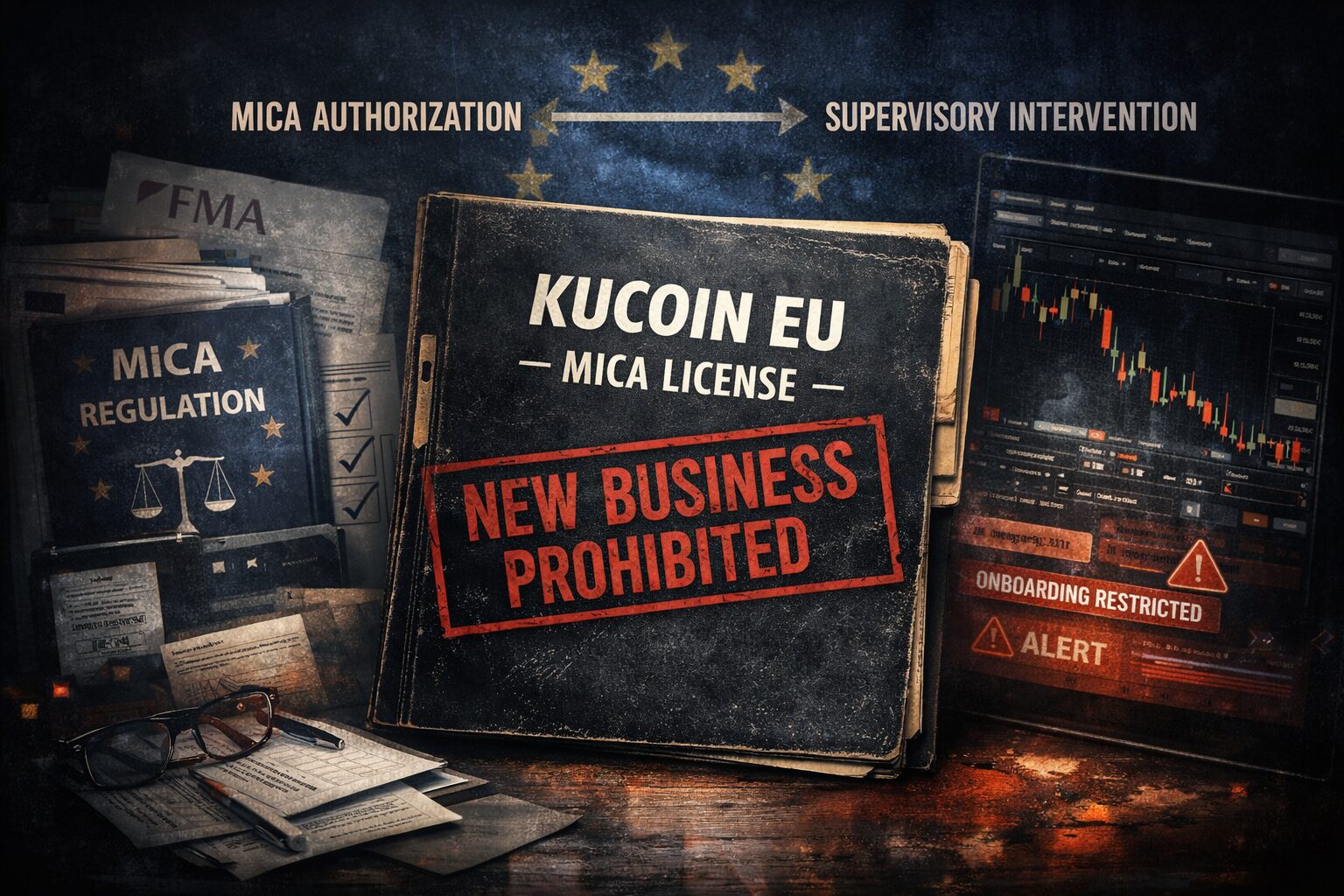
According to RatEx42, the crypto exchange KuCoin has been classified as DAREX Tier D — Material Regulatory Transition Exposure. The classification follows supervisory action by Austria’s FMA, which prohibited KuCoin’s EU entity from conducting new business. The case highlights how even MiCA-authorized structures can face significant operational continuity risks.
Key Findings
- RatEx42 assigns DAREX Tier D to KuCoin
- Austrian FMA prohibited KuCoin EU entity from onboarding new business
- Supervisory action linked to AML/CFT and sanctions control deficiencies
- Demonstrates structural regulatory exposure despite prior MiCA positioning
What Is DAREX?
The Digital Asset Regulatory Exposure Index (DAREX) is a structured analytical framework developed by RatEx42. It assesses the regulatory transition exposure and operational continuity sensitivity of digital asset infrastructure providers, including exchanges, custodians, and on/off-ramps.
DAREX does not evaluate financial strength or solvency. Instead, it focuses on how regulatory developments may impact the ability of a provider to continue operating across jurisdictions.
KuCoin’s EU Strategy Meets Supervisory Reality
KuCoin (www.kucoin.com) had positioned itself as a forward-looking player in Europe by announcing that its Austrian entity, KuCoin EU Exchange GmbH, had obtained a MiCA license to operate across the European Economic Area.
However, this positioning was materially challenged in February 2026, when Austria’s Financial Market Authority (FMA) issued a supervisory measure prohibiting the entity from conducting new business. The regulator cited deficiencies in internal organization related to AML/CFT and sanctions compliance.
This development places KuCoin in a structurally sensitive position within the EU regulatory environment.
DAREX Classification Explained
According to RatEx42, KuCoin’s DAREX Tier D classification is driven by a decisive supervisory event rather than gradual deterioration.
The DAREX framework distinguishes between:
- Structural regulatory exposure (DAREX)
- Conduct or compliance risk (RatEx42 risk signals)
In KuCoin’s case:
- The existence of a MiCA license would normally support a lower exposure classification
- However, the FMA prohibition on new business constitutes a material regulatory event directly affecting operational continuity
Under DAREX governance rules, such supervisory actions act as hard triggers, overriding the numerical scoring model and leading to Tier D.
Importantly, this classification does not imply insolvency or financial distress. It reflects elevated regulatory exposure and operational sensitivity within the EU market.
Implications for Merchants & Counterparties
For merchants, institutional traders, and counterparties, the KuCoin case illustrates a key point:
Regulatory authorization alone does not eliminate operational risk.
Supervisory intervention can:
- Restrict onboarding of new clients
- Limit expansion within regulated markets
- Increase compliance and operational uncertainty
In practical terms, counterparties should monitor not only licensing status but also ongoing supervisory relationships and enforcement signals.
Conclusion
KuCoin’s classification as DAREX Tier D highlights how quickly regulatory exposure can escalate, even for entities that have entered the MiCA authorization layer.
The case reinforces the relevance of DAREX as a framework focused on structural regulatory risk, rather than reputational or financial assessments.
Whistle42 Call for Information
FinTelegram encourages insiders, merchants, and users with information about KuCoin or similar crypto service providers to come forward.
You can submit information securely and, if necessary, anonymously via the Whistle42 platform.