


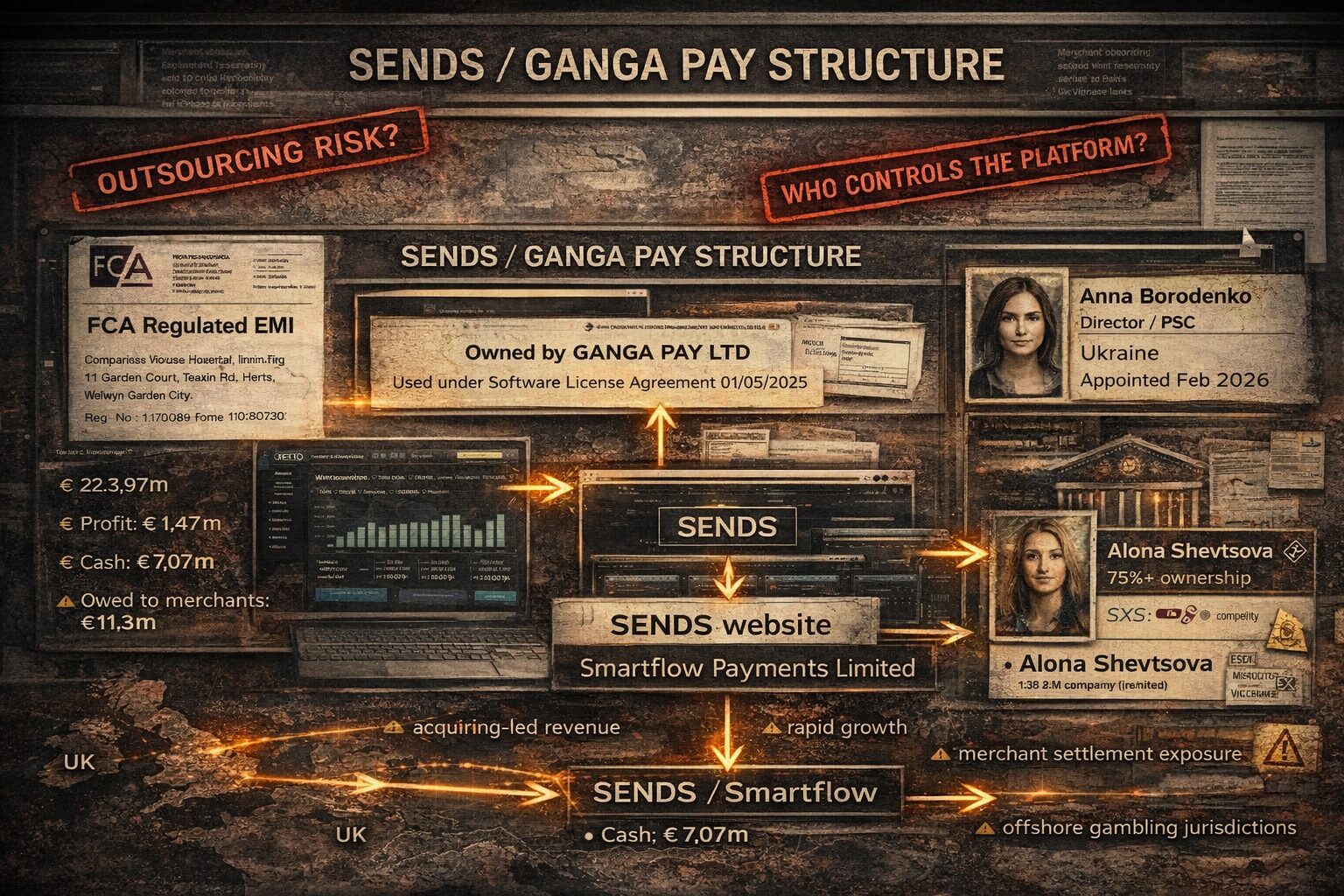
FinTelegram’s review of the SENDS/Smartflow structure has uncovered a new layer that intensifies the compliance questions around the UK EMI. Multiple SENDS pages state that the website is owned by GANGA PAY LTD and merely used by Smartflow Payments Limited under a Software License Agreement dated 01/05/2025. GANGA PAY is an active UK company, but its public Companies House profile presents it as an IT/data-processing/web-portal business, not as an FCA-authorised payment institution.
At the same time, Smartflow’s 2024 accounts show explosive growth in acquiring revenue, while whistleblower material continues to link SENDS to a merchant cluster allegedly tied to offshore-casino payment flows. The structure does not prove wrongdoing. But in the context of Alona Shevtsova’s public sanctions/ESBU backdrop and a newly inserted Ukrainian controller at GANGA PAY, it raises a material outsourcing, governance, and AML-risk question.
Key Findings
- SENDS’ public website is not owned by the regulated EMI itself. SENDS pages state that the site is owned by GANGA PAY LTD and used by SMARTFLOW PAYMENTS LIMITED under a software licence dated 01/05/2025.
- GANGA PAY is publicly presented as a tech/web company, not a regulated EMI. Companies House lists SIC codes for IT consultancy, data processing/hosting, web portals, and advertising agencies.
- Anna Borodenko now controls GANGA PAY. Companies House shows Anna Borodenko, Ukrainian, country of residence Ukraine, appointed as director on 13 February 2026, and GANGA PAY’s people records show two prior directors resigned in October 2024 and February 2026.
- Smartflow is now a large acquiring-led business. The 2024 accounts show turnover of €23,969,696, profit after tax of €1,473,734, cash of €7,074,469, and €11,301,172 owed to merchants. Revenue was overwhelmingly from acquiring fees (€23,933,239) rather than e-money operations.
- The Shevtsova backdrop matters. Companies House shows Alona Shevtsova as the sole active PSC of Smartflow with 75%+ ownership, and ESBU states that suspects, including bank shareholders, organised a UAH 5 billion miscoding scheme for illegal casinos using more than 20 controlled companies and false payment purposes.
What the GANGA PAY Licence Arrangement Means
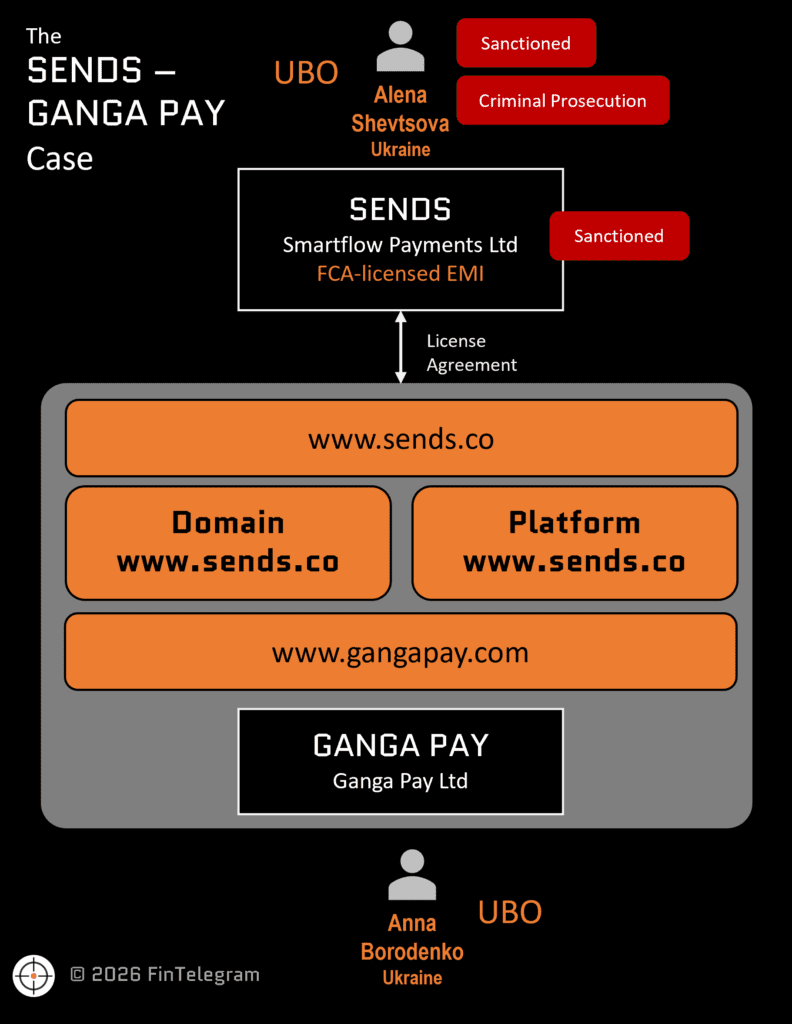
The license agreement between SENDS and GANGA PAY separates the regulated payments entity from the digital asset customers actually use. According to SENDS’ own wording, GANGA PAY owns the website, while Smartflow uses it under licence. That is not inherently improper. Regulated firms often license software, onboarding tools, websites, and other infrastructure. But in financial services, the key issue is whether this is ordinary outsourced technology or whether critical customer-facing and onboarding functions have effectively been placed in the hands of an unregulated affiliate or vendor.
From a compliance perspective, that distinction is crucial. If the site ownership, codebase, customer journeys, merchant-facing interfaces, or data flows are controlled by a non-regulated licensor, the regulated EMI must still be able to show that it retains full control over onboarding, transaction monitoring, complaints handling, audit rights, resilience, and regulatory accountability. The structure therefore raises an outsourcing-governance question, not just a branding question.
The CyberRating platform RatEx42 has classified SENDS as “RED – Critical Risk” due to the apparent involvement of the FCA-regulated EMI in payment clusters associated with illegal casinos, as well as its lack of transparency in corporate governance and questionable compliance processes.
Go to the SENDS compliance profile on RatEx42.
Who Is Anna Borodenko?
The verified public profile on Anna Borodenko is currently thin. Companies House shows only that she is a Ukrainian national, resident in Ukraine, appointed director of GANGA PAY on 13 February 2026, with identity verification completed. I did not find, in the records reviewed, a strong public professional profile linking her to a widely known regulated-payments track record. That absence does not prove anything by itself. But in a structure already attracting scrutiny, it increases the importance of understanding source of funds, business purpose, and why control of the licensor changed hands in February 2026.
The governance history around GANGA PAY also deserves attention. Companies House shows earlier control by Aphrodite Kittou and then Irakli Koberidze, before Borodenko took over. That degree of turnover in a company now sitting behind the public-facing SENDS platform is not dispositive, but it is a legitimate governance and integrity signal for counterparties and regulators to examine.
Smartflow’s 2024 Growth Changes the Risk Profile
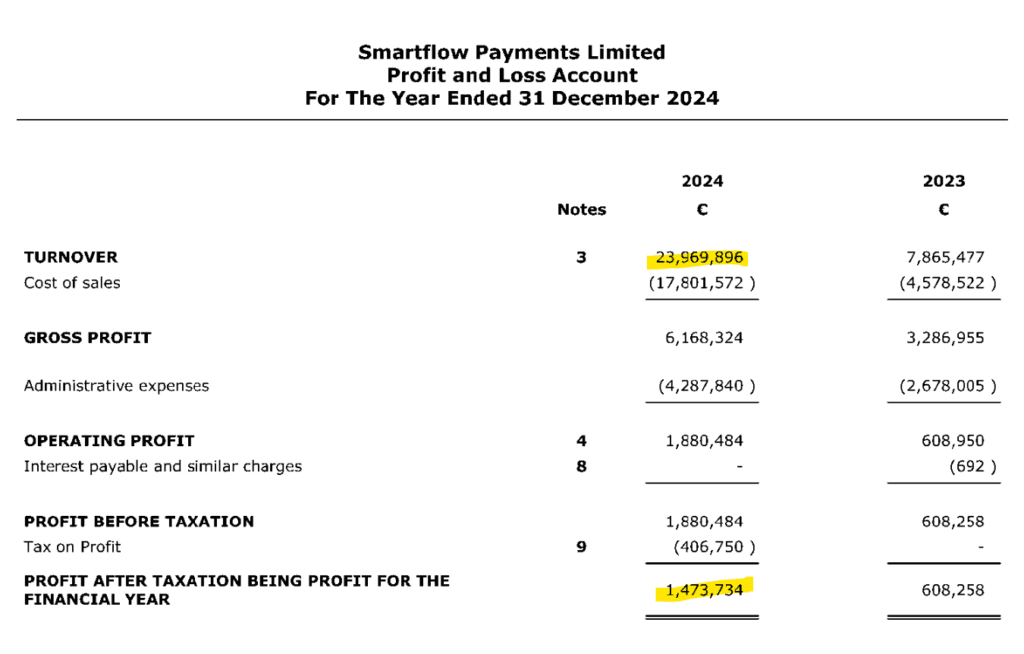
The company reports turnover rising from €7.7 million in 2023 to almost €24.0 million in 2024, with profit after tax of €1.47 million and cash at bank of €7.07 million. On page 15 of the accounts, the turnover note shows that almost all revenue came from acquiring fees, while e-money operations contributed only a negligible amount. On page 18, the balance-sheet note shows €11.3 million due to merchants, underscoring that this is now an operationally significant merchant-acquiring business.
That matters because the website/licence issue is not sitting behind a tiny dormant firm. It is sitting behind a rapidly scaling acquiring platform whose business model is overwhelmingly dependent on merchant acquisition and settlement flows. In that context, any uncertainty about control of customer-facing infrastructure, merchant funnels, or onboarding tooling becomes much more serious from an AML and prudential perspective.
The Shevtsova Context
The wider context around Smartflow’s control remains highly relevant. Companies House identifies Alona Shevtsova as Smartflow’s active PSC with 75%+ ownership. The Ukrainian ESBU has publicly described a case in which suspects, including bank shareholders, allegedly organised the legalisation of illegal-casino funds using miscoding, more than 20 controlled companies, and false payment purposes describing non-existent goods and services. That does not prove Smartflow or GANGA PAY repeated such conduct. But it makes the Smartflow/GANGA PAY outsourcing and merchant-acquiring structure far more sensitive than it would be in an ordinary EMI case.
Read our report on the Alona Shevtsova case here.
One additional point from the accounts is also notable. The directors’ report says that on 31 May 2025 Smartflow moved all money-transfer activities from IFX Payments Limited to PayrNet Limited. The accounts also say part of the company’s intangible assets relate to licensed payment software development. That reinforces the point that Smartflow’s operating model relies materially on external and/or licensed infrastructure relationships.
Compliance Assessment
The GANGA PAY Path
GANGA PAY is not a passive web/IP shell. Its own site presents it as a payment-solutions / payments-technology company, and Companies House shows a business profile consistent with software, hosting, web, and data-processing activities rather than regulated financial services. That makes the structure more nuanced, not less concerning.
The key issue is not simply that GANGA PAY lacks an FCA licence. The real issue is where the boundary lies between regulated services carried out by Smartflow and non-regulated payments-technology functions supplied by GANGA PAY.
A split structure of this kind can be entirely legitimate. Many EMIs license software, websites, onboarding tools, tokenisation modules, APIs, and merchant-interface technology from specialist vendors or affiliates. But the legitimacy of the structure depends on function and control. If GANGA PAY is merely providing software, hosting, UX, or technical integration, that may be ordinary outsourcing. If it is involved in customer journeys, merchant onboarding, complaint routing, payment orchestration, data processing tied to regulated activity, or decisioning around transactions or merchants, then the arrangement becomes a far more sensitive outsourcing-governance and operational-control issue for the regulated EMI.
The Exploding Turnover
That distinction matters even more because Smartflow is no longer a small peripheral operator. Its 2024 accounts show turnover rising to €23.97 million, profit after tax of €1.47 million, cash of €7.07 million, and €11.3 million owed to merchants. The turnover note shows that revenue was overwhelmingly generated from acquiring fees (€23.93 million), while e-money operations contributed only a marginal amount. In other words, this is now a materially significant merchant-acquiring business. In that context, uncertainty about who controls the public-facing platform, merchant-interface layer, and related technology becomes a meaningful AML, prudential, and governance question rather than a technicality.
The Ownership Question
The control picture intensifies that concern. Companies House shows Alona Shevtsova as the sole active PSC of Smartflow with 75%+ ownership, and Anna Borodenko, a Ukrainian national resident in Ukraine, as director of GANGA PAY since 13 February 2026. GANGA PAY’s officer history shows recent controller turnover, while Smartflow’s public-control record is already sensitive because of Shevtsova’s wider background. That does not prove that the SENDS–GANGA PAY structure is improper. It does mean the arrangement should be assessed as a heightened outsourcing, governance, and AML-risk structure requiring close examination of ownership, source of funds, operational dependency, audit rights, resilience, and regulatory oversight.
Sanctions & Criminal Investigations
The structure is further sensitized by the sanctions-screening context. Smartflow Payments Limited / SENDS and its controlling figure Alona Shevtsova appear in OpenSanctions-linked screening context, while Shevtsova is also publicly tied to official Ukrainian sanctions and the Economic Security Bureau of Ukraine (ESBU)’s illegal-casino miscoding case.
OpenSanctions inclusion does not establish liability by itself, but for a regulated EMI it is a material compliance signal that should trigger enhanced due diligence, governance scrutiny, and close review of related-party arrangements, outsourcing dependencies, and merchant-acquiring exposure.
The right compliance questions are therefore practical and direct:
- What exactly does GANGA PAY license to Smartflow?
- Does it own only the website and software stack, or does it also influence onboarding, merchant acquisition, or data flows tied to regulated activity?
- Was the FCA informed of the arrangement as a material outsourcing dependency?
- What due diligence was performed when Anna Borodenko became controller of the licensor in February 2026?
- And, most importantly, can Smartflow demonstrate that all core regulated decisions — onboarding, MCC classification, transaction monitoring, complaints handling, and suspicious-activity escalation — remain fully inside the control perimeter of the FCA-authorised EMI?
Summary Table
| Entity / Person | Jurisdiction | Verified public role | Why it matters |
|---|---|---|---|
| Smartflow Payments Limited / SENDS www.sends.co | UK | FCA-authorised EMI; controlled by Alona Shevtsova; acquiring-led 2024 revenue profile | Regulated entity at the centre of the structure. Sanctioned entity. |
| GANGA PAY LTD www.gangapay.com | UK | Active private company; payment solution provider; site owner/licensor for SENDS website; SIC codes for IT/data/web/advertising | Non-regulated company owning the public-facing SENDS website. |
| Anna Borodenko | Ukraine / UK company role | Director and controlling person of GANGA PAY since 13 Feb 2026; Ukrainian; resident in Ukraine | Newly inserted control person in the licensor layer. |
| Alona Shevtsova | Ukraine / Poland / UK company control | Active PSC of Smartflow with 75%+ ownership | Makes the structure more sensitive given public ESBU allegations. OpenSanctions entry. |
| ESBU miscoding case | Ukraine | Public case involving illegal casinos, false payment purposes, and controlled companies | Context that intensifies AML concerns around related structures. |
Whistleblower Call
FinTelegram invites insiders, former employees, counterparties, acquirers, auditors, compliance staff, and technology contractors with information about Smartflow Payments Limited / SENDS, GANGA PAY LTD, Anna Borodenko, Alona Shevtsova, outsourced onboarding systems, merchant-interface tooling, related-party licensing, or casino-adjacent merchant clusters to contact Whistle42 securely.
We are especially interested in:
- the Software License Agreement dated 01/05/2025,
- documents showing what GANGA PAY actually licenses to Smartflow,
- merchant onboarding and MCC-classification files,
- complaint-escalation and transaction-monitoring records,
- and source-of-funds / governance records around GANGA PAY’s February 2026 control change.