




The Lithuanian crypto landscape is undergoing a violent contraction. Following the suspension of utPay, the iGaming crypto giant Dream Finance UAB d/b/a CoinsPaid and CryptoProcessing has officially shuttered its Lithuanian operations. As the MiCA “grandfathering” period expires, the Bank of Lithuania is flushing out high-risk processors, leaving the SoftSwiss-linked empire to retreat to Estonian and North American strongholds.
Key Facts
- CoinsPaid’s Legal Hub states: Dream Finance UAB (Lithuania) temporarily suspended all crypto-asset services, including onboarding, execution of transactions, and concluding new agreements; the site remains for legal/regulatory info and contacts.
- CoinsPaid lists Dream Finance US LLC (Delaware) and Dream Finance Processing Inc. (Canada) as additional group entities (MSB registrations referenced on its disclosures).
- The Bank of Lithuania warns Lithuania’s transitional period ends 31 Dec 2025; after that, providers without MiCA licensing lose the right to operate in Lithuania.
- Context: FinTelegram recently reported a MiCA-related suspension affecting another Lithuania-linked crypto and iGaming facilitator (utPay), suggesting a broader enforcement/clean-up wave.
A Coordinated Exit or a Forced Retreat?
The announcement by Dream Finance UAB (the Lithuanian arm of the Dream Finance Group headed by Max Krupyshev) of a “temporary suspension” of all crypto-asset services marks a watershed moment for the iGaming payment sector. As of early 2026, the “Wild West” era of Lithuanian crypto registration is definitively over. Our analysis explores the regulatory mechanics and the broader implications for the SoftSwiss/CoinsPaid ecosystem.
1. The “Cliff-Edge” of MiCA Compliance
The suspension is no coincidence. December 31, 2025, served as the final “cliff-edge” for the Lithuanian VASP transition. Under the Markets in Crypto-Assets (MiCA) regulation, the Bank of Lithuania has replaced the previous low-barrier registration model with a rigorous CASP authorization process.
- Capital Thresholds: Firms must now demonstrate a minimum of €125,000 in fully paid-up capital.
- The “Fit and Proper” Filter: Regulators have intensified scrutiny on beneficial owners and management.
- The Pattern: Much like utPay (Utrg UAB), CoinsPaid’s decision to “suspend” rather than “obtain” a license suggests either a failed application or a strategic withdrawal to avoid a public license revocation.
Read our utPay report on the shutdown here.
2. The SoftSwiss Connection and the iGaming Web
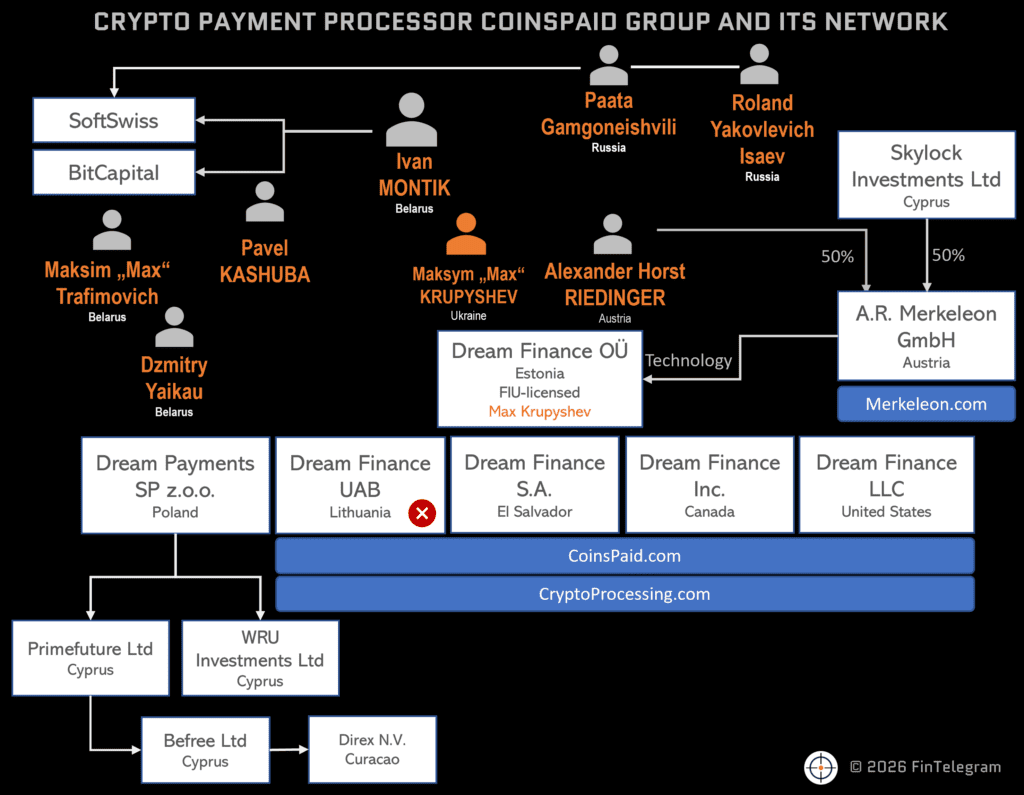
CoinsPaid/Dream Finance is not merely a payment processor; it is the financial backbone of the SoftSwiss iGaming group. FinTelegram’s intelligence indicates that both entities are controlled by the same beneficial owners, positioning CoinsPaid as the primary crypto rail for thousands of online casinos.
By processing an estimated €23 billion in transactions, CoinsPaid sits at the center of the high-risk “shadow banking” sector. The loss of a Lithuanian license—previously a badge of “EU regulation”—undermines the group’s perceived legitimacy and complicates its ability to maintain Euro-denominated fiat rails.
Read our CoinsPaid reports here.
3. Jurisdictional Arbitrage: The Estonian and North American Pivot
While the Lithuanian doors have closed, the Dream Finance Group is far from dormant.
- Estonia: Dream Finance OÜ remains active, banking on Estonia’s slightly different (though also tightening) regulatory timeline.
- North America: The existence of Dream Finance US LLC (Delaware) and Dream Finance Processing Inc. (Canada) indicates a calculated effort to preserve “Western” corporate identities to satisfy merchants and banking partners.
However, under MiCA’s “passporting” rules, without a valid CASP license from a primary EU regulator (like the Bank of Lithuania), these entities cannot legally target or serve the broader EU market.
The Compliance Verdict
The “temporary” nature of this suspension is likely a euphemism for a permanent exit from the Lithuanian jurisdiction. For compliance officers and banking partners, the message is clear: The Dream Finance entities are currently operating outside the regulated perimeter of the Lithuanian financial system. Hopefully, the transition to MiCA is successfully “flushing” the high-risk gambling ecosystem out of the Baltics.
The compliance question regulators and counterparties should ask is not only “did they apply?” but also “what happens to flows during the transition?” CoinsPaid markets itself as a major crypto payments ecosystem, widely used in high-risk verticals like iGaming. A Lithuania pause combined with a continuing Estonia hub creates a practical concern: service continuity may shift jurisdictionally, while risk exposure (merchant portfolio quality, KYB depth, transaction monitoring, downstream casino networks) remains the same problem—just routed differently
Whistle42: Call for Information
Are you an insider at Dream Finance or SoftSwiss with knowledge of the Bank of Lithuania’s specific enforcement actions? Do you have information on how funds are being rerouted through Estonian or North American entities to bypass EU restrictions?
Submit your evidence anonymously via Whistle42.com. Your data is essential to maintaining transparency in the crypto-iGaming sector.




The Salvadorian entity started its liquidation process in March 2024 and does not exist anymore. According to an inquiry made by FOCOS a year ago, Dream Finance (Salvador) was dealing with offshore entity and also tool a weird loan from AlphaPo, confirming the close relationship between the two entities.
Dream Finance (Poland) has also been liquidated. Pavel Kashuba and Dimitry Yatzkau appeared as the UBOs for the Polish entity confirming the link between CoinsPaid and SoftSwiss.
https://www.elsalvadornow.org/2025/01/31/bitcoin-company-chose-el-salvador-to-safeguard-us2-1-million-from-casinos-in-tax-havens-empresa-bitcoin-eligio-a-el-salvador-para-custodiar-2-1-millones-de-casinos-en-paraisos-fiscales/