



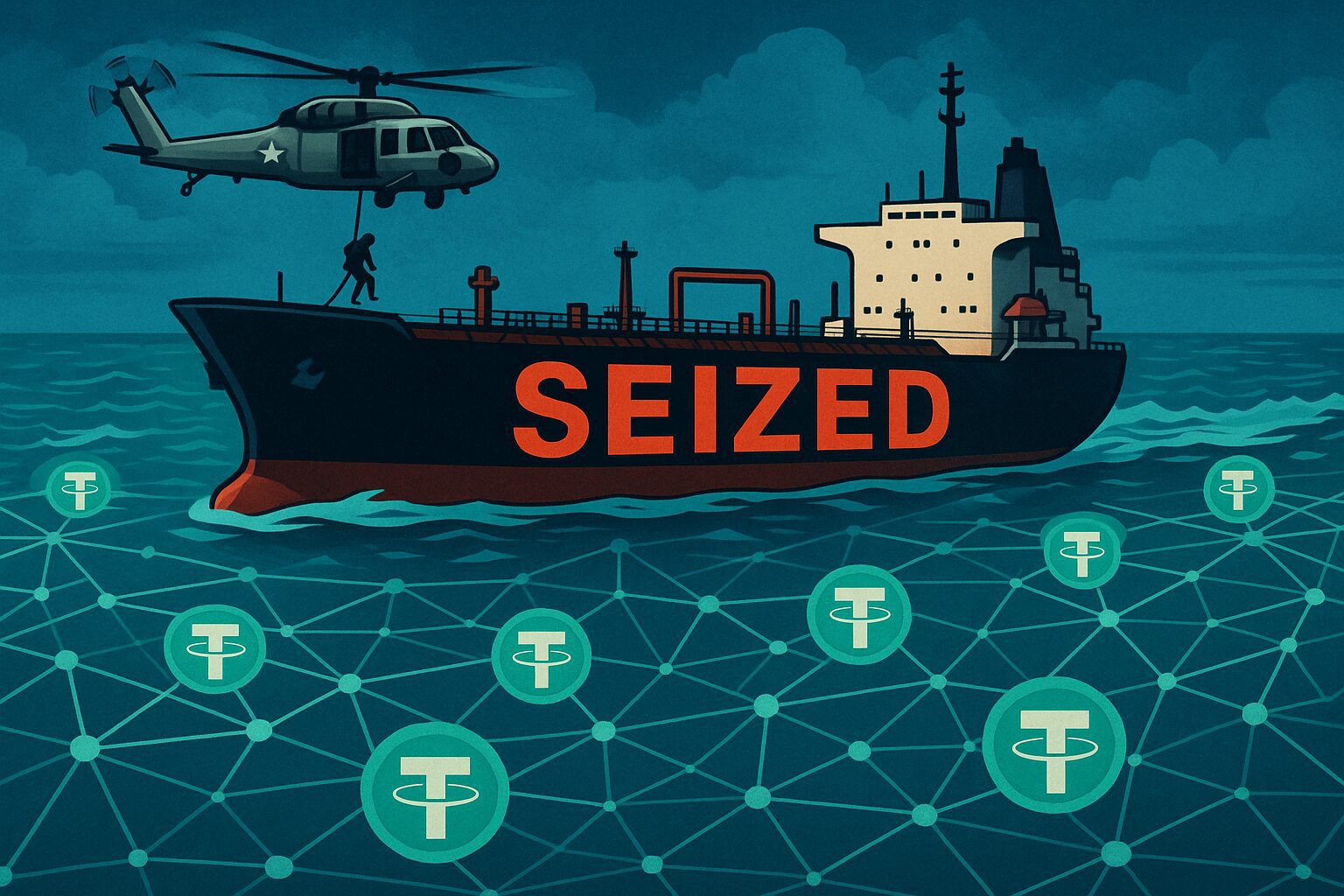
The dramatic U.S. seizure of the supertanker Skipper off Venezuela’s coast—personally announced by President Donald Trump and amplified by Attorney General Pam Bondi’s helicopter-raid video—is officially framed as a sanctions and counter-terrorism operation. In reality, it sits at the intersection of three fault lines: Washington’s dependence on heavy Venezuelan crude, Venezuela’s slow exit from the classic petrodollar system, and PDVSA’s growing use of USDT stablecoins and Chinese channels to move oil money outside the reach of the U.S. banking system.
The Strategic Perfect Storm: Quality, Currency, and Hegemony
Venezuela presents the United States with a double vulnerability that intensifies pressure on an already heavily indebted superpower. First, Venezuela produces super-heavy, high-sulfur crude grades—particularly Merey, Boscan, and Hamaca—that are ideally suited to the complex coking units of U.S. Gulf Coast refineries.
As Mexican heavy crude production declines and Canadian pipeline flows remain constrained, Venezuelan barrels have become irreplaceable for optimal refinery operations and diesel output. The loss of up to 200,000–300,000 barrels per day of Venezuelan heavy crude has already tightened U.S. refinery feedstock markets, driving up costs and threatening fuel price stability—a politically sensitive issue for any administration.
Second and more strategically threatening, Venezuela under Maduro has systematically abandoned the petro-dollar. Since 2024, state oil company PDVSA has required new customers to prepay up to 50% of spot crude shipments in Tether’s USDT stablecoin via digital wallets, with over half of all crude shipments now involving USDT payments by mid-2025.
Venezuela also shifted to pricing and settling oil in Chinese yuan as early as 2017, deepening financial integration with Beijing. In September 2025, approximately 84% of Venezuela’s crude exports flowed to China—either directly or via shadowy intermediaries—paid in yuan or converted through USDT.
This combination undermines two pillars of U.S. financial hegemony simultaneously: it deprives U.S. refiners of optimal crude while routing oil revenues outside dollar-denominated banking channels that traditionally recycle petrodollars into U.S. Treasuries.
USDT as the New Petro-Currency Infrastructure
Venezuela’s reliance on USDT represents more than sanctions evasion—it constitutes a parallel petro-currency infrastructure that bypasses U.S. control while still referencing dollar value.
By July 2025, an estimated $119 million in USDT flowed into Venezuela’s private sector in a single month, with the government quietly authorizing select banks to exchange bolívars for USDT since June 2025. PDVSA uses USDT to avoid the risk that oil proceeds will be frozen in foreign bank accounts subject to OFAC jurisdiction, effectively creating a “digital dollar” market that operates outside traditional correspondent banking and SWIFT.
This model mirrors strategies deployed by Iran and Russia, which increasingly use crypto and stablecoins to conduct sanctioned energy trade. For the United States, the danger is not nominal de-dollarization—oil is still priced in dollar-equivalent USDT—but operational de-dollarization: the flows no longer pass through New York clearing banks, no longer generate demand for U.S. Treasuries, and no longer submit to U.S. financial surveillance and enforcement. Each barrel settled in USDT marginally weakens the structural demand for dollars and Treasuries that has enabled the U.S. to sustain $35 trillion in national debt and run persistent deficits without triggering a currency or bond crisis.
Economic Pressure on a Heavily Indebted United States
The erosion of petro-dollar recycling comes at a particularly vulnerable moment. The U.S. national debt surpassed $35 trillion in 2024, having nearly doubled from $14.8 trillion a decade earlier, sustained largely by Federal Reserve quantitative easing and robust foreign demand for Treasuries—much of it driven by petrodollar recycling from oil exporters.
J.P. Morgan Research estimates that each 1-percentage-point decline in foreign Treasury holdings relative to GDP (roughly $300 billion) would drive yields up by more than 33 basis points, raising borrowing costs across the economy and constraining fiscal space. If major energy exporters systematically shift settlement outside the dollar banking system, the resulting reduction in Treasury demand would exert upward pressure on U.S. interest rates, crowding out domestic investment and destabilizing state and federal budgets already stretched by deficit spending.
Venezuela’s pivot to USDT and yuan thus threatens not only dollar prestige but the fiscal arithmetic underpinning U.S. debt sustainability. Control over Venezuelan oil—the world’s largest proven reserves—would allow Washington to dictate currency terms for a substantial share of global heavy crude supply, reinforcing structural dollar demand and shoring up Treasury inflows.
From Sanctions Enforcement to Military Action
The 10 December tanker seizure must be understood in this dual economic context. While Attorney General Pam Bondi justified the operation as enforcement against a vessel “sanctioned for its involvement in an illicit oil shipping network supporting foreign terrorist organizations,” the execution involved Coast Guard personnel, Marines, special forces, two helicopters, and Department of Defense assets—an operation of military scale and character. Trump himself declared, “We keep the oil, I guess,” a statement that frames the seizure not as law enforcement but as resource appropriation.
Senator Chris Van Hollen characterized the seizure as evidence that U.S. military operations in the Caribbean—including over 22 boat strikes killing at least 87 people since September 2024—are not primarily about drug interdiction but about regime change by force. The tanker seizure, combined with the deployment of the USS Gerald Ford carrier strike group, fighter jet overflights of the Gulf of Venezuela, and Trump’s stated intention to conduct land strikes, constitutes a campaign of escalating military pressure aimed at restoring U.S. control over Venezuelan oil and, by extension, over the currency terms of that oil’s sale.
Hypothesis: Strategic Resource Seizure to Counter Financial Erosion
The hypothesis emerging from these dynamics is stark: the United States, facing the twin pressures of irreplaceable heavy crude needs and eroding petro-dollar flows, has escalated from economic sanctions to quasi-military resource seizure in an attempt to reassert control over Venezuelan energy and re-anchor oil transactions within dollar-clearing infrastructure. The tanker seizure is not an isolated enforcement action but a signal of willingness to use military force to defend financial hegemony when economic levers prove insufficient.
If Venezuela—and by extension China, Russia, and other USDT-adopting energy exporters—succeeds in normalizing stablecoin settlement outside U.S. banking rails, the resulting erosion of structural Treasury demand could trigger a fiscal crisis for a United States already burdened by unsustainable debt levels. In this framing, the Skipper seizure represents not law enforcement but a new form of economic warfare: the physical interdiction of energy flows to prevent their settlement in non-controlled digital currencies, even when those currencies are nominally pegged to the dollar.