




FinTelegram has warned many times against fraud marketing campaigns chasing victims for scams on Google and social media platforms. In a blog post, the U.S. Federal Trade Commission (FTC) confirms that Facebook, Instagram, and other social media platforms are a “gold mine” for scammers. The latest consumer protection data report shows a sharp spike in online fraud schemes, particularly crypto scams. More than 95,000 U.S. consumers reported about $770 million in losses to fraud initiated on social media platforms in 2021, up from $258 million in 2020.
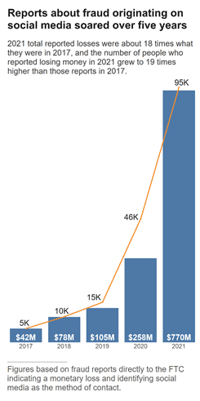
Cybercrime losses initiated on social media account for about 25% of all reported losses to fraud in 2021. This represents a stunning eighteenfold increase over 2017 reported losses. People between 18 to 39 were more than twice as likely as older adults to report losing money to these scams in 2021.
For scammers, there’s a lot to like about social media. It’s a low-cost way to reach billions of people from anywhere in the world.
FTC blog post
According to the report, Crypto scams have contributed to the massive surge in fraud reports. More than half of people who reported losses to investment scams last year said it started on social media. The FTC said that people are tricked into sending money, often cryptocurrency, on promises of huge returns but end up losing their funds.
Blockchain analysis company Chainalysis reported that illicit crypto transactions topped $14 billion last year, an all-time high. However, the amount of illegal activity compared to legitimate transactions hit an all-time low as the global adoption of cryptocurrency skyrocketed. Illicit crypto transactions were prevalent in the decentralized finance, or DeFi, space, which experienced explosive growth last year, Chainalysis said.
After investment scams, FTC data point to romance scams as the second most profitable fraud on social media. Losses to romance scams have climbed to record highs in recent years. More than a third of people who said they lost money to an online romance scam in 2021 said it began on Facebook or Instagram.