

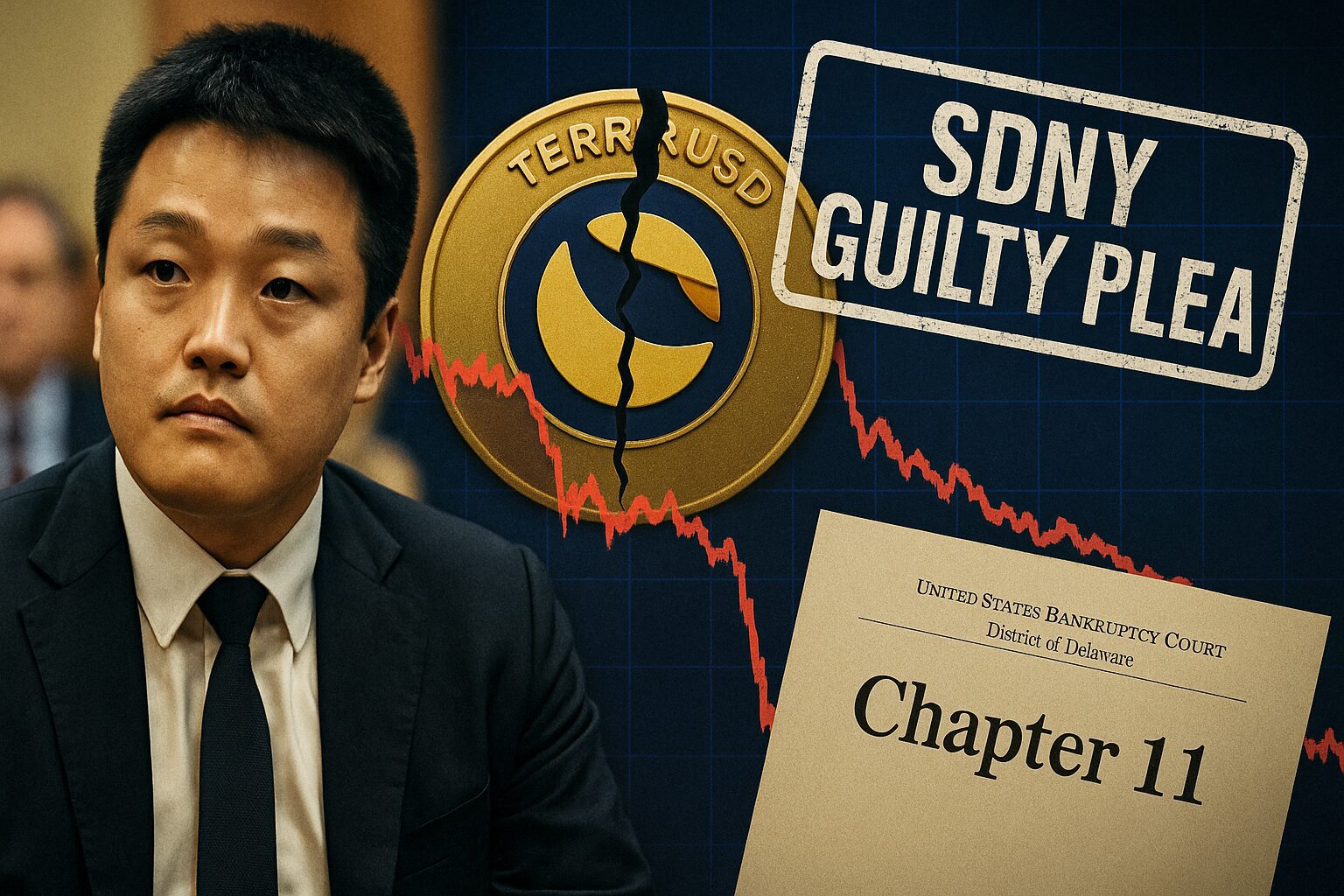
Terraform Labs co-founder Do Kwon has pleaded guilty in U.S. federal court to fraud tied to the 2022 collapse of TerraUSD/LUNA, a $40+ billion implosion that helped ignite the last crypto winter. Terra’s “algorithmic stablecoin” design and the 20% Anchor yield drew massive deposits—until the peg snapped, triggering a death spiral, cascading failures, and ultimately Terraform Labs’ Chapter 11. Regulators and courts now frame the episode not as a tech mishap but a deception of investors and users.
Key Points
- Guilty plea (SDNY): Do Kwon admitted to schemes defrauding investors in connection with TerraUSD/LUNA; sentencing guidance caps his agreed sentence at up to ~12 years under the reported plea deal details (Sources: US DOJ,Reuters,AP News).
- What Terraform Labs was: The company behind the Terra blockchain, issuing TerraUSD (UST)—an algorithmic stablecoin that maintained its $1 target via mint-burn arbitrage with LUNA, not cash reserves (Sources: coindesk.com,pmc.ncbi.nlm.nih.gov).
- Anchor’s 20% yield magnet: UST demand was turbocharged by Anchor Protocol’s ~20% APY, backed in part by subsidies—fuel for unsustainable growth (Sources: Business Insider,paxos.com)
- The collapse (May 2022): UST de-pegged, the mint-burn mechanism flooded supply, LUNA cratered, and roughly $40–60B in value evaporated (Sources: coindesk.com,Reuters,WIRED)
- Trigger for crypto winter: Terra’s failure propagated stress across CeFi and DeFi, contributing to subsequent blow-ups and a broad market freeze (Sources: newyorkfed.org,arxiv.org,repository.law.umich.eduTIME).
- Bankruptcy: Terraform Labs filed Chapter 11 in the U.S. (Delaware) on Jan 21, 2024; a wind-down trust now administers claims.
Short Narrative
In 2021–2022, Terra became the fastest-growing “decentralized money” experiment: UST promised dollar-like stability without dollars; Anchor promised a savings account-like return without a bank. The mechanism: when UST drifted below $1, arbitrageurs could burn UST for $1 of newly minted LUNA, and vice-versa above $1—in theory restoring the peg. In practice, once confidence cracked, minting explosive quantities of LUNA couldn’t plug a run.
The peg broke, UST plunged, LUNA hyper-inflated to near-zero, and market participants stampeded for exits. The shock reverberated through leveraged lenders, hedge funds, and exchanges, deepening the 2022 “crypto winter.”
Extended Analysis
1) The Technology & the Sales Pitch
- Algorithmic stablecoin design: UST wasn’t backed by treasuries or bank cash; it relied on mint-burn convertibility with LUNA and market incentives. This architecture works only while belief and market liquidity hold.
- Anchor’s role: Anchor’s ~20% APY lured capital at scale. Analyses show the rate depended on subsidies and couldn’t weather sustained outflows—creating a reflexive loop between UST demand and LUNA price.
2) The Unraveling
- Peg break & “death spiral”: As UST slipped under $1, redemptions minted more LUNA, diluting its price and weakening the defense—classic run dynamics documented by central banks and researchers (Sources: riksbank.se,hkma.gov.hk).
- Contagion: Empirical studies by the New York Fed, OECD, and academia link Terra’s collapse to broader market stress, with knock-on failures in leveraged crypto lenders and funds (Sources: newyorkfed.org,OECDarxiv.org).
3) From Collapse to Courtroom
- Civil & criminal track: After a 2024 SEC civil win (liability for fraud) and Terraform’s Chapter 11 filing, U.S. prosecutors pursued criminal charges. Kwon has now pleaded guilty in SDNY to fraud-related offenses tied to Terra’s collapse.
- What prosecutors alleged: Kwon misled investors about UST stability and the means of restoring its peg, including orchestrating price support via a trading firm—facts referenced in reports on the plea.
- What’s next: Sentencing has been scheduled; separate exposure may remain in South Korea. Terraform’s wind-down/claims process continues in Delaware.
Actionable Insight (for Regulators, Funds, and Platforms)
- Stablecoin risk rules: Treat algorithmic pegs as market-structure risk, not cash-equivalent. Require disclosures on peg defense mechanics, reserves (if any), and third-party support arrangements.
- Yield scrutiny: Flag subsidized yields (e.g., Anchor-style) as marketing-driven acquisition costs with run risk, not sustainable returns. Stress-test outflow scenarios (Sources: Business Insider,paxos.com).
- Counterparty mapping: Maintain interdependency maps across exchanges, lenders, and tokens to anticipate contagion channels documented during Terra’s collapse (Sources: newyorkfed.org,arxiv.org).
- Disclosure & manipulation: Mandate explicit disclosure of any price-support agreements or market-making arrangements that affect a token’s peg or liquidity.
Call for Information
FinTelegram invites insiders, former employees, counterparties, and auditors with knowledge of Terraform Labs, Anchor Protocol, market-support arrangements, or the claims process in the Delaware case to submit information via Whistle42.