


What Are Crypto Perpetual Contracts (“Perps”)?
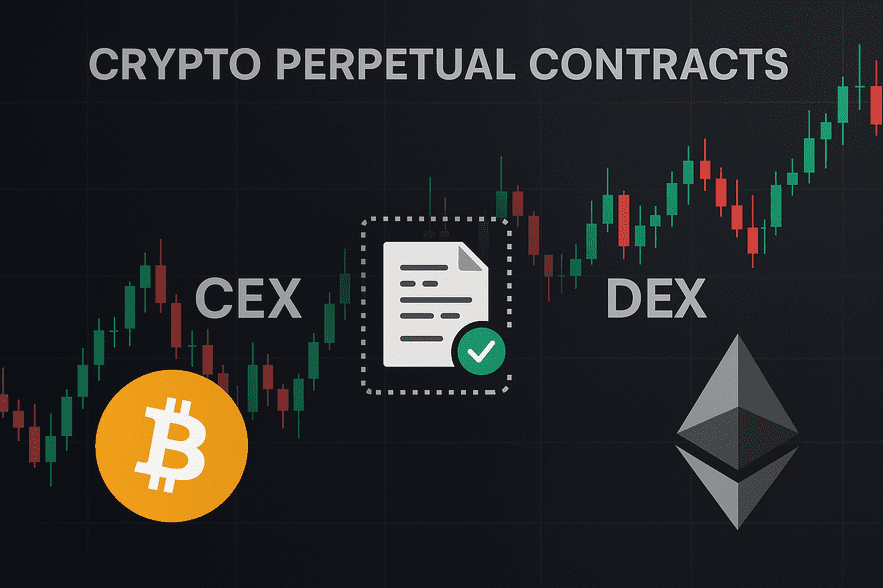
Crypto perps (short for Perpetual Futures) are a type of derivative (financial instrument) that lets traders speculate on the price of an underlying asset (such as Bitcoin, Ethereum, or other cryptocurrencies) without ever owning the asset itself. Unlike traditional futures contracts, which always have a set expiry date, perps are open-ended—they can be held indefinitely, provided margin requirements are met (Sources: Coinbase, Kraken, Gemini)
How Do Perps Work?
When trading a perp, there are always two sides:
- The long (betting on the price going up)
- The short (betting on the price going down)
The position size is usually much larger than your actual collateral, thanks to leverage. If the price moves in your favor, the profit can be significant—but losses can be equally large if the market turns against you.
Funding Rate
To keep the price of perps close to the real spot price, the market uses a mechanism called the funding rate:
- If the perp trades above the spot price, long traders pay shorts.
- If it trades below the spot, shorts pay longs.
- These payments typically happen every few hours and incentivize traders to keep the perp price close to the spot price.
Where Can You Trade Perps? (CEXs vs DEXs)
Centralized Exchanges (CEXs)
Perps were first launched on centralized platforms like BitMEX, Binance, Bybit, Kraken, and Coinbase.
- CEXs are custodial: funds stay on the exchange while open positions are managed.
- Usually provide deep liquidity, fast matching, multiple assets, and regulated environments (but may require KYC).
Decentralized Exchanges (DEXs)
Decentralized perpetual DEXs such as dYdX, GMX, and Drift enable traders to:
- Trade perps fully non-custodially: funds remain in the trader’s wallet; all trades are executed by smart contracts.
- Enjoy permissionless access and greater privacy, but may experience less liquidity and higher on-chain costs.
Leverage: Power and Peril
Leverage means controlling a position worth more than your deposited margin. For example, with $20,000 and 10x leverage, you can open a $200,000 position. For every 1% the market moves against you, you lose 10% of your margin. A 10% adverse move will fully liquidate your position.
- Initial margin: Capital required to open a position.
- Maintenance margin: Minimum remaining capital needed to keep the position open; if breached, the contract is liquidated automatically.
Why Trade Perps?—Use Cases
- Speculation: Take leveraged bets on price movements, both up and down, without holding the actual asset.
- Hedging: Protect other crypto investments from adverse price moves with offsetting perp positions.
- Arbitrage: Buy on the spot market, sell on perps, or vice versa, to profit from price discrepancies.
Risks and Opportunities
Risks
- Leverage Risk: Amplifies both gains and losses—liquidation risk is very real.
- Funding Costs: Holding positions over time can generate significant costs through the funding rate.
- Counterparty/Smart Contract Risk: On CEXs, you trust the exchange; on DEXs, bugs or exploits in the smart contract could cause loss of funds.
- Volatility: Sudden price moves can trigger margin calls and liquidations, often more quickly than traders expect.
Opportunities
- Capital Efficiency: Small collateral enables access to large positions and strategies unavailable with spot-only trading.
- Sophisticated Strategies: Perps let users go short, hedge, and construct complex risk/reward structures impossible with simple spot trading.
- 24/7 Liquidity: Both CEX and major DEX perp markets run around the clock.
Final Thoughts
Crypto perps are a cutting-edge financial tool, fusing the efficiency of futures with the 24/7 nature of crypto markets. Their combination of leverage, liquidity, and flexibility make them powerful—but risk management is crucial. Spot traders who want to expand into perps should start small, use strict position sizing, and have a clear plan for handling margin calls and volatility.
Whether you choose a CEX for its liquidity and ease or a DEX for control and transparency, understanding the mechanics—including funding rates and margin requirements—is key to success.
Leverage and the chance for outsized returns draw many traders to perps, but the risks are equally outsized. Approach with caution, discipline, and a continuous focus on education.