




Crypto Payment Processor Watch Series
Executive Summary
CoinsPaid represents one of the most concerning cases in the crypto payment processing sector, where significant market presence masks extensive compliance violations and potential criminal activity. Operating as the self-proclaimed “#1 crypto payment gateway for iGaming,” the Estonia-licensed company processes over €3 billion annually while allegedly facilitating money laundering, illegal gambling, and sanctions evasion across multiple jurisdictions.
Critical Investment Warning: FinTelegram’s comprehensive investigations reveal systematic financial misconduct, including potential insolvency, shadow ownership by sanctioned entities, and active intimidation of whistleblowers. The company’s deep integration with unlicensed gambling operations and alleged document forgery create unacceptable regulatory and reputational risks.
Company Overview
Corporate Structure and Shadow Leadership
CoinsPaid operates through Dream Finance OÜ, Dream Finance UAB, and Dream Finance US LLC. Until recently, Dream Finance S.A. in El Salvador was also listed as the operator; however, this entity has since been removed from the website. The company maintains a complex multinational structure that obscures actual ownership and control.
Official Leadership:
- CEO: Max Krupyshev (Ukraine) – Public face and crypto influencer
- Beneficial Owner: Alexander Horst Riedinger (Austria) – Alleged frontman
- Shadow Control: Ivan Montik (Belarus) – Co-founder of SoftSwiss and alleged true controller beside Pavel Kashuba and Dzmitry Yaikau.
Key Concern: Multiple sources indicate Riedinger serves as a front for Belarusian interests, with Ivan Montik wielding actual control over operations. This shadow ownership structure enables sanctions evasion and regulatory manipulation.
Business Model and Market Dominance
CoinsPaid operates multiple brands including CoinsPaid.com, CryptoProcessing.com, and the secretly integrated AlphaPo, creating a dominant position in high-risk payment processing. The company claims to handle 8% of global on-chain Bitcoin flows and processes over 8 million monthly transactions for 500+ gambling operators.
Operational Scale:
- €3 billion processed in Q4 2022
- 500+ iGaming operators served
- 150+ countries supported
- 100+ employees across multiple jurisdictions
Key Business Metrics
| Metric | Value |
|---|---|
| Trading Names | CoinsPaid, CryptoProcessing, AlphaPo |
| Founded | 2018 |
| Headquarters | Tallinn, Estonia |
| Legal Entities | https://fintelegram.com/tag/dream-financeDream Finance OÜ, Dream Finance UAB, Dream Finance US LLC, Dream Finance S.A. |
| CEO | Max Krupyshev (Ukraine) |
| Beneficial Owner (UBO) | Alexander Horst Riedinger (Austria) |
| Key Figures | Ivan Montik, Pavel Kashuba, Dzmitry Yaikau |
| Total Processing Volume (Q4 2022) | €3 Billion |
| Monthly Transaction Volume | 8+ Million Transactions |
| Merchant Accounts | 500+ Operators |
| Countries Supported | 150+ |
| Cryptocurrencies Supported | 20+ |
| Fiat Currencies | 40+ |
| Employees | 100+ |
| License – Estonia | FIU Estonia CASP License |
| License Number | FVT000166 |
| Business Model | Crypto Payment Gateway & Exchange |
| Target Industries | iGaming, Online Gambling, High-Risk |
| Major Security Incidents | $37.3M Hack (July 2023), $7.5M Hack (2024) |
| Former Brand Names | AlphaPo (integrated operations) |
| Related Entities | SoftSwiss, Merkeleon GmbH |
| Global Bitcoin Flow Share | 8% of Global On-Chain Bitcoin Flows (allegedly) |
The impressive growth metrics mask fundamental compliance failures and potential insolvency issues that threaten the company’s operational viability.
Regulatory Framework and License Status
Current Authorization
CoinsPaid holds an Estonian CASP license (FVT000166) from the Financial Intelligence Unit FIU), renewed in September 2023 after 15 months of regulatory scrutiny. The company invested €5 million in share capital to meet Estonia’s stringent requirements, positioning itself as a compliant operator in the European market.
Regulatory Claims:
- Estonia FIU licensed under new CAMA framework
- Regular third-party security and compliance audits
- AML/KYC compliance systems
- Preparation for EU MiCAR implementation
Critical Compliance Failures
Despite regulatory licensing, FinTelegram investigations reveal systematic violations that contradict the company’s compliance narrative:
| Issue | Description | Impact |
|---|---|---|
| Money Laundering Operations | Laundering hundreds of millions of euros annually through crypto | Critical |
| Illegal Gambling Facilitation | Processing payments for unlicensed gambling operators globally | Critical |
| Financial Insolvency/Negative Equity | Operating with negative equity despite €37M+ in losses | High |
| Belarusian Shadow Control | Austrian UBO Riedinger fronting for Belarusian interests | Critical |
| SoftSwiss Casino Integration | Deep integration with unlicensed SoftSwiss casino platforms | High |
| AlphaPo Hidden Integration | Secret operational merger with AlphaPo payment processor | High |
| Regulatory Evasion | Exploiting regulatory loopholes across multiple jurisdictions | High |
| Document Forgery Allegations | Alleged forged signatures in Cyprus court documents | Critical |
| Whistleblower Intimidation | Systematic campaign against former director Frédéric Hubin | Medium |
| Tax Fraud Allegations | Non-compliance with local tax regulations across EU | High |
| Sanctions Evasion | Facilitating payments in sanctioned countries (Russia/Belarus) | Critical |
| Corporate Structure Manipulation | Using shell companies to obscure true ownership structure | High |
The most damaging revelations involve CoinsPaid’s secret operational merger with AlphaPo, creating a single entity that processes payments for unlicensed gambling operations while maintaining separate public identities to deceive regulators.
Financial Misconduct and Insolvency Concerns
Security Breaches and Financial Losses
CoinsPaid has suffered multiple devastating security incidents:
- July 2023: $37.3 million theft attributed to Lazarus Group (Source: CoinsPaid)
- 2024: Additional $7.5 million breach
- Total Losses: Over $44 million in confirmed thefts
Insolvency Indicators: Whistleblower reports suggest the company operates with negative equity, continuing operations despite being technically bankrupt. The discrepancies between publicly reported and actual losses raise serious questions about financial transparency.
Money Laundering Operations
Former director Frédéric Hubin and other whistleblowers allege CoinsPaid launders hundreds of millions of euros annually through cryptocurrency transactions. The operation allegedly involves:
- Network of Belarusian expatriates across European countries
- Processing payments for offshore and illegal gambling platforms
- Systematic evasion of AML/KYC requirements
- Tax fraud across multiple jurisdictions
The SoftSwiss Connection
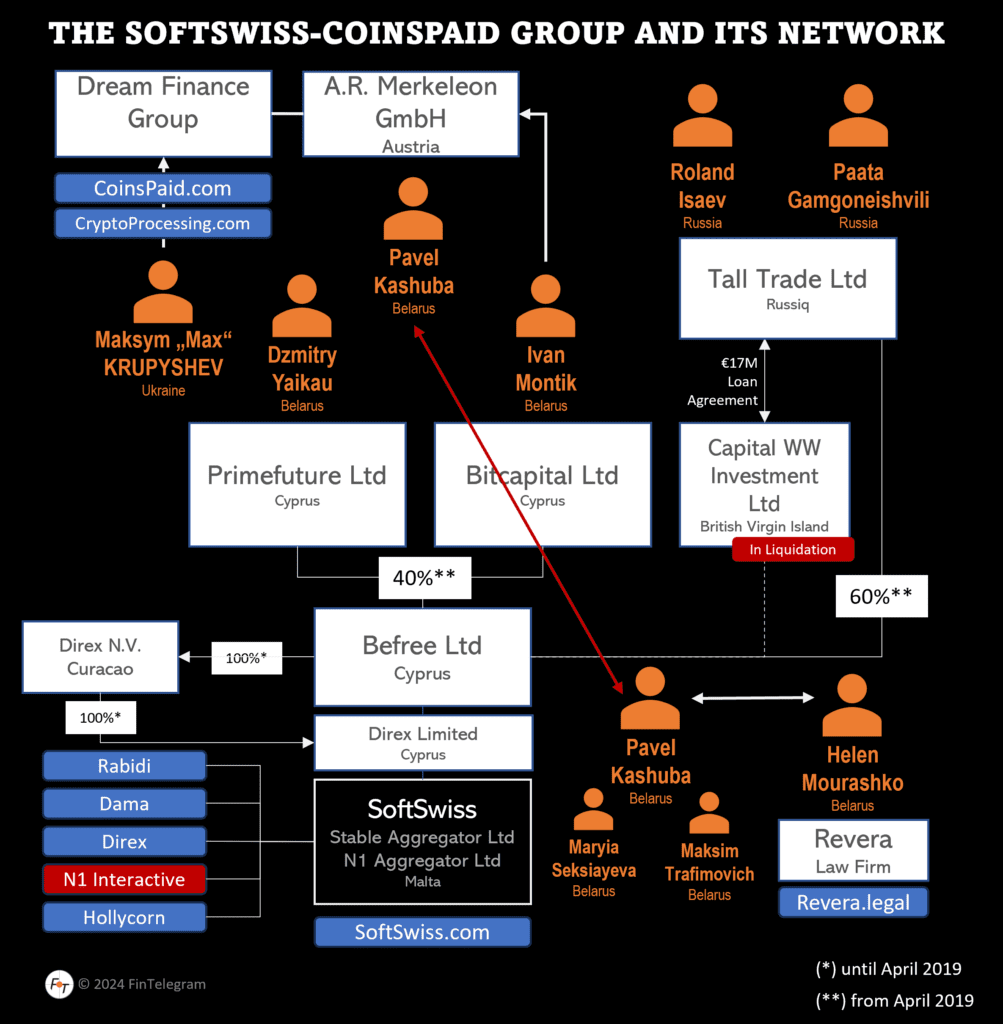
Unlicensed Gambling Ecosystem
CoinsPaid‘s most significant compliance failure involves its deep integration with SoftSwiss, a Belarus-founded iGaming platform operator. This relationship enables unlicensed gambling operations across regulated European markets through brands including:
Regulatory Violations: These platforms operate without proper licenses in regulated markets, with CoinsPaid providing the payment infrastructure that enables continued operations despite regulatory warnings.
Download our report on Rabidi, Softswiss and CoinsPaid here.
Sanctions Evasion Concerns
The Belarus connection raises serious sanctions compliance issues, particularly given:
- Ivan Montik‘s role as SoftSwiss founder and CoinsPaid co-founder
- Operations in sanctioned countries including Russia and Belarus
- Use of Austrian fronting to obscure Belarusian control
- Processing payments for platforms serving sanctioned jurisdictions
Whistleblower Intimidation and Document Forgery
The Frédéric Hubin Case
Former CoinsPaid director Frédéric Hubin‘s explosive allegations have triggered a systematic intimidation campaign. Hubin claims:
- CoinsPaid operates with negative equity
- Systematic money laundering operations
- Belarusian shadow control of operations
- Processing payments for illegal SoftSwiss casinos
Corporate Retaliation: CoinsPaid filed a criminal complaint against Hubin in Estonia, alleging that he had embezzled funds. The Estonian police carefully investigated this complaint and concluded that Hubin had not committed any criminal acts.
FinTelegram analyzed the police statement and found that Hubin had apparently tried to protect CoinsPaid from a possible hacker attack. In this respect, the action taken against Hubin can be considered an attempt at intimidation.
Document Forgery Allegations
Most concerning are allegations that CoinsPaid participated in document forgery for Cyprus court proceedings. FinTelegram reports that CoinsPaid co-signed documents with Payabl (another high-risk processor) containing allegedly forged signatures in an attempt to obtain injunctions against investigative reporting.
Risk Assessment and Investment Implications
Regulatory Enforcement Risk
CoinsPaid faces potential enforcement actions across multiple jurisdictions:
European Union: MiCAR implementation increases scrutiny of CASP operations, particularly those serving unlicensed gambling
Estonia: Regulatory review of license renewal given mounting compliance concerns
Austria: Investigation of Alexander Riedinger’s fronting activities
Multiple Jurisdictions: AML/sanctions investigations related to Belarusian connections
Operational Sustainability
The company’s business model depends on relationships that violate regulatory frameworks:
- Over 70% of business derived from gambling operations
- Many clients operate without proper licenses
- Shadow ownership structure enables regulatory evasion
- Multiple security breaches demonstrate operational vulnerabilities
Reputational Contamination
Association with CoinsPaid creates cascading reputational risks:
- Regulatory scrutiny for partner institutions
- Sanctions compliance concerns for financial counterparties
- AML violations for correspondent banking relationships
- Professional liability for service providers
Market Position and Competitive Analysis
Industry Leadership Claims
CoinsPaid claims market leadership in crypto iGaming payments, processing €3 billion annually with 500+ operator clients. However, this dominance relies on serving unlicensed operators that compliant processors avoid.
Competitive Vulnerabilities:
- Business model depends on regulatory arbitrage
- Client base consists primarily of high-risk operators
- Shadow ownership creates sanctions compliance issues
- Multiple security breaches demonstrate operational weakness
Fee Structure and Business Economics
CoinsPaid offers competitive processing fees below 1% with no monthly charges or rolling reserves. However, the low-cost model depends on:
- Inadequate compliance investment
- Regulatory arbitrage through Estonian licensing
- Serving clients other processors reject
Investment Recommendation
Risk Rating: CRITICAL – AVOID
CoinsPaid presents unacceptable risks that disqualify it from any legitimate investment consideration:
Primary Disqualifying Factors:
- Criminal Enterprise Allegations: Systematic money laundering and sanctions evasion
- Financial Insolvency: Operating with negative equity following major losses
- Shadow Ownership: Belarusian control through Austrian fronting arrangement
- Document Forgery: Alleged participation in legal document manipulation
- Whistleblower Intimidation: Systematic campaign against former executives
- Regulatory Violations: Enabling unlicensed gambling across regulated markets
Enforcement Prediction
Given the severity and scope of violations, CoinsPaid faces imminent regulatory action:
- License revocation in Estonia likely within 12 months
- Criminal investigations probable in multiple jurisdictions
- Civil forfeiture actions targeting laundered proceeds
- Sanctions designation possible for shadow controllers
Industry Impact and Systemic Risk
Contagion Concerns
CoinsPaid’s operations create systemic risks for the cryptocurrency ecosystem:
- Undermines regulatory confidence in licensed operators
- Creates compliance contamination for partner institutions
- Demonstrates inadequacy of current licensing frameworks
- Validates regulatory concerns about crypto payment processors
Regulatory Response
The CoinsPaid case will likely accelerate regulatory tightening:
- Enhanced beneficial ownership disclosure requirements
- Stricter AML/KYC enforcement for crypto processors
- Increased sanctions compliance scrutiny
- Coordinated international enforcement actions
Whistleblower Call to Action
The CoinsPaid investigation demonstrates the critical importance of insider information in exposing financial crime. Current and former employees, business partners, and clients with knowledge of CoinsPaid‘s operations are encouraged to provide confidential information through FinTelegram’s secure whistleblower platform.
Specific Information Sought:
- Financial records demonstrating insolvency or losses
- Documentation of money laundering operations
- Evidence of sanctions evasion activities
- Communications regarding document forgery
- Internal records of shadow ownership arrangements
Secure Reporting: Whistleblowers can safely submit information regarding CoinsPaid and related entities through Whistle42’s secure platform: https://whistle42.com
Conclusion
CoinsPaid represents a textbook case of how cryptocurrency payment processors can exploit regulatory gaps to facilitate criminal activity while maintaining a veneer of compliance. The company’s Estonian license and professional marketing mask an operation allegedly controlled by sanctioned interests, designed to launder money and evade international sanctions.
Investment Verdict: CoinsPaid is unsuitable for any legitimate investment or business relationship. The combination of criminal enterprise allegations, financial insolvency, shadow ownership, and active enforcement risks creates unacceptable exposure for any associated party.
The case serves as a critical warning about the cryptocurrency payment sector’s vulnerabilities and the need for enhanced regulatory oversight. Investors, financial institutions, and service providers must implement rigorous due diligence procedures to avoid contamination from operations like CoinsPaid.
Final Assessment: CoinsPaid should be treated as a high-risk criminal enterprise masquerading as a legitimate financial services provider. Any association with the company or its principals creates immediate legal, regulatory, and reputational jeopardy.
This investor briefing is based on investigative reports, regulatory filings, and publicly available information. The serious nature of the allegations requires independent verification through appropriate legal and regulatory channels.