



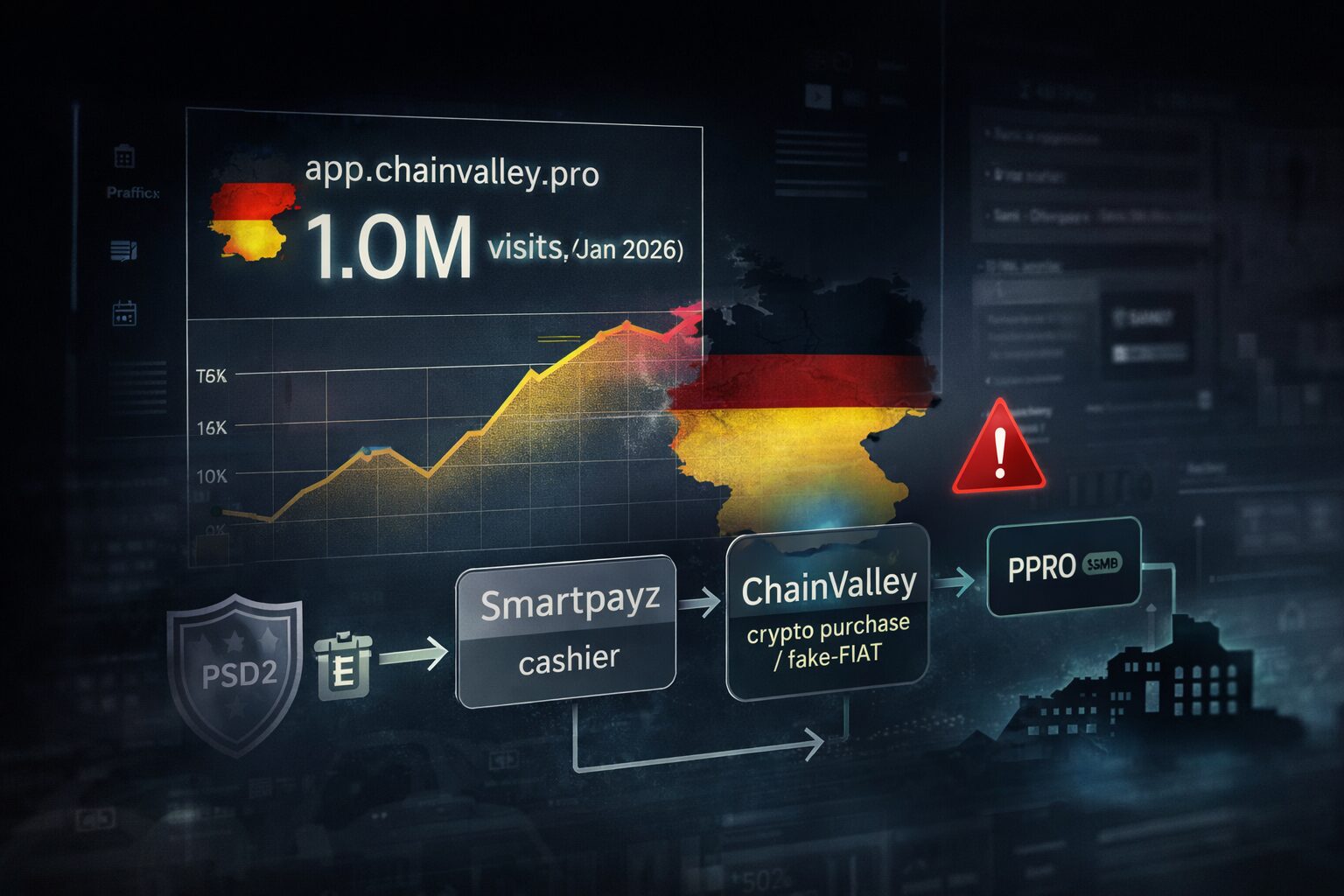
A seismic shift is occurring in the high-risk payment landscape. Following the MiCA-driven regulatory “cliff-edge” in Lithuania on December 31, 2025, illegal offshore casinos have found a new haven: ChainValley. This Polish Virtual Asset Service Provider (VASP) has seen a staggering 362% explosion in traffic, effectively replacing the suspended utPay as the primary “fake FIAT” rail for German players. Operating in a regulatory vacuum created by Poland’s recent veto of its national MiCA framework, ChainValley appears to be facilitating millions in unlicensed gambling transactions while its official terms of service—which prohibit such activity—remain a mere paper shield.
KEY FINDINGS
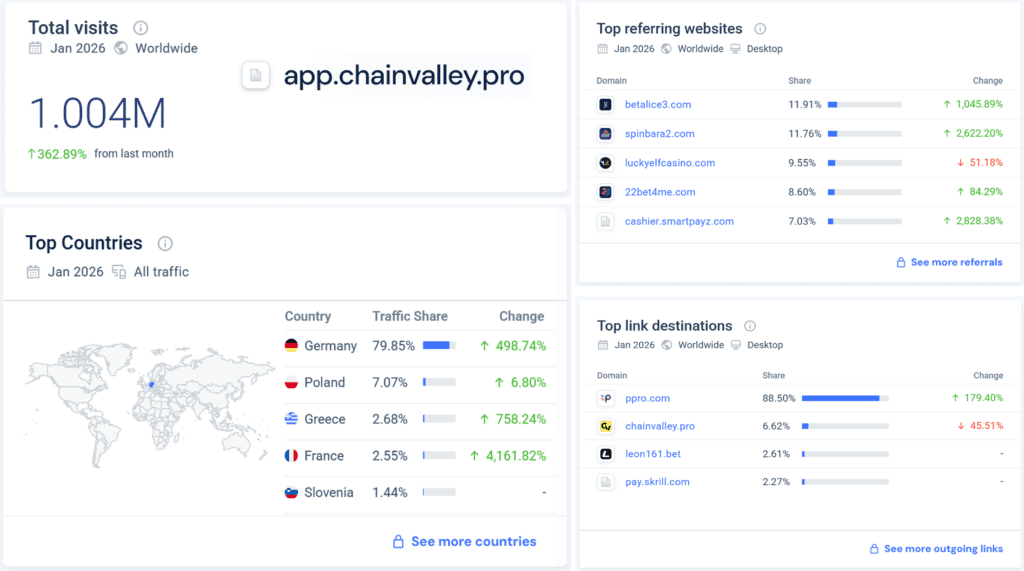
- Explosive Traffic Surge: Similarweb data reveals that app.chainvalley.pro visits skyrocketed from approximately 250,000 in December 2025 to over 1 million in January 2026.
- The utPay Replacement: As Lithuanian regulator Lietuvos Bankas enforced the MiCA transition, utPay (formerly a dominant iGaming facilitator) saw a 75% collapse in traffic. ChainValley has almost perfectly absorbed this volume.
- German Player Focus: Nearly 80% of ChainValley’s traffic originates from Germany, targeting players at illegal offshore casinos like DudeSpin.
- Shadow Partnerships: Traffic analysis identifies PPRO (accounting for 90% of outgoing links) and the blacklisted Smartpayz as critical infrastructure partners for ChainValley’s payment flows.
- Regulatory Arbitrage: ChainValley is exploiting Poland’s status as the “lone MiCA holdout” in the EU following the December 2025 presidential veto of the Polish Crypto-Asset Market Act.
COMPLIANCE & RISK ANALYSIS
1. The “Fake FIAT” Mechanism
ChainValley functions as a “fake FIAT” rail. In this setup, players believe they are making a standard bank transfer or card payment for a service. In reality, ChainValley acts as an on-ramper, instantly converting these FIAT deposits into cryptocurrency to fund offshore casino accounts. This obfuscates the transaction’s true nature from the player’s bank, bypassing gambling blocks.
2. PSD2 / Payment services perimeter:
If ChainValley (a VASP registrant) is functionally acting as a fiat receiving agent or money remitter for casino deposits, the obvious question is: under what PSD2 authorisation chain? Poland’s RDWW register is not a financial licence, and Polish tax/treasury communications have been clear that registered virtual currency activity is not “licensed or supervised” like regulated financial services (oversight is primarily AML/CFT control)
3. Regulatory Migration: Lithuania to Poland
The “Lithuanian Blackout” of early 2026—which saw major players like utPay and CoinsPaid (Dream Finance) suspend services—was the catalyst for ChainValley’s growth. While Lithuania now requires a rigorous MiCA license (€125k capital, “Fit and Proper” checks), Poland remains under a simplified VASP registration regime.
Read our ChainValley reports here.
4. What This Likely Is: “Gambling-by-Conversion”
Let’s be explicit: the core activity behind these rails is not “payments innovation.” It is regulated gambling evasion. Many of the casinos feeding these gateways are unauthorised in key EU jurisdictions, yet they localise language, present EU-friendly payment options, and accept EU deposits. The payment rail then performs the real trick: a casino deposit is operationally reframed as something else—often a crypto purchase—before value is moved to the casino operator.
That is not a neutral technicality. It is a compliance design choice.
Working Hypothesis: Compliance at ChainValley is likely non-existent or “theatrical.” The company’s Terms & Conditions explicitly forbid illegal gambling, yet the data shows they are the primary gateway for it. This suggests a deliberate circumvention of AML/KYC protocols to capture the displaced utPay market.
Partner Risk: PPRO and Smartpayz
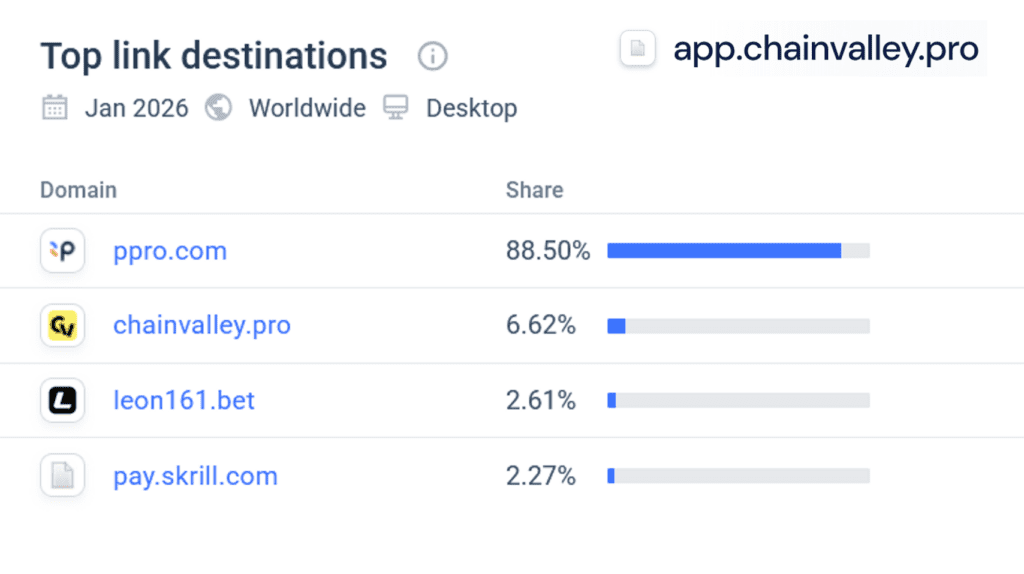
The high concentration of outgoing traffic to PPRO (approx. 90%) is alarming. It suggests that PPRO’s infrastructure is being used to process the underlying bank transfers for these crypto-purchases. Furthermore, the integration with Smartpayz—a gateway already blacklisted by RatEx42—solidifies ChainValley’s position within a network of high-risk, non-compliant entities. Compliance questions to be asked:
- PPRO (www.ppro.com): What is the contractual relationship (if any) with ChainValley? Which merchant(s) are onboarded? What MCC/merchant classification is used? What geoblocking / gambling policies apply? (PPRO positions itself as a platform enabling local payments for merchants.)
- Smartpayz (www.smartpayz.com): Why does cashier.smartpayz.com appear as a top referrer into the ChainValley flow (screenshot above)? Smartpayz’s own website contains disclaimers suggesting it is informational and does not process client funds—yet the “cashier” subdomain behaves like a transaction surface.
Black-listed: Smartpayz Compliance Profile on RatEx42.
Call for Information
If you are a player, bank compliance employee, PSP insider, or have handled disputes linked to these deposits, we need documents—not anecdotes:
- deposit confirmations (screenshots) showing payee/beneficiary,
- bank statement line items (with references),
- any ChainValley “order” pages, crypto quotes, or wallet outputs,
- chargeback / complaint correspondence,
- casino cashier screens showing the advertised method vs. actual flow.
Submit securely via Whistle42 (anonymous if needed). The more receipts we get, the faster we can map the merchant chain and identify the accountable regulated entities.