



Executive Summary
The global stablecoin market has moved from a crypto-trading utility into a strategic layer of digital financial infrastructure. Stablecoins are now used for exchange settlement, cross-border payments, dollar access, DeFi liquidity, remittances, and increasingly institutional payment flows.
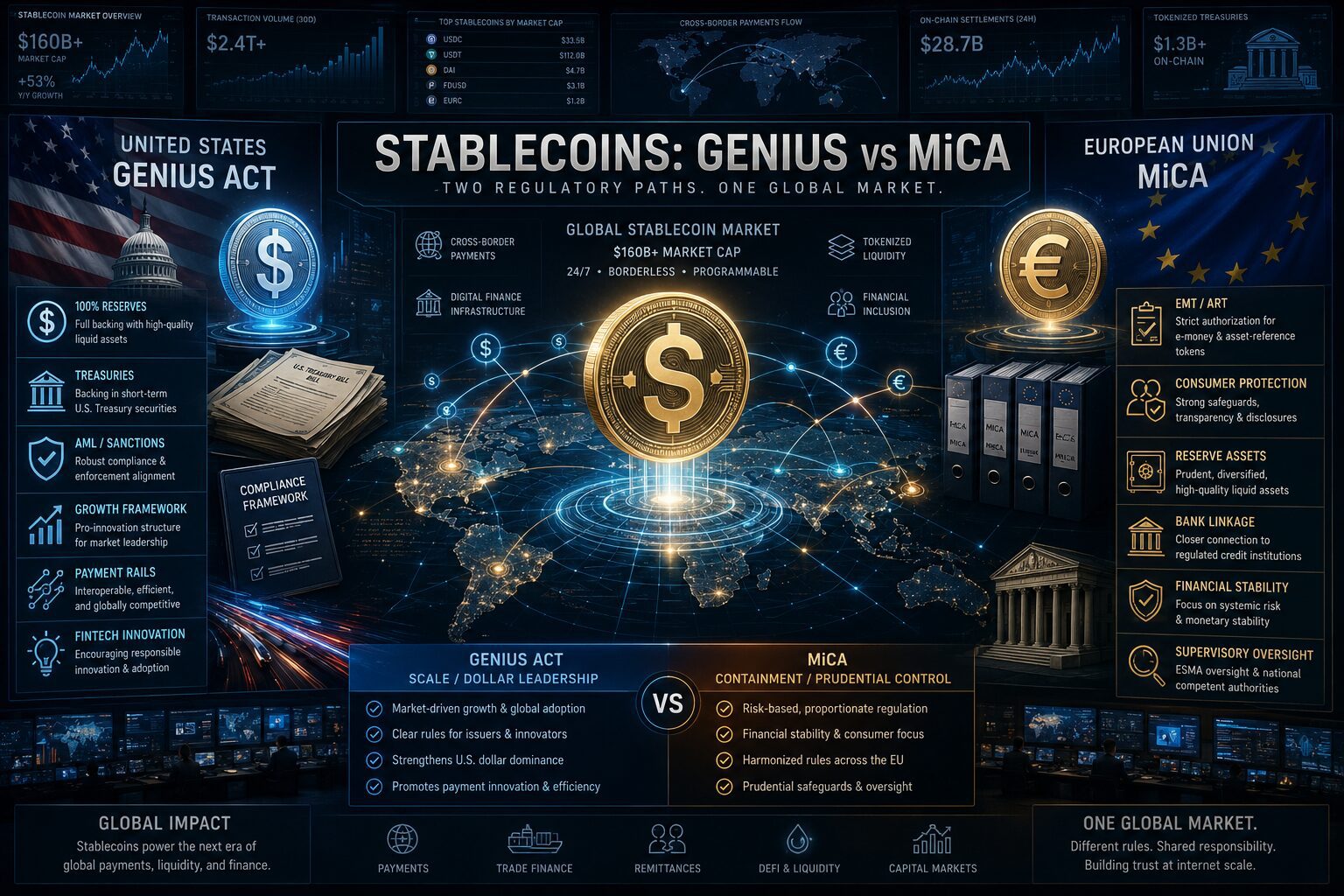
The regulatory divide between the United States and the European Union is becoming structural. The U.S. GENIUS Act is designed to domesticate and scale dollar-backed payment stablecoins under a federal framework. The EU’s MiCA regime is designed to contain stablecoin risks, protect monetary sovereignty, and prevent reserve-run contagion into the banking sector.
The result is an emerging asymmetry: the U.S. is turning stablecoins into a dollar-export and Treasury-demand mechanism, while Europe is regulating stablecoins primarily as a financial-stability risk.
Background: The UniCredit Warning
Elena Carletti, Deputy Vice Chair of UniCredit and head of the bank’s risk committee, warned that Europe may be less able than the U.S. to contain shocks arising from the connection between stablecoins and banks.
The reference point is the 2023 Silicon Valley Bank (SVB) crisis. SVB held deposits linked to crypto firms, and its collapse destabilized a major stablecoin before U.S. authorities invoked a systemic-risk exception and guaranteed all deposits. That intervention helped stabilize both the banking system and the affected stablecoin market.
Carletti’s concern is that Europe cannot easily replicate such a response. Under MiCA, stablecoin issuers must hold reserves in bank deposits and low-risk liquid assets. This creates a forced link between stablecoin issuers and banks. In a stress scenario, Europe may face a double weakness: stablecoins become dependent on banks, while banks may be exposed to volatile stablecoin reserve flows — without a U.S.-style emergency backstop.
Global Importance of Stablecoins
Stablecoins are no longer a niche crypto instrument. Their market capitalization has grown from a few billion dollars in 2019 to roughly USD 300 billion. The market remains overwhelmingly dollar-based and concentrated in the largest issuers, particularly USDT and USDC. Their strategic importance rests on four functions:
- Crypto settlement layer: Stablecoins remain the dominant cash-equivalent inside crypto markets.
- Cross-border payments: They offer fast, 24/7 settlement outside traditional correspondent banking rails.
- Dollar access: In emerging markets, dollar stablecoins function as synthetic offshore dollars.
- Treasury demand: Large fiat-backed stablecoin issuers hold substantial reserves in cash and short-term government securities, especially U.S. Treasuries.
This explains why the stablecoin debate is no longer merely about crypto regulation. It is about monetary power, banking liquidity, payment sovereignty, sanctions control, and the future role of the dollar and euro in digital finance.
U.S. Approach: GENIUS Act
The GENIUS Act creates the first comprehensive U.S. federal framework for payment stablecoins. Its core policy logic is pro-growth but prudentially framed. Key features include:
- 100% reserve backing with liquid assets such as U.S. dollars and short-term Treasuries.
- Monthly public disclosure of reserve composition.
- Prohibition on misleading claims that stablecoins are government-backed, federally insured, or legal tender.
- Priority protection for stablecoin holders in issuer insolvency.
- Bank Secrecy Act application, including AML and sanctions compliance.
- Technical capability to freeze, seize, or burn stablecoins when legally required.
- A pathway for U.S.-regulated banks and non-bank issuers to issue payment stablecoins.
- Conditional market access for foreign issuers subject to comparable supervision and U.S. registration requirements.
The strategic purpose is visible: regulate the sector, protect users, and scale dollar-backed stablecoins as part of U.S. digital-asset leadership.
EU Approach: MiCA
MiCA takes a more restrictive and risk-control-oriented approach. Stablecoins are mainly regulated as either:
- E-money tokens (EMTs): tokens referencing one official currency; or
- Asset-referenced tokens (ARTs): tokens referencing multiple assets, currencies, commodities, or a basket.
Issuers require authorization and must comply with reserve, governance, disclosure, own-funds, liquidity, redemption, and supervisory requirements. The EBA has a central role in technical standards and supervision of significant ARTs and EMTs, while ESMA coordinates broader crypto-market rules.
MiCA’s objective is not to create a global euro-stablecoin industry at all costs. Its logic is defensive: market integrity, consumer protection, financial stability, and monetary sovereignty.
The ECB remains skeptical of a large private stablecoin market in Europe. It fears that stablecoins could make bank deposits more volatile, reduce bank lending capacity, complicate monetary policy, and create new run dynamics.
GENIUS vs. MiCA: Key Differences
| Topic | U.S. GENIUS Act | EU MiCA |
|---|---|---|
| Strategic policy direction | Promote regulated dollar stablecoins and U.S. digital-asset leadership | Contain stablecoin risk and protect financial stability |
| Core philosophy | Innovation with prudential guardrails | Prudential containment and consumer protection |
| Main stablecoin category | Payment stablecoins | EMTs and ARTs |
| Reserve model | 100% backing with liquid assets, especially cash and short-term Treasuries | Reserve assets, bank deposits, low-risk liquid assets, liquidity and own-funds requirements |
| Monetary policy angle | Supports dollar dominance and Treasury demand | Protects euro sovereignty but restricts rapid stablecoin scaling |
| Issuer opportunity | Strong pathway for banks, non-bank issuers, and fintechs | More complex authorization and supervisory burden |
| Foreign issuer access | Possible, but subject to U.S. comparability, OCC registration, U.S. reserve requirements, sanctions compliance | Non-EU issuers face MiCA compliance burden for EU access |
| AML/sanctions focus | Explicit Bank Secrecy Act, sanctions compliance, freeze/seize/burn capability | AML obligations mainly through broader EU AML/CASP framework plus MiCA governance and supervision |
| Bank linkage | Stablecoins become regulated payment instruments with Treasury/cash reserve base | Stablecoin reserves create strong links to EU banks and deposit markets |
| Competitive effect | Likely accelerates U.S. dollar stablecoin dominance | May protect the EU system but weaken EU stablecoin competitiveness |
| Regulatory tone | Industrial-policy tool for dollar-based digital finance | Risk-management framework for crypto-assets |
| Market outcome | Encourages institutional adoption | Encourages compliance but may slow scale and innovation |
Compliance Analysis
The UniCredit warning identifies the key European vulnerability: MiCA reduces issuer risk at the micro level but may create systemic linkage at the macro level. If stablecoin issuers must hold substantial reserves in bank deposits and liquid instruments, their risk becomes bank-system risk. In a crisis, redemptions could pressure both the issuer and the banks holding reserves.
In the U.S., the policy architecture is different. The GENIUS Act channels stablecoin reserves toward cash and short-term Treasuries, while the 2023 SVB precedent demonstrated that U.S. authorities may act aggressively to contain systemic spillovers. This does not remove risk, but it creates a more credible expectation of crisis intervention.
Europe has stricter rules but potentially weaker crisis elasticity. The U.S. has a more growth-oriented regime with stronger systemic backstop expectations.
Market Implications
The immediate winner is the U.S. dollar stablecoin sector. Dollar-backed tokens already dominate global supply, liquidity, exchange settlement, DeFi activity, and cross-border crypto payments. GENIUS may reinforce that dominance by giving institutional issuers, banks, fintechs, and payment platforms a clearer legal route.
Europe faces a different problem. MiCA provides legal certainty, but legal certainty alone does not create market depth. Euro stablecoins remain marginal globally. Even if MiCA-compliant euro stablecoins emerge, they must compete against the network effects, liquidity, exchange integration, and global demand for dollar tokens.
This is why the European debate increasingly frames stablecoins as a strategic-autonomy issue. If Europe regulates too tightly, it may protect banks but leave digital money markets to the dollar. If it relaxes too much, it may import bank-liquidity and monetary-policy risks into the EU financial system.
Hypothesis: Europe’s Stablecoin Dilemma
Europe is likely to produce compliant but structurally smaller stablecoin issuers, while the U.S. is likely to produce globally scalable dollar stablecoin champions.
Under MiCA, European issuers will have regulatory legitimacy but face higher compliance costs, stricter reserve constraints, fragmented banking relationships, and a more skeptical central-bank environment. In contrast, U.S. issuers benefit from a large domestic capital market, deep Treasury liquidity, stronger dollar demand, and a law explicitly designed to promote stablecoin growth.
The likely outcome is a two-speed stablecoin market:
- U.S. stablecoins become global payment and settlement infrastructure.
- EU stablecoins remain regulated, safer, but comparatively niche instruments.
Unless Europe creates a more positive stablecoin strategy — or successfully launches a digital euro and tokenized commercial-bank deposit ecosystem — MiCA may unintentionally reinforce digital dollarisation. The EU may win the regulatory-risk argument while losing the market-scale argument.
Conclusion
Stablecoins are becoming a strategic financial infrastructure layer. The U.S. has chosen to regulate and scale them. Europe has chosen to regulate and contain them.
The UniCredit warning captures the core risk: MiCA links stablecoin issuers to banks without giving Europe a clearly equivalent crisis backstop. That may make the EU framework safer in normal times but more fragile in stress scenarios.
From a compliance perspective, MiCA is stronger on containment. From a market-structure perspective, GENIUS is stronger on competitiveness. The decisive question is whether Europe can develop a stablecoin and digital-money strategy that protects financial stability without surrendering the future of programmable money to the dollar.