



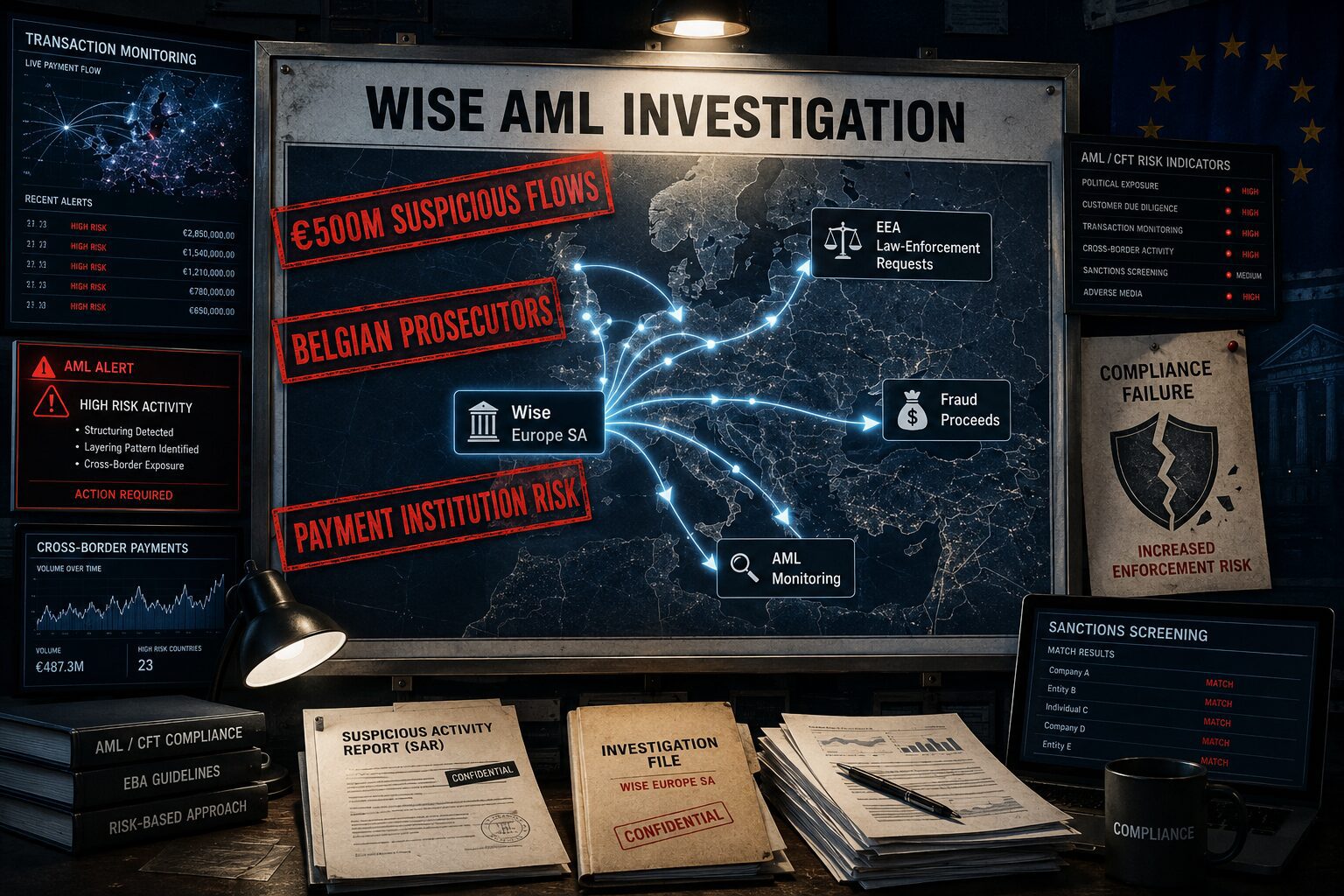
The Bureau of Investigative Journalism (TBIJ) has reported that Belgian prosecutors are investigating Wise, the London-headquartered money transfer and payments giant, over concerns that Wise accounts may have been used in connection with approximately €500 million in suspicious transactions. The investigation reportedly focuses on Wise’s European operations and potential indications of non-compliance with anti-money laundering (AML) legislation.
Wise has not been accused of criminal wrongdoing in court. The investigation is ongoing. However, the case adds another regulatory pressure point to a company that has grown into one of the most important cross-border payment infrastructures for retail users, freelancers, SMEs, and increasingly business customers.
Key Points
- Belgian prosecutors reportedly opened the investigation after Wise accounts appeared in hundreds of judicial assistance requests from more than 30 European countries.
- The suspicious transaction exposure reportedly amounts to approximately €500 million.
- The investigation concerns Wise’s European operations, handled through Wise Europe SA in Belgium.
- Wise told TBIJ that its Belgian office manages law-enforcement requests across the EEA and that it is cooperating with the Brussels prosecutor.
- This is not an isolated compliance issue: Wise has previously faced AML-related scrutiny in Europe and the United States.
- The case highlights a broader structural issue: electronic money institutions and payment institutions are becoming critical nodes in cross-border financial crime risk.
The TBIJ Findings
According to TBIJ, Belgian prosecutors are examining whether Wise may have failed to comply with AML obligations after its accounts appeared repeatedly in criminal-proceeding assistance requests across Europe. These requests reportedly involved fraud, corruption, drug trafficking, and other suspected criminal proceeds.
The core issue is not whether Wise intentionally enabled money laundering. The relevant compliance question is whether its transaction monitoring, customer due diligence, suspicious activity detection, and law-enforcement response framework were sufficiently robust for the scale and risk profile of its business.
This distinction matters. A payment institution can be fully legitimate and still become systemically attractive to criminal networks if its onboarding, account controls, transaction monitoring, and escalation procedures do not scale as fast as its customer base and transaction volume.
Wise’s Regulatory Position
Wise Europe SA is authorised in Belgium and passported across the EEA. This makes Belgium a central regulatory jurisdiction for Wise’s European operations. TBIJ reports that Wise’s Belgian office handles law-enforcement requests across the EEA, which helps explain why the Belgian prosecutor’s office is a central node in the current investigation.
Wise reportedly said it is working with the Brussels prosecutor and routinely cooperates with regulators and law-enforcement authorities. The company also stated that around one third of its staff is dedicated to fighting financial crime.
That statement is important, but it also raises a sharper compliance question: if a company has such a large financial crime function, why did hundreds of judicial requests across Europe still accumulate into a reported €500 million suspicious exposure pattern?
Prior AML Pressure
The new Belgian investigation follows earlier AML-related issues. In 2024, the Financial Times reported that the National Bank of Belgium had required Wise to implement a remediation plan after identifying weaknesses in customer address documentation. In 2025, Wise US entered into a $4.2 million multistate settlement with US regulators over alleged inadequacies in its AML/CFT programme.
Those earlier matters do not prove wrongdoing in the Belgian criminal investigation. However, they indicate a recurring theme: Wise’s compliance architecture has been under regulatory pressure in multiple jurisdictions.
Compliance Analysis
From a compliance perspective, the Wise case is a classic scale-versus-controls problem. Wise built its market position by making cross-border payments cheaper, faster, and easier than traditional correspondent banking. That is precisely what made the company successful. But the same speed, reach, and convenience also make such platforms attractive to fraud networks, mule-account operators, sanctions evaders, and money-laundering structures.
For payment institutions, the key risks are:
- Mule Account Networks
Fraud proceeds can be rapidly moved through seemingly ordinary retail or business accounts. - Cross-Border Fragmentation
Criminal flows often touch multiple jurisdictions, making law-enforcement coordination slow and incomplete. - High-Velocity Transaction Patterns
Fast transfers reduce the time available for intervention before funds leave the platform. - CDD Gaps
Weak or outdated customer documentation can undermine risk scoring and transaction monitoring. - Business Account Misuse
SME and freelancer-style accounts can be abused as payment collection layers for scams or unlicensed activity.
Why This Matters
Wise is no longer a niche fintech. It is a major global payment infrastructure provider. In Q4 FY2026, Wise reported £49.4 billion in quarterly cross-border volume and 11.3 million active customers. It has also shifted its primary listing to Nasdaq while maintaining a London presence.
This makes the Belgian investigation strategically significant. It is not merely a local enforcement matter. It is a test case for how regulators and prosecutors assess the AML responsibilities of global payment platforms that operate between traditional banking, e-money infrastructure, and fintech convenience.
FinTelegram Assessment
FinTelegram’s preliminary assessment is that the Wise case should be viewed as part of a broader regulatory trend: electronic money institutions and payment institutions are moving from “fintech innovation” status into “systemic compliance infrastructure” status.
The core question is no longer whether such firms are cheaper or faster than banks. The question is whether they can detect, stop, report, and explain suspicious flows at the same speed at which they process legitimate transactions.
Wise may ultimately demonstrate that it acted appropriately and cooperated fully with authorities. But the reported €500 million suspicious transaction exposure, combined with prior AML remediation and US enforcement history, creates a material reputational and regulatory issue.
Call For Information
FinTelegram invites former Wise employees, compliance officers, law-enforcement sources, affected customers, and payment industry insiders to provide information about:
- Wise account closures and fund freezes;
- suspicious transaction reporting processes;
- mule account patterns;
- law-enforcement request handling;
- Wise Europe SA compliance operations;
- onboarding and proof-of-address remediation;
- fraud complaints involving Wise accounts;
- business account misuse and high-risk merchant flows.
Information can be submitted confidentially through Whistle42.




Wow , very intereseting