




Excerpt
In a case that raises fundamental questions about legal ethics and professional accountability, the Dutch law firm BarentsKrans has come under fire for abandoning the highly recognized European Fund Recovery Initiative (EFRI) and over 600 financial fraud victims just days before a critical court deadline. EFRI accuses the law firm of concealment, conflict of interest, and unethical conduct—all while pocketing tens of thousands of euros meant for justice. This is not just a legal misstep. It’s a betrayal.
5 Key Points
- 600+ victims left in limbo: EFRI, representing fraud victims of Payvision-facilitated scams, was deserted just five days before a crucial appeal deadline.
- Undisclosed conflict of interest: BarentsKrans allegedly failed to disclose prior ties to Payvision and secretly sought their approval before accepting the mandate.
- No work product delivered: Despite receiving full payment (€30,000) and the case file weeks prior, the firm delivered no draft, no outline, and no handover.
- Retainer weaponized: BarentsKrans offered to return 50% of the retainer—only if EFRI deleted public criticism and waived legal claims.
- Systemic warning sign: The firm’s conduct raises serious questions about the state of consumer redress under the Dutch legal system, especially in mass fraud cases.
Short Narrative
When EFRI engaged the Amsterdam-based law firm BarentsKrans (website) in April 2025 to file an urgent appeal against ING subsidiary Payvision, it was supposed to be a bold move toward justice for more than 600 European victims of binary options and gambling scams. Instead, it turned into a disaster.
Without delivering a single legal product, and just five days before a court-imposed deadline, BarentsKrans walked away from the case—citing “time pressure” and belatedly revealing a conflict of interest with the very entity EFRI was suing. The fallout has not only jeopardized legal recourse for the victims, many elderly, but has also cast a harsh light on the integrity of one of the Netherlands’ most prominent law firms.
Extended Analysis
BarentsKrans’ conduct in the EFRI vs. Payvision case could potentially violate multiple provisions of the Gedragsregels (Dutch Legal Ethics Code). Specifically:
- Conflict of Interest: On 18 March 2025—before the mandate was even accepted—BarentsKrans secretly contacted Payvision to “seek permission” to act against them. The fact that one of the firm’s partners had previously represented ING/Payvision was never disclosed to EFRI until it was too late. This undermines the legal principle of undivided loyalty.
- Abandonment of Client: William Schonewille, the BarentsKrans partner in charge, resigned without notice shortly after EFRI demanded transparency and a filing timeline. No documents were submitted to the court, and no fallback was offered, leaving the victims exposed at a critical juncture.
- Extortionate Settlement Tactics: Following their withdrawal, BarentsKrans offered to refund just half of the €30,000 retainer, but only if EFRI agreed to silence public complaints and waive future claims. This tactic resembles coercion, not client care.
- Inadequate Communication: BarentsKrans had access to the full case file since 21 March, yet made no substantial requests for further documentation until early May. The firm shifted its strategy erratically and failed to explain the rationale, showing a complete disregard for the time-sensitive nature of the appeal.
What makes this case even more egregious is BarentsKrans’ positioning as a champion of consumer rights in WAMCA collective redress cases. If a firm with such public-facing values behaves like this, it invites a deeper reckoning for the Dutch legal system and investor protection mechanisms.
“As the chair of EFRI, I have dealt with countless fraud cases—but I never imagined that we would be left stranded by a law firm at the most critical point of legal proceedings. What happened between EFRI and BarentsKrans feels like a betrayal of professional trust. I truly feel scammed—not for myself, but for the hundreds of victims we represent who are now left without recourse. It’s a devastating outcome for people who have already lost so much” (E. Sixt, EFRI Chair)
Background: Amsterdam – A Nexus of Cybercrime and Legal Complicity?
To fully understand the gravity of BarentsKrans’ actions, one must recognize the broader criminal context: the Payvision case is not just another financial fraud—it is one of the most significant cybercrime money laundering scandals to have emerged from Europe in the past decade.
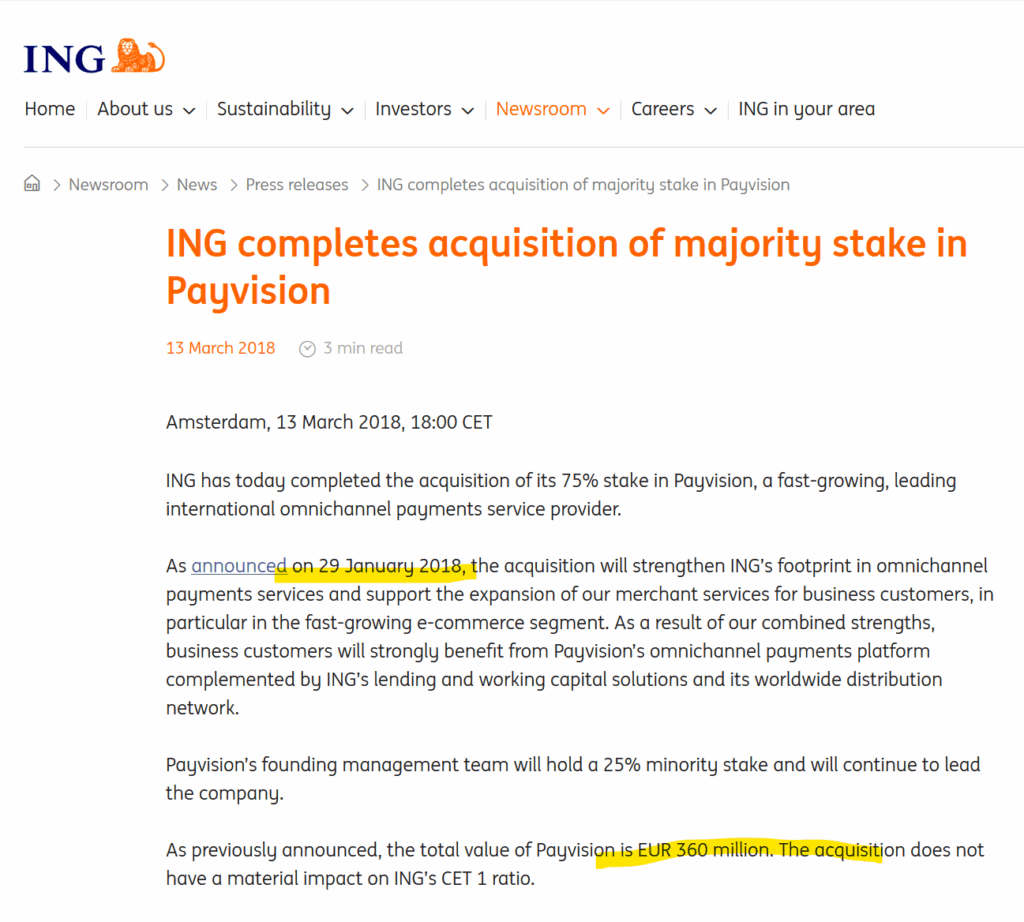
Payvision, a Dutch FinTech acquired by ING for €360 million in 2018, was a central payment facilitator for some of the most notorious cybercrime networks, including those operated by Uwe Lenhoff and Gal Barak. These organizations lured tens of thousands of victims—primarily elderly and financially inexperienced—into fraudulent online trading platforms, stealing hundreds of millions of euros.
Read the Payvision reports here.
Between 2015 and 2019, Amsterdam functioned as a laundering hub. Payvision processed payments for dozens of illegal binary options and gambling schemes, often routing funds through opaque corporate structures and offshore banks. These funds were the stolen life savings of victims across the EU, funneled and whitewashed through an institution that branded itself as a FinTech innovator but in reality, was a criminal enabler dressed in a compliance façade.
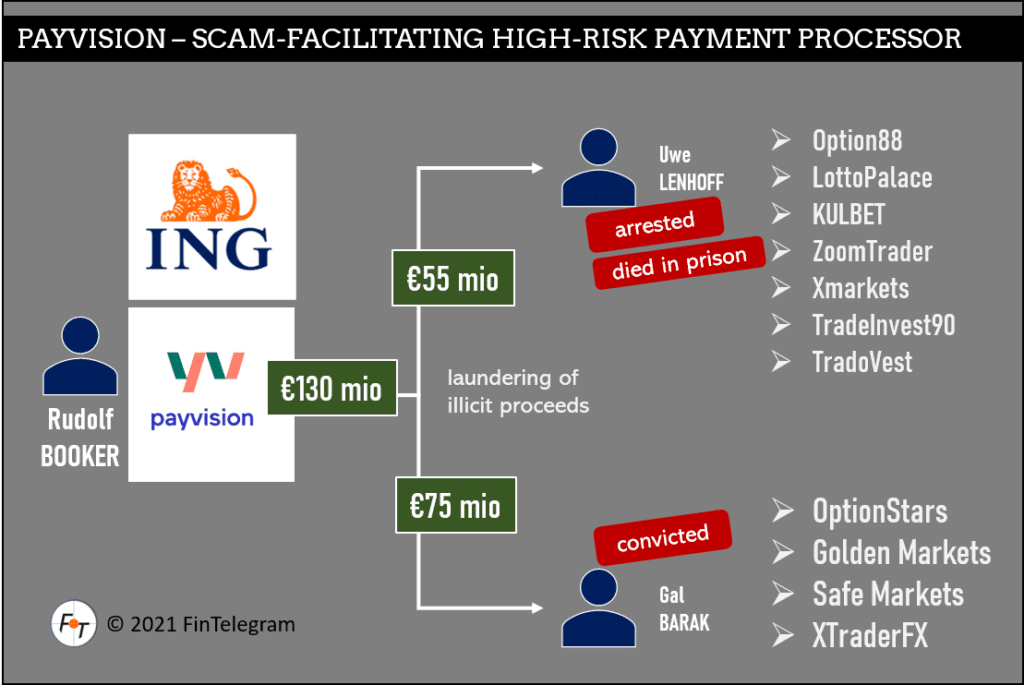
By the time Lenhoff was arrested in 2019 (he later died in custody) and Barak was convicted in 2020, the damage had been done. Thousands of victims were left defrauded—many of them now represented by EFRI, the European Funds Recovery Initiative. Their mission has been clear: hold accountable the institutions that enabled the crime, starting with Payvision and its parent ING.
And yet, in the very city where the crimes were perpetrated, BarentsKrans—a prestigious Amsterdam-based law firm—chose to abandon these victims at the eleventh hour. Their actions cannot be viewed in isolation; they must be judged against the backdrop of Amsterdam’s systemic failure to protect victims and prosecute financial crime enablers.
This isn’t just a legal misstep—it’s an institutional disgrace rooted in a city that has too often looked away.
Strategic Implications
This legal debacle should trigger red flags for institutional investors and consumer advocates alike. If Dutch law firms can abandon mass fraud victims at the eleventh hour, and do so with opaque settlement offers and undisclosed conflicts, how secure is any legal recourse in the Netherlands for victims of financial crime?
Investors in Dutch legal tech, mass tort funds, or litigation finance entities should reconsider exposure. The reputational risk alone is now measurable.
FinTelegram urges EFRI and similarly affected NGOs to escalate complaints to the Dutch Bar Association and, if necessary, file legal malpractice suits against BarentsKrans. Meanwhile, whistleblowers and other law firms should come forward. If you’re handling mass harm cases, remember: credibility dies in the dark. Transparency is not optional—especially when justice is on the line.
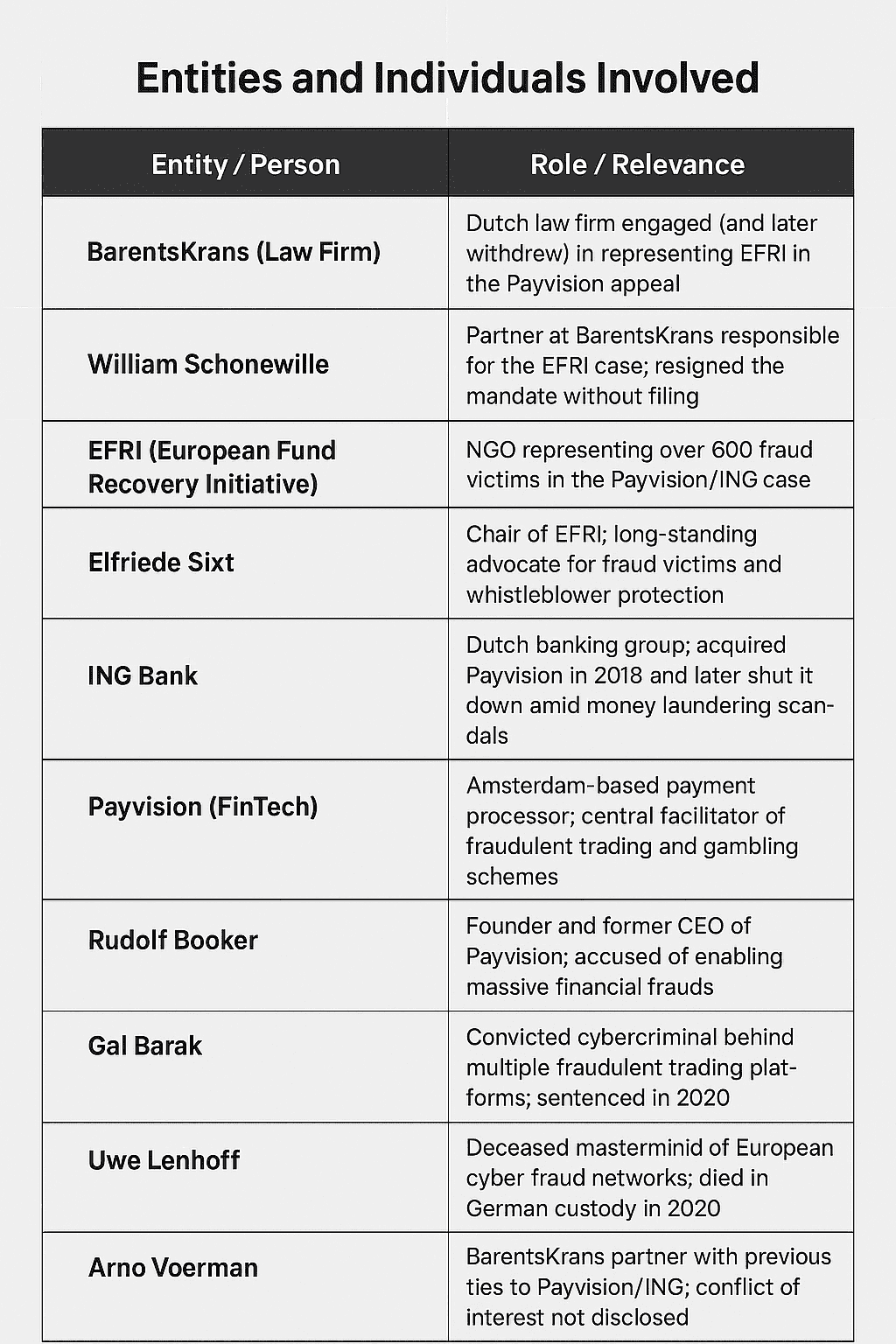
Summarizing Table
| Entity / Person | Role / Relevance |
|---|---|
| BarentsKrans (Law Firm) | Dutch law firm engaged (and later withdrew) in representing EFRI in the Payvision appeal (website: www.barentskrans.nl) |
| William Schonewille | Partner at BarentsKrans responsible for the EFRI case; resigned the mandate without filing |
| EFRI (European Fund Recovery Initiative) | NGO representing over 600 fraud victims in the Payvision/ING case |
| Elfriede Sixt | Chair of EFRI; long-standing advocate for fraud victims and whistleblower protection |
| ING Bank | Dutch banking group; acquired Payvision in 2018 and later shut it down amid money laundering scandals |
| Payvision (FinTech) | Amsterdam-based payment processor; central facilitator of fraudulent trading and gambling schemes |
| Rudolf Booker | Founder and former CEO of Payvision; accused of enabling massive financial frauds |
| Gal Barak | Convicted cybercriminal behind multiple fraudulent trading platforms; sentenced in 2020 |
| Uwe Lenhoff | Deceased mastermind of European cyber fraud networks; died in German custody in 2020 |
| Arno Voerman | BarentsKrans partner with previous ties to Payvision/ING; conflict of interest not disclosed |
| N. van Ruiten | Co-claimant in the appeal alongside EFRI; also impacted by the case outcome |