


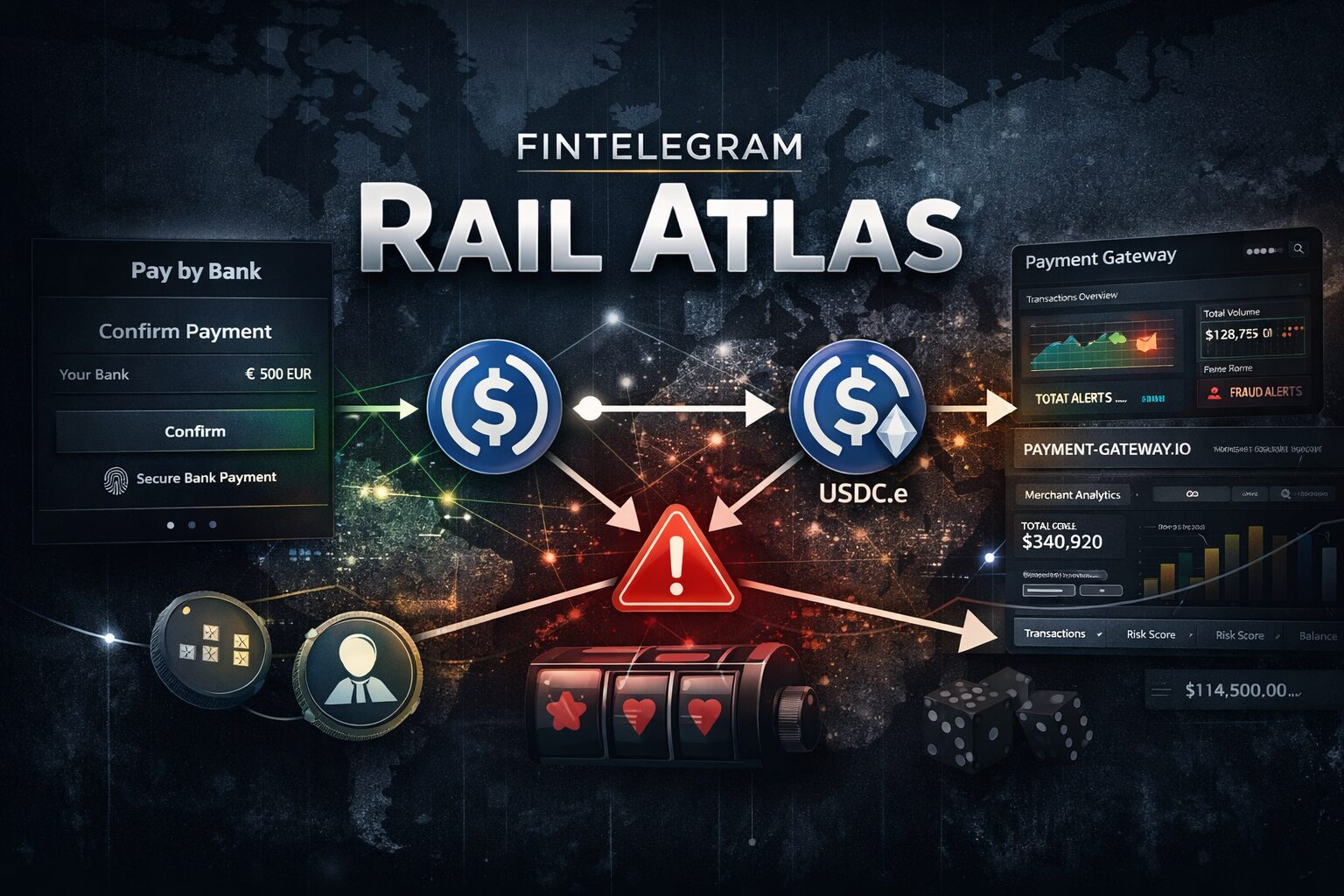
FinTelegram is evolving. Instead of treating illegal offshore casinos as isolated stories, we now investigate them as repeatable payment architectures—the rails that keep them alive. Our new Rail Atlas consolidates evidence-based “rail patterns” (open banking gateways, fake-fiat onramps, payee substitution, gateway meshes) into evergreen hubs—so enforcement, banks, and readers can see the system, not just the symptom.
Key Facts
- FinTelegram ’26 focuses on cyberfinance chokepoints: payments, open banking, stablecoin rails, and gateway stacks enabling illegal casinos.
- We convert recurring tactics into Rail Hubs (evergreen pages) under the Rail Atlas.
- We operate an Airtable Case Register to track cases, entities, evidence, and rail mappings consistently.
- Whistleblower information via Whistle42 is recorded and triaged into Airtable as strategic intelligence.
- FinCrime Observer will increasingly handle financial-crime coverage, separate from FinTelegram but connected via Whistle42.
- Whistle42 is being developed into a cross-platform whistleblower hub; a C42 reward token is planned for Q1 2026.
Short Analysis
Illegal offshore casinos and other grey- and dark-side schemes no longer rely on a single payment provider. They run multi-layer payment stacks: open banking consent screens that look “regulated,” “bank transfer” options that are actually stablecoin purchases, and e-wallet flows where the payee is not the casino operator at all. This is not random. It is engineering.
FinTelegram’s response is to document and publish these systems as rails—repeatable patterns that can be verified, compared, and mapped across brands. The Rail Atlas is our way of turning scattered exposures into structured compliance intelligence.
Extended Analysis
Why We Built the Rail Atlas
Traditional reporting often stops at: “This casino is illegal.” That may be true—but it’s incomplete. The operational truth is: illegal casinos survive because their payment rails survive. When one gateway is blocked, another appears. When card acquiring gets difficult, open banking consent flows fill the gap. When disputes rise, “crypto purchase + wallet transfer” flows reduce chargeback risk by reframing the transaction.
The Rail Atlas captures these mechanics as evergreen hubs—so readers don’t have to relearn the same tricks in every case. Each hub explains:
- How the rail works (step-by-step)
- What evidence proves it (screenshots, redirects, descriptors, on-chain settlement)
- What chokepoint actions exist (banks, PSPs, gateways, onramps, enforcement)
- Where it appears (a living Case Index)
How we investigate: “Follow the Conversions”
Our method is simple and repeatable:
- Identify the casino or scheme and its licensing/claims
- Walk the cashier flows and capture UI evidence
- Map redirects, domains, and provider roles (gateway, facilitator, agent)
- Capture descriptors and settlement endpoints (including wallets and tokens)
- Classify the observed behavior under one or more rails
- Publish a case report—and link it back to the Rail Atlas hubs
This is compliance intelligence built for action: it helps banks, fintechs, and regulators see the enabling infrastructure.
Airtable: the case register behind the reporting
To make this systematic, we use Airtable as our internal case register. It is where we track:
- Cases, entities, domains, and role assignments
- Evidence artifacts (screenshots, links, descriptors, wallet addresses, TX hashes)
- Rail classifications (which pattern applies, with confidence grading)
- Investigation status and next steps (what we still need to verify)
Airtable is not “admin.” It’s the engine that turns new findings into a repeatable investigative pipeline—and it allows us to expand quickly from a single casino to an entire cluster when the rails match.
Whistle42: strategic intelligence, systematically captured
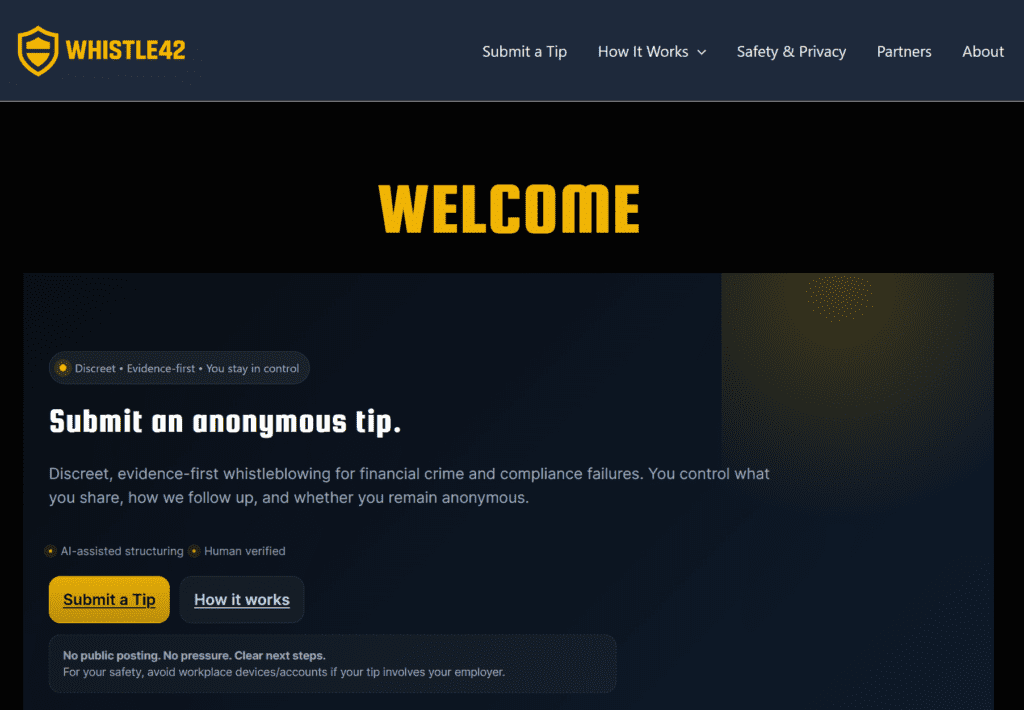
Whistleblower submissions are increasingly decisive because the most valuable facts are often hidden behind contracts, account structures, and internal policies. Whistle42 has therefore been revised to serve as a cross-platform whistleblower system.
Information submitted via Whistle42 is not just “read.” It is structured and recorded in Airtable: linked to cases and entities, assigned confidence grades, and converted into investigative tasks. This is why whistleblowers are strategically important to our work: they reduce uncertainty where the public surface ends.
FinCrime Observer: Where Financial Crime Coverage Expands
FinTelegram will stay focused on cyberfinance compliance intelligence—the chokepoints and rails. In parallel, FinCrime Observer will increasingly handle financial crime reporting. It is a separate platform with different operators, but it also uses Whistle42 and is part of the same broader ecosystem. The separation is deliberate: compliance intelligence and criminal case coverage require different editorial structures, standards, and workflows.
C42 token: rewarding high-quality whistleblower intelligence (Q1 2026)
Finally, we plan to introduce the C42 token as a reward token for whistleblowers in Q1 2026. The purpose is not hype. The purpose is incentives: high-quality, actionable intelligence should be recognized and rewarded—especially when it helps expose systemic payment enabling of illegal activity.
Actionable Insight
If you work at a PSP, open banking gateway, e-wallet, crypto onramp, or acquiring bank: stop looking only at single merchants. Look for rail patterns. The same deposit architecture repeats across multiple brands—and that repetition is the investigative signal.
Call for Information
If you have insider knowledge about offshore casino payment stacks—merchant-of-record setups, gateway contracts, descriptor logic, “crypto purchase” flows, stablecoin settlement, wallet operations, or compliance overrides—submit securely via Whistle42.com. Your information is recorded systematically in our case register and can materially accelerate enforcement-grade reporting.