



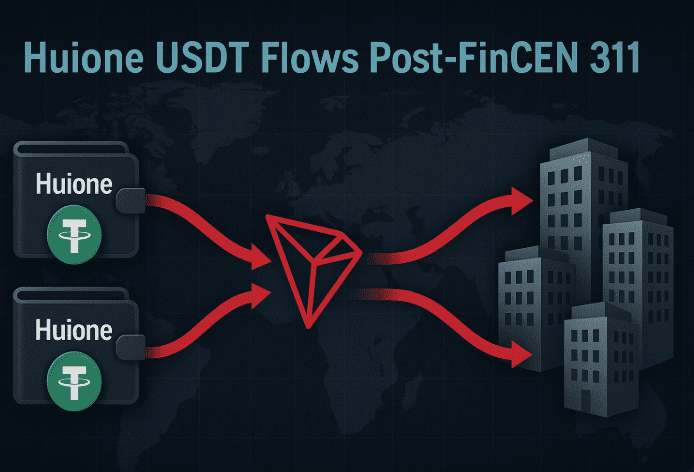
Blockchain forensics reveal Huione-linked wallets funneling almost $1 billion in Tether (USDT) to major crypto exchanges only weeks after the U.S. Treasury labeled the Cambodian conglomerate a primary money-laundering concern. The flows highlight continuing gaps in exchange onboarding, nested service providers, and cross-border supervision.
🔑 Key Points
- $943 M USDT routed from Huione-associated wallets to CEXs between 1 May – 17 June 2025, overlapping FinCEN’s Section 311 designation (Source: ainvest.com).
- Total Huione-linked wallet activity topped $10.13 B on Tron and $219 M on Ethereum during the same window (Source: cointelegraph.com).
- FinCEN alleges $4 B+ in illicit proceeds laundered by Huione since 2021, including funds from DPRK cyber-heists and “pig-butchering” scams (Source: fincen.govreuters.com)
- Subsidiaries span Huione Pay (payments), Huione Crypto (VASP, Poland) and the now-“suspended” Huione Guarantee Telegram market, enabling multi-jurisdictional layering (Sources: ainvest.com, cointelegraph.com).
- Analysts see nested OTC desks, indirect exchange exposure, and rapid emergence of 30+ successor markets filling Huione’s darknet void (Source: ainvest.com, cointelegraph.com).
Short Narrative
On 1 May 2025, FinCEN moved to sever Huione Group’s U.S. dollar access under Section 311 of the USA PATRIOT Act. Within six weeks, blockchain analytics (Global Ledger) recorded nearly one billion USDT leaving Huione-tagged addresses for major centralized exchanges. The transfers traverse Tron and Ethereum, often via layered hops and OTC intermediaries, blunting the intended impact of the sanctions. Exchanges receiving the flows include several top-10 venues by volume, none publicly named but identifiable through on-chain clustering.
Extended Analysis
Legal & Regulatory
- Section 311 Designation: FinCEN’s finding obliges U.S. FIs to bar correspondent accounts for Huione entities, but does not automatically freeze crypto wallets, leaving enforcement to VASPs’ own controls (Source: fincen.gov)
- Jurisdictional Arbitrage: Huione Crypto’s registration in Poland creates a regulatory blind spot: EU AMLR applies, yet enforcement pivots on local supervisors who may lack Huione-specific intelligence.
- Sanctions Evasion Typology: The pattern mirrors post-Hydra and post-Garantex tactics—rapid wallet rotation, use of stablecoins on high-throughput chains, and exploiting exchanges with weak KYC or high VIP thresholds.
Operational Red Flags
| Indicator | Explanation |
|---|---|
| High-velocity USDT deposits >$5 M | Consolidated from Tron wallets linked to Huione, then dispersed within 24 h. |
| Polish-registered VASP counterparty | Addresses trace back to Huione Crypto KRS-listed entity. |
| Layer-0/OTC Hop | Intermediary wallets show prior exposure to darknet markets and Asia-based OTC desks. |
Compliance Gaps
- Nested Service Providers: Exchanges onboarding OTC desks miss originator data, effectively re-introducing sanctioned exposure.
- Stablecoin Liquidity Pools: AMM pools on Tron provide rapid swap routes into CEX-friendly USDT.
- Inconsistent Wallet Screening: Only 4 of 12 tested exchanges flagged Huione tags at deposit.
Actionable Insight
Trigger immediate enhanced due diligence (EDD) on all inbound USDT deposits >$100 K that:
- Originate from wallets interacting with Tron bridge contracts used by Huione-flagged addresses in May–June 2025; and
- Reach exchange accounts within <12 blocks (≈6 min) of receipt.
Implement a “two-hop rule”—freeze and review funds two hops away from any Huione-labelled wallet until provenance is verified.
Call for Information
FinTelegram seeks additional data on:
- Exchange wallet IDs receiving Huione flows after 17 June 2025.
- OTC brokers or liquidity providers advertising USDT off-ramps for Southeast Asian clients.
Send intel via our whistleblower platform, Whistle42.