



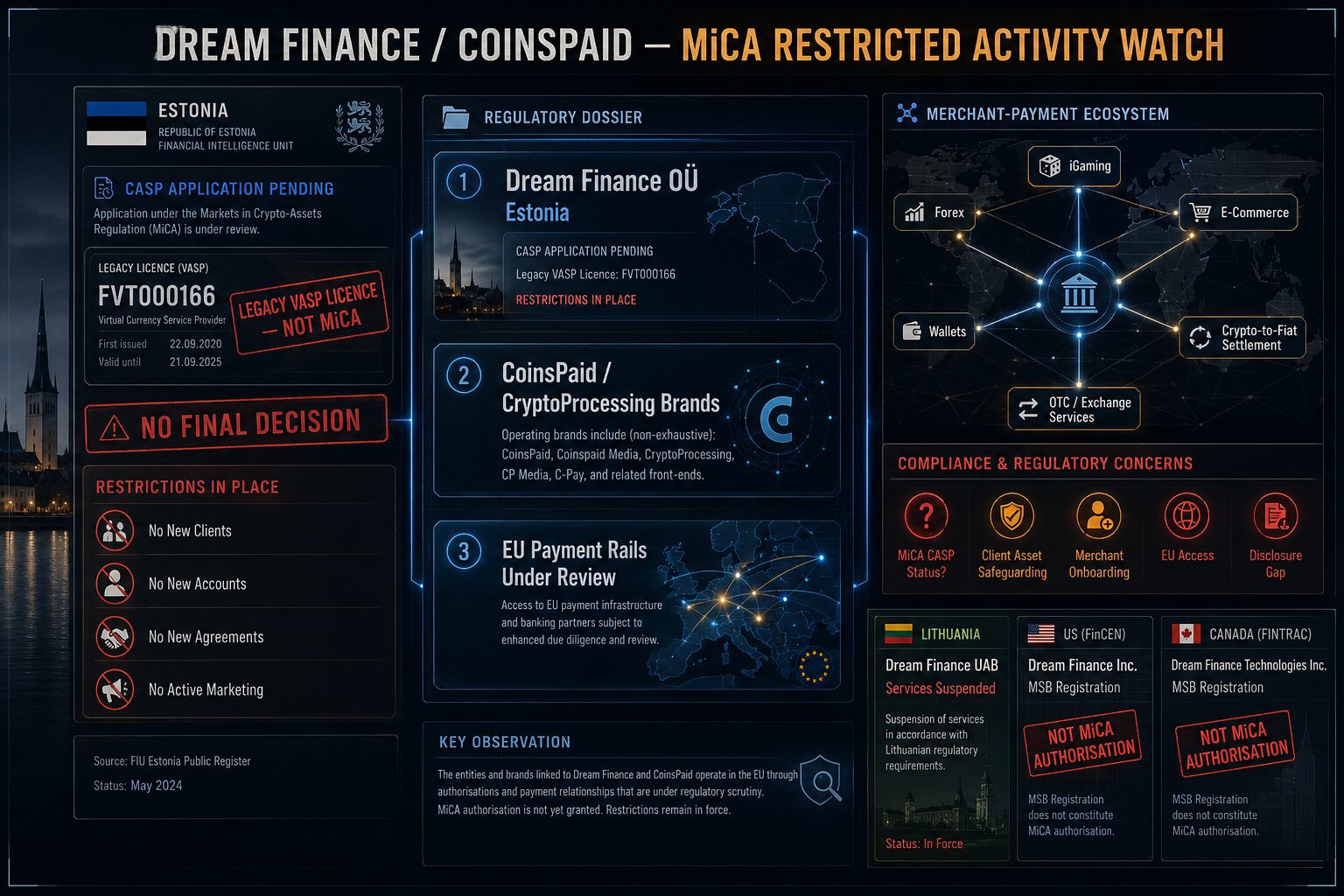
Dream Finance OÜ, the Estonian operator behind CryptoProcessing and CoinsPaid, says its MiCA CASP application remains under review. The group has restricted active operations — but the disclosure gap between CryptoProcessing and CoinsPaid raises fresh compliance questions.
Key Takeaways
- Dream Finance OÜ confirms that its MiCA CASP authorisation application in Estonia remains under review and that no final licensing decision has been issued.
- The company says it has restricted active activities: no new clients, no new accounts, no new client agreements, no expansion of services and no active marketing of regulated services.
- Dream Finance UAB in Lithuania is disclosed as having temporarily suspended all crypto-asset related services.
- CryptoProcessing pages now include MiCA restriction language, while the public CoinsPaid homepage reviewed by FinTelegram does not appear to display a comparable MiCA wind-down or restriction notice.
- FinTelegram classifies the case as Red / Restricted Activity Watch under its MiCA/MiFID-II Perimeter Radar.
Radar Classification
| Field | FinTelegram Assessment |
|---|---|
| Legal Entity | Dream Finance OÜ, Estonia; Dream Finance UAB, Lithuania; Dream Finance US LLC; Dream Finance Processing Inc. |
| Brands | CoinsPaid, CryptoProcessing |
| MiCA CASP Status | Application pending in Estonia; no final decision disclosed |
| Legacy Licence | Estonian FVT000166 still referenced on CryptoProcessing pages |
| EU Access | Restricted according to CryptoProcessing disclosures; public-facing sales funnels require monitoring |
| Lithuania | Dream Finance UAB disclosed as temporarily suspended |
| MiFID-II Relevance | Low based on disclosed payment/crypto-processing model; MiCA/CASP relevance is high |
| Payment-Rail Risk | High — crypto payments, fiat conversion, merchant settlement, iGaming vertical |
| Disclosure Gap | CryptoProcessing carries restriction language; CoinsPaid homepage reviewed by FinTelegram does not appear to carry equivalent prominent notice |
| Radar Status | Red / Restricted Activity Watch |
Why This Case Matters
This is the second case in FinTelegram’s MiCA/MiFID-II Perimeter Radar after Hyperliquid. Hyperliquid is the on-chain perps and DeFi perimeter case. Dream Finance is different. It is the crypto payment-rail case.
Read our Hyperliquid MiCA / MiFID II Perimeter Analysis here.
The Dream Finance group matters because it sits at the intersection of crypto payments, merchant processing, crypto-to-fiat conversion, wallet infrastructure, OTC/exchange services and high-risk industries such as iGaming, Forex and cross-border e-commerce. CryptoProcessing’s own website presents itself as a crypto payment processor that allows merchants to accept and exchange Bitcoin, stablecoins and more than 20 cryptocurrencies, and invites businesses to request a demo.
This is precisely the type of business model that MiCA was designed to bring into a harmonised EU authorisation regime.
MiCA Day One: Pending Is Not Authorised
On 1 July 2026, the Estonian transitional period ended. Estonia’s Finantsinspektsioon and Financial Intelligence Unit made the position clear: companies without authorisation by 1 July must cease or limit their activities, may not accept new clients, may not open new accounts and may not actively market services to EEA clients. Estonia also stated that only Lightspark Payments Europe AS had so far received a CASP authorisation from Finantsinspektsioon, while other providers may operate cross-border only if authorised in another EEA state.
ESMA’s EU-wide statement is equally clear. Unauthorised CASPs must immediately stop onboarding new EU clients, refrain from opening new accounts, cease marketing and solicitation, and limit services to what is necessary to sell, transfer, reallocate or close positions. Custody may continue only for the period strictly necessary for an orderly exit.
That is the regulatory frame for Dream Finance. A pending application is not a MiCA authorisation. It may support the company’s explanation of why it is in a restricted transitional posture, but it does not create market access.
Dream Finance OÜ: Application Pending, Activities Restricted

CryptoProcessing published a company update on 30 June 2026 stating that Dream Finance OÜ had submitted an application to Finantsinspektsioon for authorisation as a CASP under MiCA. The company disclosed that the application remains under review, that no licensing decision has been issued and that the authorisation status remains subject to the regulator’s final determination.
The update further states that Dream Finance OÜ has restricted its active activities pending the outcome of the application. According to the company, it does not onboard new clients, open new accounts, enter into new client agreements, expand the scope of services provided to existing clients or actively market regulated services to clients in the EEA or elsewhere.
That is an important admission. In MiCA terms, Dream Finance is no longer presenting itself as fully authorised for new EU business. It is presenting itself as an applicant in a restricted-activity phase.
CryptoProcessing also says existing clients may request withdrawal or transfer of assets or terminate their contractual relationship, and that client assets remain segregated from the company’s own assets under applicable safeguarding arrangements.
The Legacy Licence Problem: FVT000166
CryptoProcessing’s Legal Hub still lists Dream Finance OÜ with Estonian company number 14783543, VAT number EE102212301 and Licence No. FVT000166. That licence was a legacy Estonian virtual-currency service-provider authorisation. It is not, by itself, a MiCA CASP authorisation after 1 July 2026. This is not a semantic issue. It is the core of the new EU regime.
The ESMA Interim MiCA Register consists of CSV files including authorised crypto-asset service providers and non-compliant entities, and ESMA states that the register is updated and republished at regular intervals. ESMA’s MiCA page shows the latest listed update as 26 June 2026 and explains that the register data is provided by national competent authorities.
The practical compliance question is therefore simple:
Does Dream Finance OÜ have a MiCA CASP authorisation — or only a pending application and a legacy Estonian FVT licence?
Based on Dream Finance’s own disclosure, the answer as of publication is: application pending, no final decision disclosed.
Follow our MiCA MiFID II Perimeter Radar here.
Lithuania: Dream Finance UAB Suspended
The Legal Hub also lists Dream Finance UAB in Lithuania. Its important notice states that the Lithuanian entity has temporarily suspended all crypto-asset related services, including onboarding of new clients, execution of transactions and conclusion of new agreements. It further states that the website is maintained solely for mandatory legal information, regulatory disclosures and contact details for former clients, counterparties and competent authorities.
This is significant because Lithuania was one of the EU’s busiest crypto registration hubs before MiCA. For Dream Finance, Lithuania appears to have moved from operational base to suspended entity. Estonia then became the critical MiCA licensing gate.
The Multi-Entity Structure
CryptoProcessing’s contact page states that the CoinsPaid and CryptoProcessing brands are operated by Dream Finance OÜ and lists other group entities: Dream Finance UAB in Lithuania, Dream Finance US LLC in Delaware with a FinCEN MSB registration number, and Dream Finance Processing Inc. in Canada with a FINTRAC MSB registration number.
The same page contains a footer notice stating that Dream Finance OÜ’s CASP application remains under review by EFSA/Finantsinspektsioon and that the company has restricted its activities pending a final decision. It also states that references to Dream Finance OÜ products or services are informational only and do not constitute an offer, solicitation or invitation to obtain regulated services.
This multi-entity structure is precisely why the MiCA Radar approach is necessary. MiCA authorises specific legal entities for specific services. A brand is not authorised. A US MSB registration is not a MiCA authorisation. A Canadian MSB registration is not a MiCA authorisation. A legacy Estonian FVT licence is no longer enough for new EU crypto-asset services.
The CoinsPaid Disclosure Gap
The disclosure picture becomes more interesting when comparing CryptoProcessing and CoinsPaid. The CryptoProcessing ecosystem now carries MiCA application and restriction language on several pages, including the company update, contact page and footer disclosures.
The public CoinsPaid homepage reviewed by FinTelegram, however, presents the group as blockchain-based payment infrastructure for global commerce, highlights the Coinspaid ecosystem, and includes calls to action such as “Book a call,” “Get in touch,” “Become a partner” and “Book a free demo with an expert.” The reviewed page did not show a comparable prominent MiCA application, restriction or wind-down notice in the parsed website content.
FinTelegram does not claim that CoinsPaid is actively onboarding EU clients through that page. But the discrepancy matters. Where one brand page says activities are restricted and another brand page continues to present a commercial sales funnel without a similarly visible MiCA restriction notice, compliance teams should ask whether the restriction is implemented consistently across the entire group.
The issue is not just legal wording. It is user journey, merchant funnel, affiliate funnel and actual onboarding control.
Why The Merchant-Rail Layer Is High Risk
CryptoProcessing’s website explicitly targets merchant categories including travel, real estate, marketing, e-commerce, luxury goods, Forex and iGaming & Gambling. It also states that customers pay in crypto, the processor can convert it to fiat and send funds to the merchant’s bank account.
That business model may involve several MiCA-relevant services: exchange of crypto-assets for funds, exchange of crypto-assets for other crypto-assets, transfer services, custody or safeguarding of crypto-assets, wallet infrastructure, and potentially operation of payment and settlement workflows.
For high-risk merchants, the compliance questions multiply. Crypto payment rails used by iGaming, Forex or offshore e-commerce merchants can create elevated AML, sanctions, chargeback-substitution, source-of-funds, consumer-protection and regulatory-arbitrage risks.
From 1 July 2026, any such EU-facing payment rail must be tested against the new MiCA authorisation perimeter.
Recent Governance Signal: MiCA Licensing Specialist On Board
On 23 June 2026, CryptoProcessing announced that Jelena Zolotenko had joined the Management Board of Dream Finance OÜ. The announcement highlighted her background in risk management, compliance and AML, and stated that her focus would be MiCA, including driving the application process through to approval.
This suggests that Dream Finance understood the seriousness of the MiCA licensing challenge. But the timing is notable. A board-level MiCA licensing appointment days before the transition deadline does not change the current regulatory status. It may improve the application path, but it does not convert “pending” into “authorised.”
FinTelegram Assessment
Dream Finance is not an offshore-only mystery platform. It is a visible European crypto payment group that has now publicly acknowledged the decisive MiCA fact: its Estonian CASP application remains under review, and active activities have been restricted.
That is a materially better disclosure posture than pretending that a legacy licence is still enough. However, the case remains a Red Radar issue because:
- The group does not disclose a final MiCA CASP authorisation.
- The Estonian legacy licence FVT000166 is still visible on CryptoProcessing pages.
- The Lithuanian entity has suspended crypto-asset services.
- The group’s business model covers crypto payments, exchange, wallet and merchant settlement functions.
- The public CoinsPaid homepage reviewed by FinTelegram does not appear to carry the same prominent MiCA restriction notice as CryptoProcessing.
- The group targets or historically targeted high-risk merchant verticals including iGaming, Forex and global e-commerce.
FinTelegram’s conclusion:
Dream Finance has entered the MiCA restricted-activity zone. Until Finantsinspektsioon grants a CASP authorisation, the group should be treated as a pending applicant, not as an authorised EU crypto-asset service provider.
Right Of Reply
FinTelegram invites Dream Finance OÜ, Dream Finance UAB, Dream Finance US LLC, Dream Finance Processing Inc., CoinsPaid, CryptoProcessing, Max Krupyshev, Jelena Zolotenko and all relevant representatives to provide a factual statement on MiCA authorisation status, restricted activities, EU client handling, merchant onboarding, safeguarding arrangements and the disclosure gap between CryptoProcessing and CoinsPaid.
Call For Information
FinTelegram invites current and former employees, compliance officers, merchants, PSPs, banks, acquirers, casino operators, regulators, lawyers and insiders with information about Dream Finance, CoinsPaid, CryptoProcessing, MiCA applications, merchant onboarding, iGaming payment rails or post-MiCA wind-down practices to contact FinTelegram via Whistle42.