


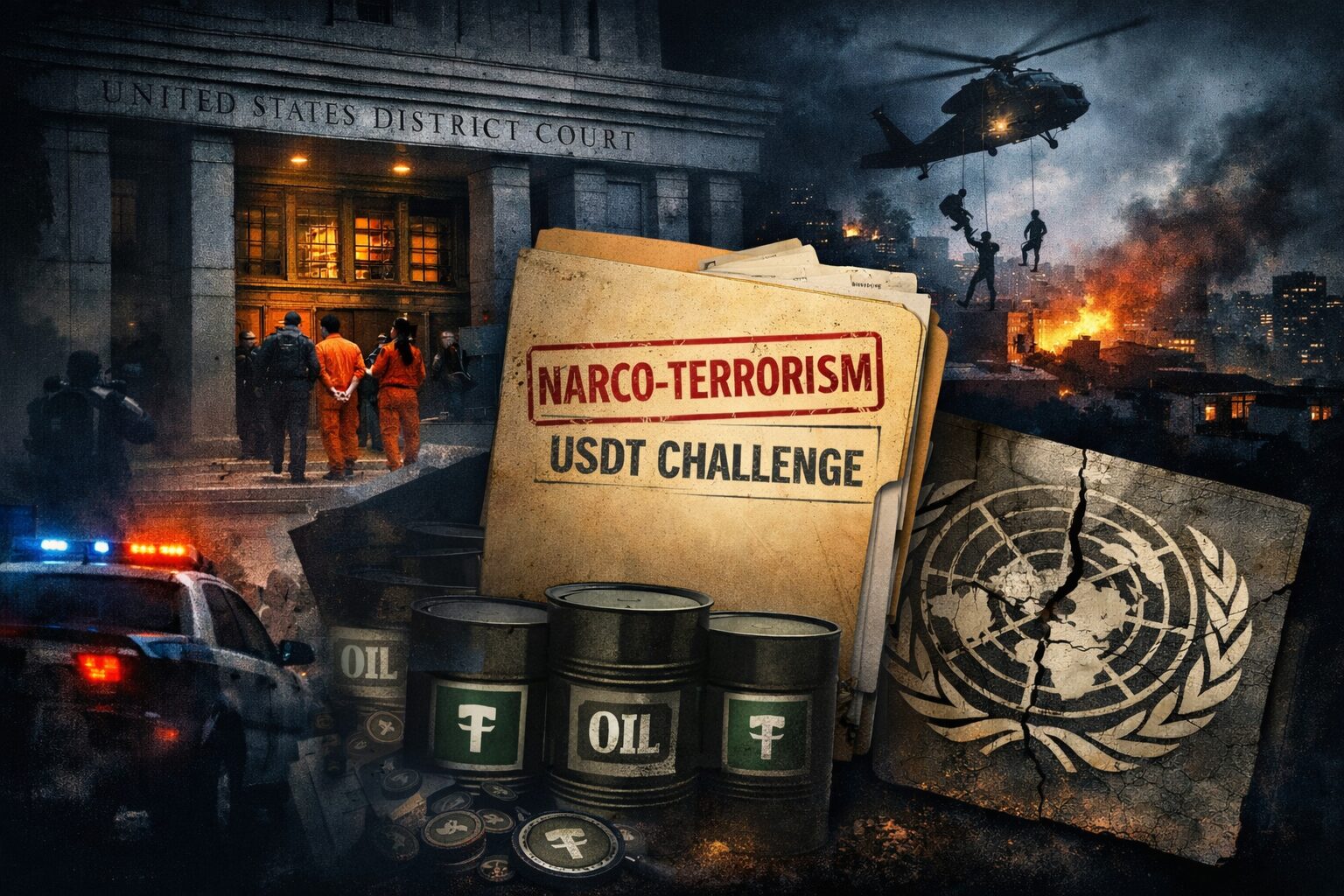
The U.S. has revived its 2020 “narco-terrorism” case against Venezuelan leader Nicolás Maduro—now in U.S. custody after a military operation in Caracas that Washington frames as law enforcement. But FinTelegram’s prior reporting suggests the courtroom story may be only half the plot: heavy crude, USDT settlement rails, and China’s oil foothold sit uncomfortably close to the timing, tactics, and messaging of this escalation.
Key Points
- The charges: U.S. prosecutors accuse Maduro (and others) of narco-terrorism and cocaine importation conspiracy (among further counts in filings) (Source: US DOJ)
- The operation: U.S. forces captured Maduro and Cilia Flores in Caracas on Jan 3; the administration publicly framed it as an anti-drug/anti-“narco-terror” campaign (Source: TIME).
- Oil reality check: U.S. Gulf Coast refineries were built for heavy grades like Venezuela’s; much U.S. shale output is lighter, which keeps imports structurally relevant (Source: U.S. Energy Information Administration).
- The stablecoin angle: PDVSA’s increased reliance on USDT for oil-related settlement was widely reported in 2024, raising sanctions-and-AML scrutiny questions (Source: Reuters).
- The China angle: Reuters has documented China as a major buyer/investor in Venezuela’s oil sector, and the post-Maduro reshuffle is explicitly being framed as a blow to Beijing’s position. Reuters+1
Short Narrative
This case didn’t start this week. It started in March 2020, when the DOJ unsealed charges portraying Maduro and allied officials as leaders of a transnational narcotics enterprise and paired the legal attack with a State Department rewards push (Source: US DOJ)
Fast-forward: sanctions, offshore trading workarounds, and a familiar dynamic—resource pressure meets financial-rail innovation. PDVSA’s move toward stablecoin settlement (USDT) for oil exports was reported in 2024 as a sanctions-era attempt to reduce funds getting stuck or frozen in traditional banking channels.
Then came the kinetic crescendo: a U.S. operation in early January that ended with Maduro and Flores in U.S. hands—an act many observers immediately framed as a sovereignty-shredding “law enforcement” hybrid. FinCrime Observer has focused on the criminal case mechanics; FinTelegram is looking at the political economy behind the trigger.
Extended Analysis
1) Heavy crude: the unglamorous driver Washington won’t headline
The U.S. produces a lot of oil—but not all barrels are operationally equal. The EIA has long noted that the U.S. produces lighter crude while importing heavier crude that many refineries are configured to process.
Reuters explicitly ties the post-Maduro shock to refinery economics: Gulf Coast plants were built for heavy-grade crude like Venezuela exports, and even with shale, many still “require heavy grades to optimise operations.”
So when commentators say “the U.S. needs Venezuelan oil because its own oil isn’t the right quality,” that’s not conspiracy—it’s refinery physics. The question is whether this physics helped shape the policy timeline.
2) “De-dollarization” via USDT: escaping banks, not the unit of account
Venezuela’s USDT pivot is often described as “moving away from the dollar.” The irony: USDT is a dollar proxy—but it can move outside the classic U.S.-influenced correspondent banking grid. Reuters reported PDVSA would increase digital-currency usage for oil exports amid sanctions churn, and experts warned that such rails require sharper AML scrutiny.
FinTelegram previously framed this as “petro-dollar from within”: not replacing USD pricing, but relocating the plumbing into crypto settlement paths that are harder to freeze, slower to attribute, and easier to launder through intermediaries (Source: FinTelegram).
If that analysis is directionally correct, then Maduro’s legal exposure and PDVSA’s stablecoin rails are not separate stories—they are the same chokepoint story, just told with different labels.
3) China: the other defendant sitting in the gallery
Reuters describes China as a major buyer and investor in Venezuela’s oil sector and presents the recent U.S. posture as explicitly aimed at pushing Beijing out of its foothold.
This matters because Washington’s messaging around the operation has not been only about drugs; it has repeatedly drifted into oil control and “running” transitions.
So here’s the provocative question regulators and investors should ask: Was the “narco-terrorism” indictment the legal lever—and oil/USDT/China the strategic payload? The U.S. can insist both are true. Courts may be asked to decide whether that insistence survives due-process scrutiny.
Call for Information
Have documentation on PDVSA’s USDT settlement flows, intermediary trading desks, shipping/STS activity, escrow structures, or legal filings tied to the Maduro/Flores case? Submit securely via Whistle42.com. We verify sources before publication.