

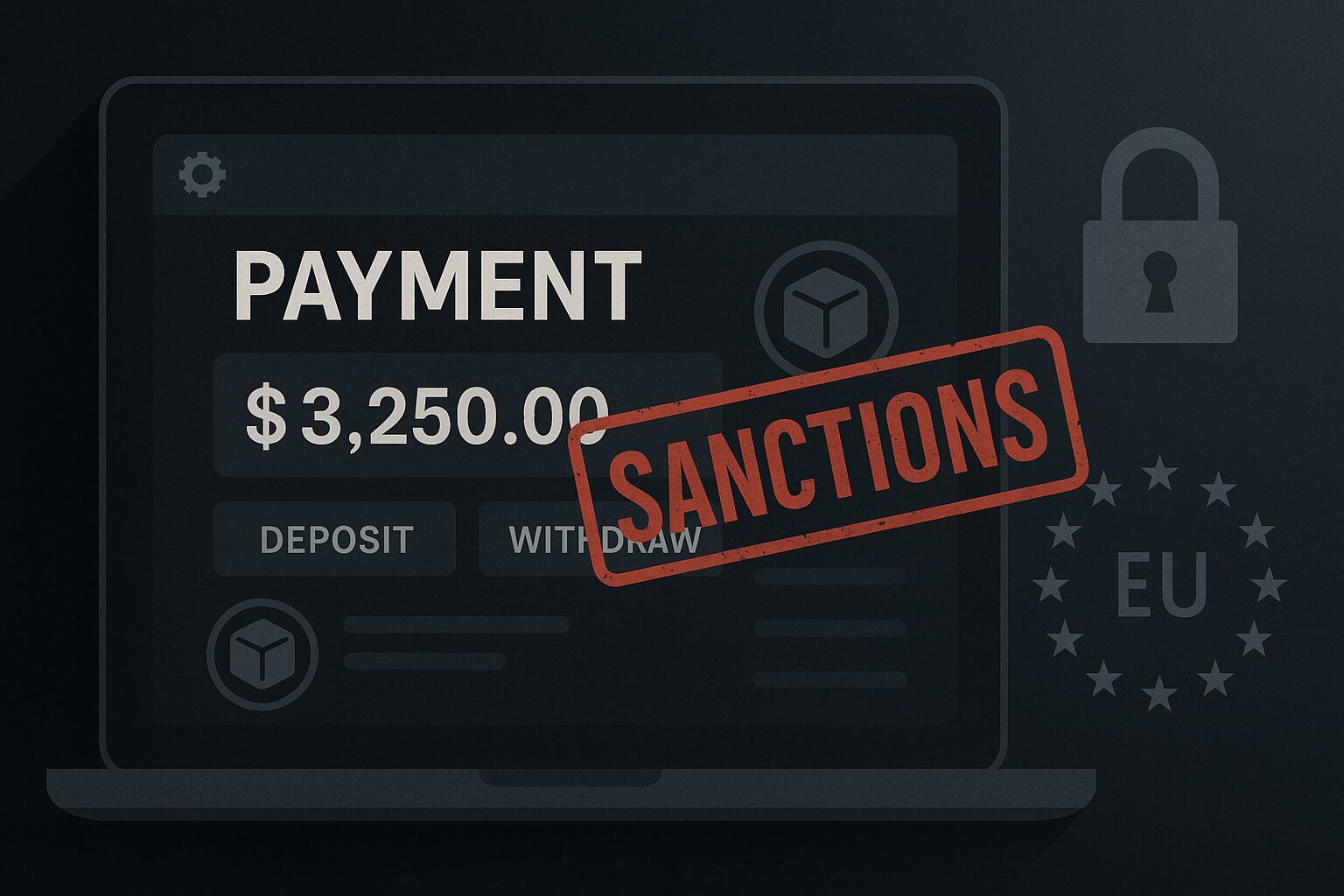
The Russian-linked payment processor Payeer is now formally hit by an EU transaction ban—a move that, in practice, cuts off payment rails and counterparties across Europe. While Payeer blames sanctions-driven partner blocks and has announced shutdown timelines, FinTelegram continues to receive whistleblower complaints about frozen accounts and unpaid balances. The key question is no longer “is Payeer high-risk?”—but who is still exposed, and where the trapped funds actually sit.
Key Points
- EU transaction ban: Payeer is added to Annex XLV (Part A) with entry into force on 25 November 2025, prohibiting EU persons/entities from engaging in transactions with Payeer (Source: Альта-Софт
- Payeer’s wind-down messaging: Payeer first said it would discontinue services for EU/Russia users with withdrawals until 24 November 2025, then later announced a broader shutdown and urged users globally to withdraw funds until 05 January 2026 (Source: PAYEER).
- “Partners blocked our accounts” claim: Payeer states “key partners” blocked Payeer accounts—some allegedly together with users’ assets—raising urgent questions about where funds are custody-held and under which legal entity (Source: PAYEER).
- Prior enforcement signal: Lithuania’s FCIS (FNTT) imposed a record fine (~€9.3m) on Payeer UAB for sanctions and AML/CFT breaches—well before the EU-wide transaction ban (Source: FNTT).
- Long-running opacity concerns: FinTelegram has documented Payeer’s Russian-linked control history and repeated jurisdiction/entity shifts as a recurring risk pattern (Source: FinTelegram).
Short Narrative
Payeer’s current situation looks like a classic “compliance endgame”: regulators escalate, counterparties de-risk, and users discover that the platform they treated as a functional wallet is, in reality, a counterparty risk—especially once sanctions bite.
The EU’s 19th Russia sanctions package introduced a transaction ban tool and explicitly added Payeer to the targeted list with an effective date of 25 November 2025. In parallel, Payeer publicly communicated withdrawal windows (EU/RU until 24 Nov 2025) and later a broader shutdown timeline (withdraw until 05 Jan 2026, then “support only”).
Extended Analysis
1) The transaction ban is operationally devastating (even without an “asset freeze” label).
For EU counterparties—banks, PSPs, CASPs, merchants, vendors—“transaction ban” effectively means: stop touching it. Once enforcement dates hit, legitimate off-ramps and settlement partners disappear fast.
2) The EU also tightened the net around rebrands and “successor” setups.
The amended framework explicitly extends the prohibition to actors operating on behalf of a listed entity and introduces criteria for “mirror or successor” entities (e.g., continuity of branding/UI, overlapping control, infrastructure continuity, user migration). That matters in ecosystems where payment/crypto services can reappear under fresh wrappers.
3) The Lithuania case was the early red flag—customers ignored it at their peril.
Lithuania’s FCIS (FNTT) penalty against Payeer UAB (sanctions + AML/CFT failings) was already a strong supervisory signal that Payeer’s controls and governance were not where a high-volume payment/crypto platform should be.
4) Why the whistleblower complaints matter now.
FinTelegram has received multiple reports describing frozen accounts, delayed withdrawals, and unpaid balances—a pattern that becomes especially critical when the platform itself states that partners blocked accounts and that some user assets may be locked at third parties.
That turns the real question into a tracing exercise: Which entity contracted with the user, which partner custodied the funds, and under what jurisdiction can recovery even be pursued?
Key Data Table
| Trading name | Payeer |
| Business activity | high-risk payment processor, crypto exchange, merchant service prodiver |
| Domain | https://payeer.com https://payeer.cc |
| Legal entities | Payeer E.A.S. (Paraguay) Payeer OÜ (Estonia) Payeer UAB (Lithuania) PayCorp Limited (Vanuatu) Fincana OÜ (Estonia) Runwill Sp. z o. o. (Poland) PAYEER LLC (Georgia) FINGATE LLC (Georgia) AKKORD WELT LP (Scotland) Worldwide System K/S (Denmark) Mayzus Financial Services Ltd (UK) PAYMENT SOLUTIONS LTD (BVI) PAYEER RUS LLC (Russia) PB24 CORP (Panama) |
| Related individuals | Anton Stjopotškin, Estonia (UBO) Joseph Olatilewa Jaiyeola, Estonia Ekaterina Olegovna Gorshkova, Russia Liubov Svezhentseva, Russia Kosolapova Evgenia Nikolaevna, Russia Elena Kulbikova, Russia Sergey Mayzus, Russia Dmitri Allikas (old) Stanislav Lattu (old) |
| Jurisdictions | Estonia, Vanuatu, Russia, BVI, Poland, Panama, Georgia, Denmark |
| Regulators | FCIS (Financial Crime Investigation Service) Lithuania VFSC |
| Trustpilot rating | 4.6-star rating with an “Excellent” trust level |
| Facilitated schemes | PO Trade, Pocket Option, Capital Letter, FXTradePremiums, Deal Trade Optimus Markets, Spintop Capital, SuperForex and counting |
Call for Information
FinTelegram is actively collecting evidence-grade information on Payeer’s current operations and the fate of customer funds. If you are a client, merchant, banking/PSP partner, exchange/CASP partner, affiliate, or insider, please submit information via Whistle42 (anonymity-supported).