



Executive Summary
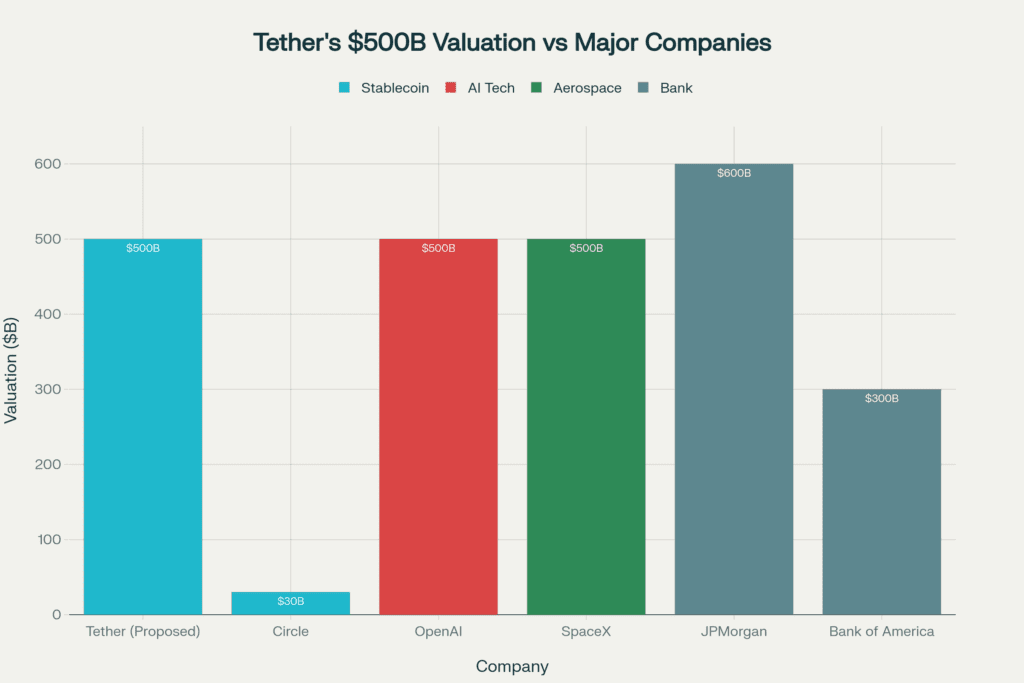
Tether Holdings SA, the world’s largest stablecoin issuer, is pursuing an unprecedented $15-20 billion capital raise at a $500 billion valuation—positioning itself among the world’s most valuable private companies alongside OpenAI and SpaceX. This ambitious fundraising represents far more than corporate expansion; it signals the maturation of stablecoins from cryptocurrency infrastructure into mainstream financial pillars, with profound implications for monetary policy, banking competition, and the ongoing “stablecoin hype” that some analysts warn could represent bubble territory.
Key Financial Metrics Summary
| Metric | Current Status | Industry Context | Strategic Implications |
|---|---|---|---|
| Proposed Valuation | $500 billion | Rivals OpenAI, SpaceX | 40x increase from 2024 Cantor deal |
| Fundraise Target | $15-20 billion | 3% equity stake | No secondary sales, pure growth capital |
| USDT Market Cap | $172 billion | 56% of stablecoin market | Dominant market position |
| Q2 2025 Profit | $4.9 billion | 99% profit margins | Superior to major banks |
| Reserve Base | $162.5 billion | Exceeds liabilities by $5.4B | Strongest balance sheet in crypto |
| Advisory Firm | Cantor Fitzgerald | Wall Street validation | Political connections via Howard Lutnick |
Tether’s $500B Valuation: Stablecoin Market Context and Growth Projections
The Strategic Context: Stablecoin Market Transformation
Market Size and Growth Projections
The stablecoin sector has experienced explosive growth, expanding from approximately $200 billion at the start of 2025 to $280 billion as of September. Citi has revised its 2030 forecasts upward to $1.9 trillion in the base case and $4 trillion in the bull scenario, reflecting blockchain’s “ChatGPT moment” for institutional adoption.
This growth trajectory represents a fundamental shift in how digital assets integrate with traditional finance. As Citi analysts note, stablecoins could support $100-200 trillion in annual transactions by 2030, comparable to traditional payment rails.
Competitive Landscape Analysis
Tether’s dominance becomes stark when viewed against competitors:
- Tether (USDT): $172 billion market cap, 56% market share
- Circle (USDC): $74 billion market cap, 25% market share
- Other issuers: Remaining 19% fragmented across multiple players
Circle’s public valuation of approximately $30 billion makes Tether’s $500 billion target particularly audacious—representing a 16.7x premium over its closest competitor.
Traditional Banking Enters the Stablecoin Arena
Major Bank Initiatives
The traditional banking sector is rapidly mobilizing around stablecoins, signaling institutional validation of the asset class:
US Banking Consortium: JPMorgan Chase, Bank of America, Citigroup, and Wells Fargo are in preliminary discussions to launch a joint stablecoin initiative, contingent on the GENIUS Act providing regulatory clarity.
European Banking Alliance: A nine-bank consortium, including ING, UniCredit, Banco Santander, and CaixaBank announced plans for a euro-denominated stablecoin launch in H2 2026, targeting the underserved European market where euro stablecoins represent less than 1% of total stablecoin circulation.
Individual Bank Strategies:
- JPMorgan: CEO Jamie Dimon confirmed plans to “be involved in stablecoins,” building on their existing JPM Coin infrastructure that processes $2 billion daily
- Citigroup: CEO Jane Fraser announced evaluation of a “Citi stablecoin” alongside tokenized deposit initiatives
- Banking Circle: Already issued EURI, a MiCA-compliant stablecoin for B2B payments
The Banking Advantage
Traditional banks entering stablecoin issuance possess several competitive advantages:
- Regulatory Infrastructure: Existing compliance frameworks and supervisory relationships
- Customer Relationships: Established corporate and institutional client bases
- Capital Resources: Access to traditional funding markets and Federal Reserve facilities
- Trust Factor: FDIC backing and century-old brand recognition
However, banks also face constraints that crypto-native issuers like Tether avoid:
- Regulatory Restrictions: Limited ability to invest reserves in higher-yield assets
- Legacy Systems: Integration challenges with existing banking infrastructure
- Compliance Costs: Higher operational overhead from traditional banking regulations
Macroeconomic Implications and Systemic Risks
The Interest Rate Dependency Model
Tether’s extraordinary profitability stems from a simple but powerful model: collecting customer dollars and investing them in US Treasury bills. With $162.5 billion in reserves earning approximately 4-5% annually, Tether generates $6.5-8.1 billion in annual interest income with minimal operational costs.
This model’s sensitivity to interest rate cycles creates both opportunity and risk:
- Rising Rates: Enhanced profitability (current beneficiary of 4.75% Fed rates)
- Falling Rates: Compressed margins (risk if rates return to zero-bound)
- Yield Curve Inversion: Potential liquidity management challenges
“Too Big to Fail” Implications
At $500 billion valuation and $172 billion in circulation, Tether approaches systemically important financial institution (SIFI) status. The company now holds Treasury bills comparable to some sovereign wealth funds, creating unprecedented monetary policy implications:
- US Treasury Demand: Stablecoin growth generates automatic demand for short-term government debt
- Liquidity Risk: Mass redemptions could force Treasury sales, impacting government borrowing costs
- Dollarization Effects: USDT adoption abroad strengthens dollar dominance globally
The Stablecoin Hype: Bubble or Breakthrough?
Bubble Warning Signals
Several factors suggest caution about stablecoin market valuations:
- Speculative Excess: Reddit analysis warns of a “stablecoin trap” where Treasury backing creates “self-reinforcing cycles” that could destabilize both crypto and sovereign debt markets.
- Valuation Disconnects: Tether’s proposed 68x price-to-earnings ratio, while justified by growth prospects, exceeds most technology companies.
- Regulatory Dependency: The entire sector’s growth narrative depends on favorable regulatory outcomes, particularly the GENIUS Act passage in the US.
Fundamental Strengths
Conversely, structural factors support continued stablecoin expansion:
- Real Utility: Unlike speculative cryptocurrencies, stablecoins solve actual payment and settlement problems.
- Institutional Adoption: McKinsey reports stablecoins are becoming “mainstream infrastructure priority” with 49% of financial institutions already using them.
- Regulatory Clarity: MiCA in Europe and pending US legislation provide frameworks for compliant growth.
Strategic Implications of Tether’s Fundraising
Capital Deployment Strategy
CEO Paolo Ardoino outlined expansion plans beyond stablecoins into:
- Artificial Intelligence: Competing with OpenAI in AI infrastructure
- Commodity Trading: Leveraging reserve management expertise
- Energy Sector: Bitcoin mining and renewable energy projects
- Communications: Potential telecommunications infrastructure
- Media Operations: Content and platform investments
This diversification strategy reduces dependence on stablecoin revenues while leveraging Tether’s massive cash position for growth investments.
Geopolitical Positioning
Tether‘s relocation to El Salvador and partnerships with crypto-friendly jurisdictions position the company as a global financial infrastructure provider independent of any single regulatory regime. This geographic arbitrage provides operational flexibility while maintaining US dollar backing.
Most Likely Scenarios
Successful Fundraising (Probability: Moderate-High)
If Tether closes at or near the $500 billion valuation:
- Market Validation: Legitimizes stablecoins as permanent financial infrastructure
- Competitive Pressure: Forces traditional banks to accelerate stablecoin initiatives
- Regulatory Attention: Increases government focus on systemically important crypto firms
- Innovation Acceleration: Provides capital for expansion beyond payment rails
Valuation Compression (Probability: Moderate)
Market conditions or investor skepticism could reduce final valuation to $200-300 billion:
- Still Transformational: Even at lower valuations, represents massive crypto industry milestone
- Precedent Setting: Establishes stablecoin issuers as legitimate fintech giants
- Banking Competition: Traditional bank stablecoin initiatives gain relative attractiveness
Deal Failure (Probability: Low)
Regulatory concerns or market conditions could derail the fundraising:
- Sector Cooling: Would suggest stablecoin growth has peaked
- Banking Advantage: Traditional bank initiatives would gain competitive positioning
- Regulatory Uncertainty: Could delay broader institutional crypto adoption
Conclusion and Market Outlook
Tether’s $500 billion valuation bid represents a watershed moment for stablecoins and crypto integration with traditional finance. The proposed fundraising occurs at the intersection of favorable regulatory developments, institutional adoption acceleration, and growing recognition of stablecoins’ utility in global payments infrastructure.
While bubble concerns merit attention—particularly given the sector’s rapid growth and regulatory dependencies—the fundamental utility of stablecoins in solving real payment problems suggests sustainable demand beyond speculative cycles.
The success or failure of this fundraising will establish important precedents for crypto company valuations, regulatory approaches, and the competitive dynamics between crypto-native and traditional financial institutions in the evolving digital asset ecosystem.
Call for Insider Information
FinTelegram seeks confidential information regarding Tether’s fundraising activities and the broader stablecoin sector through our secure whistleblower platform Whistle42.com.