



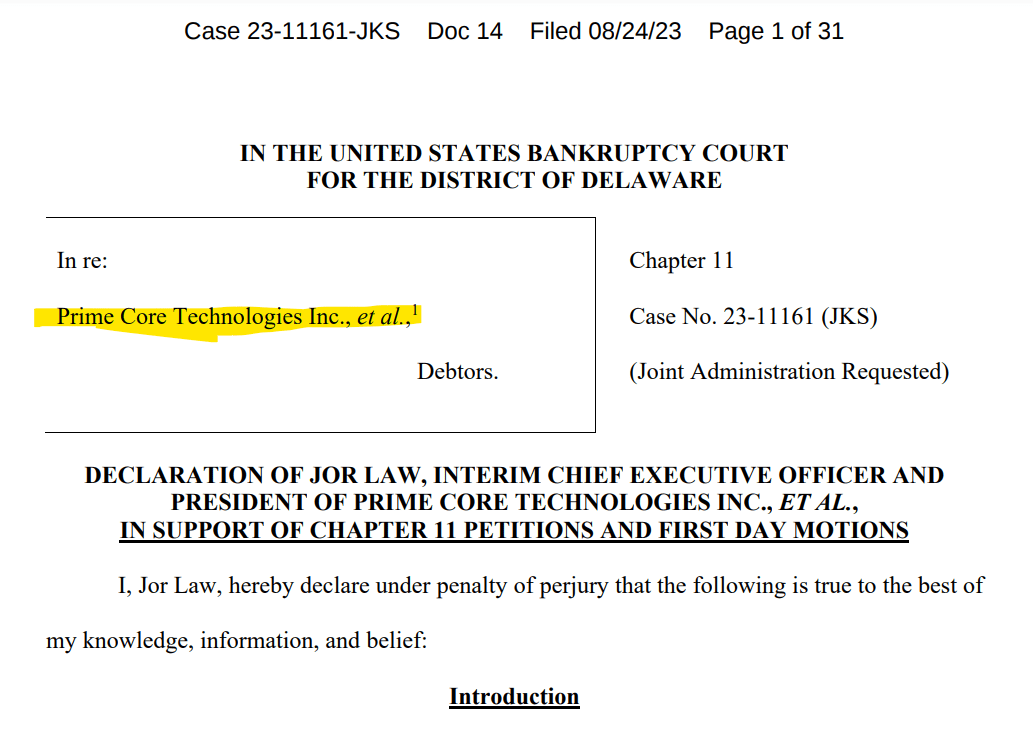
In a remarkable series of events that underscores the evolving legal challenges of the digital age, crypto firm Prime Trust has found itself facing bankruptcy following an incident involving the loss of access to a crypto wallet containing $38.9 million. This situation has stirred debates and discussions in the crypto industry and again raised questions about the efficient regulatory supervision of crypto companies. Here is a short analysis of the Prime Trust Case.
1. The Prime Trust Incident:
Based on media reports (see Decrypt and 404media), Prime Trust lost access to its crypto wallet due to a forgotten or misplaced password. In traditional banking, the loss of a password might be easily remedied through various verification processes. However, with the irreversible nature of blockchain transactions and the high emphasis on security and privacy, a lost password can be catastrophic.
1.1 The Wallet Event

The wallet in question contains assets worth $38.9 million, and the inability to access this significant sum has driven Prime Trust into financial turmoil, eventually leading to its bankruptcy filing. This so-called Wallet Event was described in great detail in the sworn affidavit of the company’s interim CEO, Jor Law. It was one of but not the only key issues that resulted in the bankruptcy.
1.2 Market Implosion And Overspending,
In 2022, Prime Trust was hit by the Terra-LUNA collapse in May 2022, resulting in the malfunction of Terra’s UST stablecoin and the LUNA governance token. Prime Trust had invested $6 million of client assets and an additional $2 million from its corporate reserves into Terra.
Despite the collapsing crypto market in 2022 in the Terra-Luna aftermath, the management team failed to change course and reduce operating costs. Instead, the company’s previous executive would have doubled down on spending at a time when revenues were strained.
According to Law, Prime Trust spent about $10.5 million in October 2022 against revenues of about $3.1 million, resulting in a net loss of over $7 million. A month later, the spending rose again to $11.1 million, costing another net loss of about $8.4 million.
Finally, the Wallet Event, a notably severe misstep wherein the firm inadvertently denied itself access to its proprietary cryptocurrency storage, collapsed the company.
2. Legal and Regulatory Angles:
- Asset Recovery and Liability: Typically, when assets are lost or misappropriated, there’s a legal framework for recovery or compensation. In the realm of crypto assets, however, this becomes complex. The decentralized and pseudonymous nature of cryptocurrencies makes the recovery process intricate. It also raises questions about who bears the responsibility for the loss. Is it the firm for not having adequate backup procedures? Or the technology providers for potentially not offering recovery solutions?
- Fiduciary Duty: If Prime Trust held funds on behalf of clients or was managing these assets for investors, there’s a potential breach of fiduciary duty. Financial entities are typically expected to maintain strict security protocols and backup systems. Failing to safeguard client assets, even due to a technological oversight like a lost password, could be seen as a breach of this duty.
- Regulatory Implications: The case highlights a gap in the regulatory landscape concerning the management and safeguarding of crypto assets. Regulatory bodies might feel the pressure to review and enhance guidelines related to crypto asset custody, backup procedures, and recovery solutions. This incident may serve as a precedent, encouraging regulatory bodies to take a closer look at how crypto firms handle and secure assets.
- Bankruptcy Proceedings: In traditional bankruptcy scenarios, assets and liabilities are assessed, and a plan is devised to repay creditors. Given that a substantial chunk of Prime Trust’s assets is locked away in an inaccessible crypto wallet, it poses unique challenges. How will the assets be valued? How will creditors be repaid if the wallet remains inaccessible?
3. Conclusion
The Prime Trust incident underscores the urgent need for a comprehensive legal framework that addresses the unique challenges posed by digital assets. It serves as a reminder of the vulnerability of even the most technologically advanced systems and the importance of rigorous security and backup measures. As the legal community grapples with this case, it is likely to set precedents and shape the future of crypto asset regulation and liability.




interesting news.
ADVCASH was washing US funds through them
account number at primetrust : 420034636473