

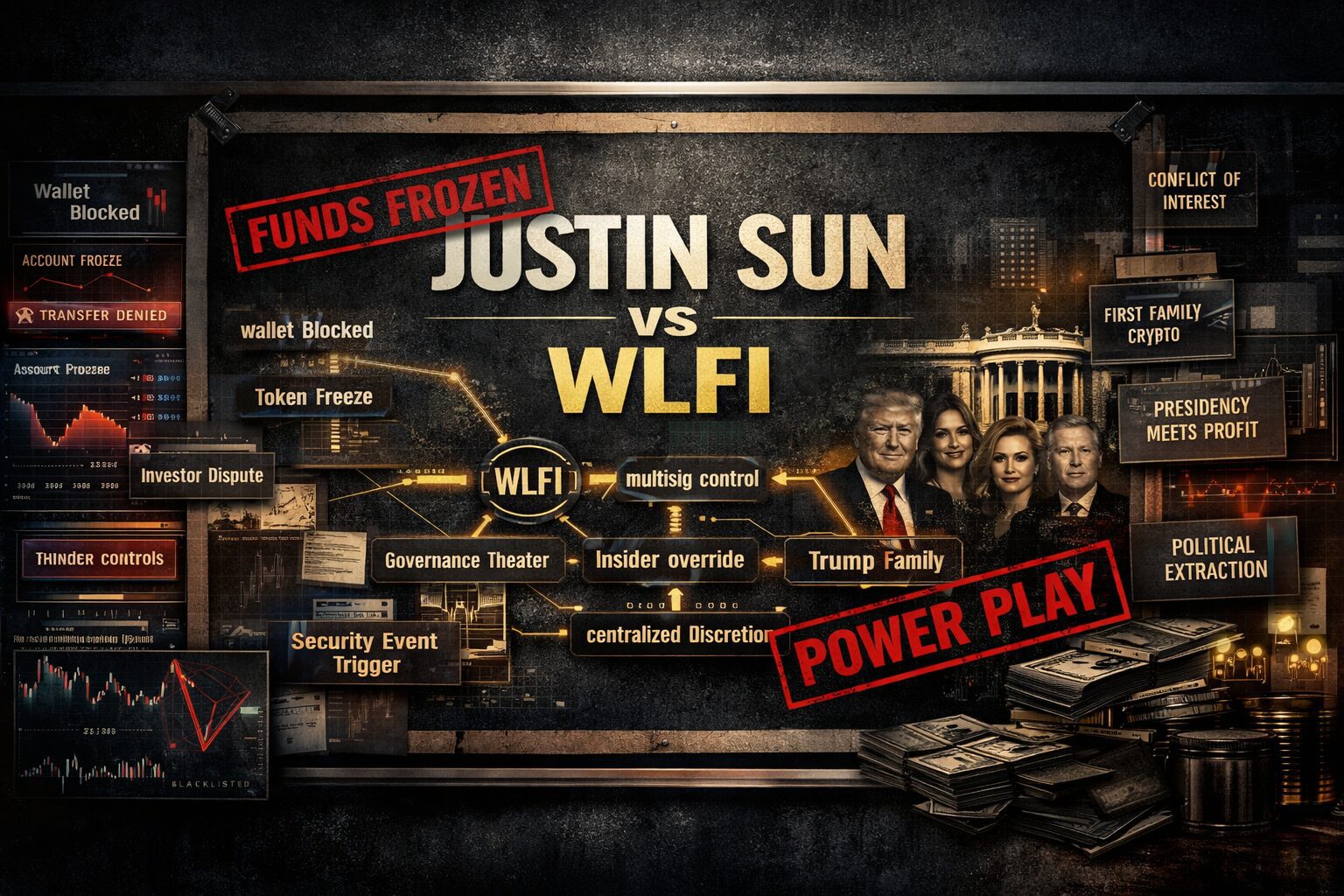
The public rupture between TRON founder Justin Sun and the Trump family’s World Liberty Financial (WLFI) is not just another crypto feud. It is a stress test for one of the most politically charged projects in the digital asset sector. What is now emerging is a deeply uncomfortable picture: a project sold under the banner of DeFi appears to have preserved powerful insider controls, including the ability to freeze or block token holders under certain conditions.
That alone would be serious. But in the case of WLFI, the compliance and governance concerns collide with something even bigger: the growing perception that the Trump family is using its presidency-adjacent power to build a fortune in crypto through centralized, insider-favoring structures dressed up as innovation. If Justin Sun, one of crypto’s most aggressive operators, has indeed found himself trapped by the very political machine he sought to support, then this dispute may become more than an internal scandal. It could become a credibility crisis for Trump-linked crypto itself.
Key Findings
- The Justin Sun dispute is a governance stress test. Sun’s allegation that WLFI froze or blocked his position raises direct questions about hidden control mechanisms and insider discretion.
- Sun publicly accuses WLFI of hiding a blacklist/backdoor function. The token contract allegedly allows the team to freeze investor wallets and seize or control locked allocations without transparent, on‑chain governance.
- WLFI appears far less decentralized than the branding suggests. The project structure points to administrative control concentrated in selected multisigs and insiders rather than a trustless community-governed system.
- This is not just a token dispute. It is a credibility event that goes to the heart of what investors were actually buying: governance rights or governance theater.
- The Trump family dimension makes the case politically explosive. WLFI is not just another crypto project. It sits at the intersection of family power, presidential prestige, and direct private monetization.
- Justin Sun’s role adds an extraordinary layer of irony. A figure known for navigating regulatory gray zones now appears to be facing a freeze or lockout inside a politically connected crypto vehicle.
- The broader crypto industry may not turn on Trump, but it may turn on Trump-linked token projects. The dispute could accelerate a distinction between support for pro-crypto policy and skepticism toward Trump-family crypto ventures.
Analysis: A DeFi Project With a Presidential Kill Switch
Not DeFi. A Trump Family Toll Booth.
World Liberty Financial looks less like a DeFi protocol and more like a private toll booth run for the benefit of the First Family.
That is the real story.
The issue is not innovation. The issue is extraction. WLFI appears structured to channel value, attention, and liquidity into a politically branded insider vehicle. In substance, it looks less like decentralized finance and more like centralized monetization wrapped in crypto marketing.
The Justin Sun Clash Is a Stress Test
The conflict with Justin Sun is not just another billionaire crypto quarrel. It is a stress test for WLFI’s true nature.
Sun’s allegation is explosive: his position was effectively frozen through wallet-control functionality. FinTelegram cannot independently verify every technical claim on the basis of current public reporting alone.
But one thing is already obvious from WLFI’s own materials: this was never genuine, trustless, community-controlled DeFi.
The paperwork points in a different direction. Administrative control sits with selected multisigs. Insider discretion is built in. Governance can snap back into centrally controlled hands whenever management invokes security or adverse-event logic.
That is not decentralization.
That is a kill switch with branding.
Governance Theater, Real Insider Power
WLFI was sold into a market that worships the mythology of decentralization.
Community. Governance. Token-holder participation. Open protocol logic.
But when the biggest outside backer says the doors can be locked from the inside, the theater falls apart.
Then the real question emerges: were investors buying governance, or just the illusion of governance?
If insiders can override the system when it matters, then token holders were never really in charge. They were spectators. Useful ones.
This is why the Sun dispute is not just personal fallout. It is a credibility event for the project itself.
The Presidency as a Crypto Profit Engine
The political dimension makes the case even more toxic.
The Trump family is not merely cheering on crypto from the sidelines. It appears to be using the presidency-adjacent power environment as a wealth-extraction machine inside the sector.
That is the extraordinary inversion here.
The family of the sitting U.S. president is not only benefiting politically from a pro-crypto climate. It is also monetizing that climate through a project critics describe as centralized, insider-favoring, and conflict-heavy.
This is not just bad optics.
It is a case study in how political power, family branding, and crypto speculation can be fused into one single revenue engine.
Justin Sun Gets Rugged by the Wrong People
There is also a brutal irony in Justin Sun’s position.
Sun built his career on surviving gray zones, outmaneuvering regulators, and navigating the global crypto perimeter with extraordinary flexibility.
And now?
He appears to have collided with an even harder reality: a crypto project linked to presidential power.
If the allegations are correct, Sun was not outplayed by the market. He was outplayed by the political machine he chose to back.
That is what gives this case its nasty edge.
The man long accused of gaming systems now appears to be trapped in one. And this one allegedly comes with a multisig-controlled loyalty test: stay aligned, or watch your liquidity disappear.
That would not be DeFi.
That would be digital patronage.
Could This Hurt Trump with Crypto?
Yes, but only up to a point.
The broader crypto industry will likely remain aligned with Trump’s general political value proposition: lighter regulation, friendlier rhetoric, and less hostility from Washington.
That relationship is bigger than WLFI.
But this dispute can still do real damage where it matters most: trust.
Not trust in Trump as a pro-crypto political figure.
Trust in Trump-linked crypto products as credible investable structures.
That distinction matters.
Serious investors, institutions, and governance-sensitive market participants may increasingly separate pro-crypto Washington from Trump family token schemes. If that separation widens, WLFI stops looking like a flagship of mainstream crypto acceptance.
It starts looking like a warning.
Conclusion
The Sun-WLFI clash is not just messy.
It is revealing.
It exposes the contradiction at the heart of Trump-branded crypto: the language of decentralization wrapped around a structure that appears centralized, politically charged, and optimized for insiders.
WLFI may still attract speculators. Trump may still retain broad support across parts of the crypto industry because of his political posture. But that does not save Trump-linked crypto ventures from scrutiny.
On the contrary, this affair sharpens the divide between political support for crypto and trust in projects tied directly to the Trump family.
For anyone looking seriously at governance, compliance, and control risk, the message is dark and simple: this is not crypto liberation. This is crypto court politics.
And Justin Sun may just have learned that, in Trump-world finance, access is never the same thing as protection.
Whistle42 Call
FinTelegram invites whistleblowers, insiders, former employees, developers, token holders, service providers, compliance professionals, and counterparties with direct knowledge of WLFI governance, wallet-control mechanisms, token freezes, treasury structures, investor communications, or Justin Sun’s dealings with the project to submit information securely through the Whistle42 whistleblower system.
If you have evidence, internal documents, screenshots, smart-contract details, governance records, or communications relevant to this case, please reach out. Confidential sources can help determine whether this is merely a governance dispute, a deception around decentralization, or something even more serious.