

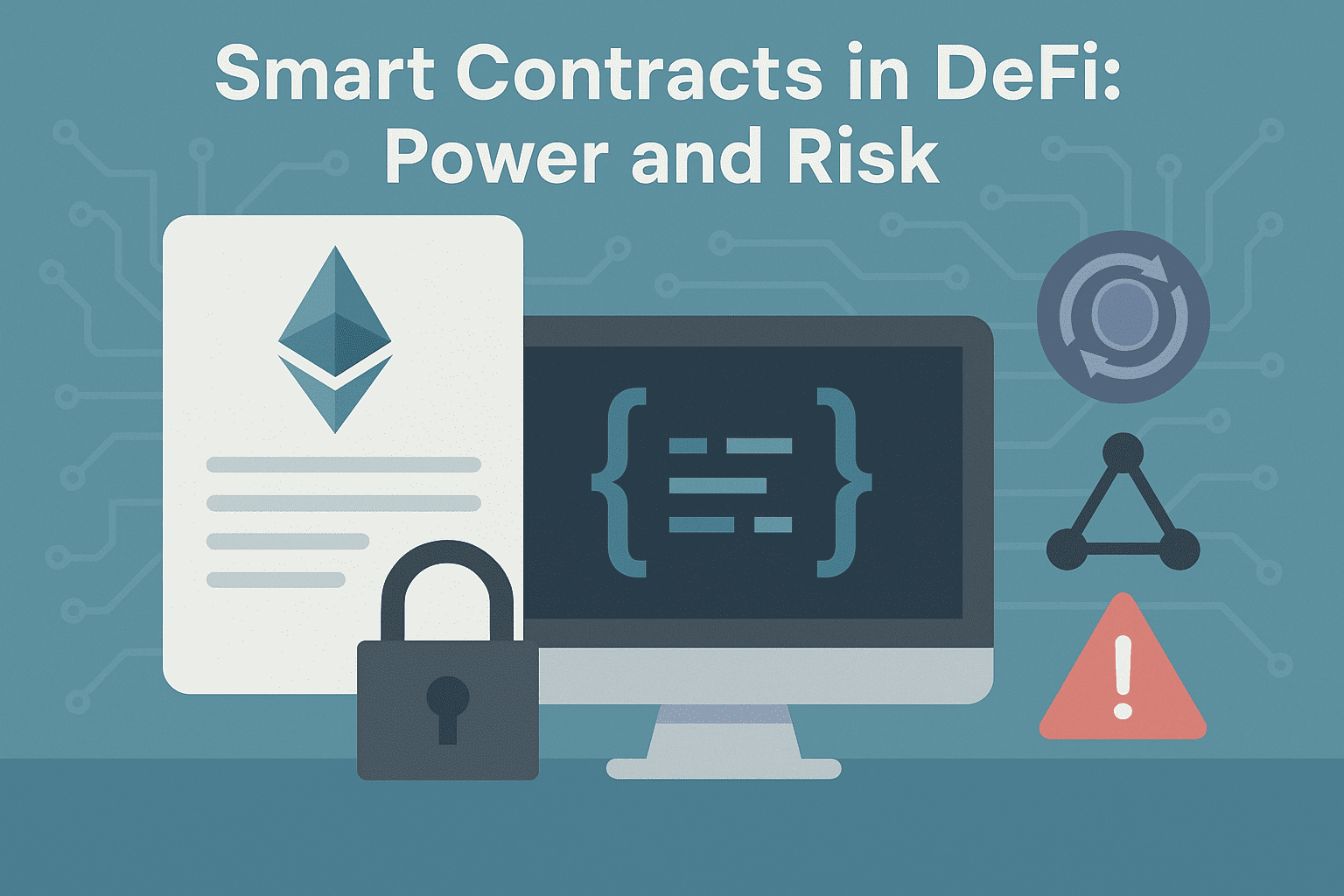
Smart contracts are the invisible architects of decentralized finance. These self-executing lines of code run everything from token swaps to lending platforms without middlemen. But while they offer autonomy, they also introduce new risks—bugs, exploits, and irreversible mistakes. In this fourth installment of our FinTelegram DeFi Series, we explain what smart contracts are, how they work, and what users and investors must understand to navigate DeFi safely.
Key Points:
- A smart contract is a self-executing digital agreement, written as computer code and stored on a blockchain.
- They eliminate intermediaries but cannot be changed once deployed—making security critical.
- Many DeFi exploits stem from flaws in smart contract logic.
- Audits help, but even audited contracts have been hacked.
- Popular DeFi platforms like Uniswap, Aave, and Compound are entirely run by smart contracts.
Short Narrative:
Smart contracts are to DeFi what servers are to the web: the silent operators in the background. First introduced with Ethereum in 2015, smart contracts allow developers to write autonomous programs that execute automatically when conditions are met—no banks, brokers, or notaries required. It automatically enforces and executes the terms of an agreement when predetermined conditions are met, without the need for intermediaries or manual intervention.
How Smart Contracts Work
- Code-Based Logic: Smart contracts use “if/when…then…” logic. For example, “If payment is received, then transfer ownership.”
- Blockchain Storage: The contract code and its execution are stored and recorded on a blockchain, ensuring transparency, security, and immutability.
- Automation: When the contract’s conditions are fulfilled, the programmed actions (such as transferring funds or issuing a digital asset) are executed automatically.
- No Intermediary: This process eliminates the need for third-party oversight, reducing costs and speeding up transactions.
For example:
- On Aave, a user deposits ETH. A smart contract instantly records the deposit and issues aToken interest-bearing receipts.
- On Uniswap, a trader swaps USDC for DAI. A contract handles the trade based on a liquidity pool’s current ratio.
The catch? If the contract is flawed, funds can be stolen or lost.
🛠️ Anatomy of a Smart Contract:
- Immutable – Can’t be changed after deployment.
- Transparent – Code is usually visible to anyone.
- Deterministic – Always behaves the same under the same inputs.
- Autonomous – No human intervention after launch.
Smart contracts power every major function in DeFi:
- Swaps (Uniswap, Sushi)
- Lending (Aave, Compound)
- Derivatives (Synthetix, dYdX)
- DAOs (Maker, Curve)
- Yield Farms (Yearn, Pendle)
Common Risks:
- Reentrancy Bugs – Allow attackers to exploit contract logic and drain funds (e.g., The DAO hack 2016).
- Unchecked Access Control – Poor permission structures lead to admin takeovers.
- Oracle Manipulation – If the contract relies on external price data, it’s vulnerable to manipulation.
- Flash Loan Exploits – Instant uncollateralized loans used to manipulate on-chain behavior.
Key Concepts Introduced:
- Smart Contract
- Immutability
- Reentrancy
- Audit
- Flash Loan
Notable Cases:
- The DAO Hack (2016): ~$60M stolen due to a reentrancy bug.
- bZx Protocol (2020): Multiple flash loan exploits, ~$8M lost.
- Poly Network (2021): ~$600M stolen and then returned by the hacker.
These cases show that code is law—but law can be flawed.
Actionable Insight for Readers:
- Always check if a protocol’s smart contracts are audited—by reputable firms like Trail of Bits, Certik, or OpenZeppelin.
- Read the audit reports—don’t just trust the badge.
- Be cautious with new contracts or unaudited forks.
Remember: “DeFi is open source—but so is the attack surface.”
Call for Information:
Are you aware of smart contract backdoors, unaudited clones, or rug-pull-ready vaults?
👉 Report anonymously at Whistle42.com and earn $TCO for qualified disclosures.