


The U.S. Supreme Court has unanimously upheld the SEC’s authority to seek disgorgement of illegal profits even where the agency cannot prove a concrete financial loss for specific investors. The ruling preserves a core enforcement remedy and materially increases litigation and settlement exposure for securities violators, including high-risk brokers, microcap operators, and crypto-related issuers touching the U.S. market.
1-Minute Briefing
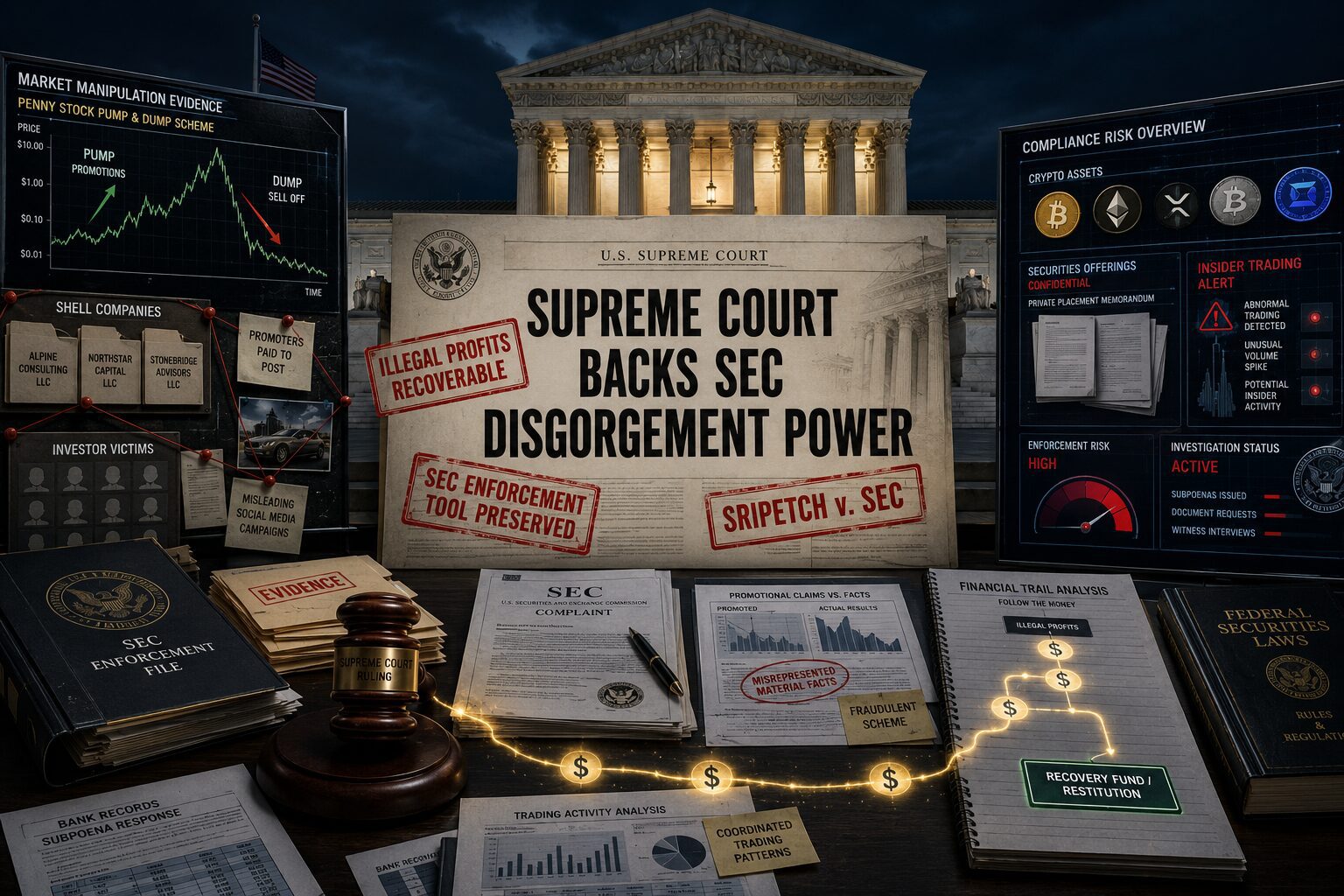
The U.S. Supreme Court has handed the Securities and Exchange Commission (SEC) a significant enforcement victory. In Sripetch v. SEC, the Court unanimously held that the SEC does not have to prove that investors suffered a measurable financial loss before seeking disgorgement of illegal profits from securities-law violators.
The decision preserves one of the SEC’s most important financial remedies: forcing wrongdoers to surrender gains obtained through fraud or unlawful securities activity. For regulated firms, promoters, crypto operators, and capital-market intermediaries, the ruling confirms a simple enforcement principle: illegal profits remain recoverable even where victim losses are difficult to quantify.
The Case
The case involved Ongkaruck Sripetch, who was accused of participating in fraudulent schemes involving multiple penny-stock companies. The SEC obtained a disgorgement order requiring him to repay illegal gains and prejudgment interest.
Sripetch challenged the order, arguing that under earlier Supreme Court precedent — especially Liu v. SEC — disgorgement should be available only where the SEC can prove that investors suffered actual financial harm. The Supreme Court rejected that argument.
Writing for a unanimous Court, Justice Neil Gorsuch explained that disgorgement is a gain-based remedy. Its core purpose is not to compensate investors for a precisely measured loss, but to prevent wrongdoers from retaining profits generated through unlawful conduct.
Context: The SEC’s Disgorgement Power
Disgorgement has long been a central SEC enforcement tool. It allows courts to require defendants to give up profits obtained through securities-law violations.
However, the remedy has been under pressure for years. In Kokesh v. SEC in 2017, the Supreme Court held that SEC disgorgement can operate as a penalty for statute-of-limitations purposes. In Liu v. SEC in 2020, the Court allowed disgorgement as equitable relief but imposed limits: it generally must be tied to net profits and awarded for the benefit of victims. In SEC v. Jarkesy in 2024, the Court restricted the SEC’s use of in-house administrative proceedings for civil penalties by emphasizing the right to a jury trial.
Against this background, Sripetch was closely watched as another potential limitation on the SEC. Instead, the Court clarified that Liu does not impose a separate requirement to prove pecuniary loss.
Compliance Consequences
For compliance professionals, the decision is important because it strengthens the SEC’s leverage in both investigations and settlement negotiations. Defendants can no longer rely as easily on the argument that the absence of demonstrable investor losses should block disgorgement altogether.
The ruling is especially relevant for offerings and distribution models where harm is diffuse, delayed, or structurally opaque, including microcap promotions, token sales, yield products, and offshore-led structures marketed into the United States. In those cases, unlawful revenue extraction, hidden compensation, manipulative trading gains, or proceeds from unregistered activity may remain fully exposed to recovery claims even where victim-level accounting is incomplete.
FinTelegram Analysis
From a FinTelegram perspective, the judgment is a net win for market integrity and investor protection because it prevents fraud actors from exploiting evidentiary complexity as a shield against repayment. It should also be read as a warning to crypto and fintech operators that formalistic defenses around investor-loss quantification will not neutralize U.S. enforcement risk when unlawful profits can still be shown.
For European and offshore operators, the ruling matters beyond traditional securities issuers. Any business model with U.S. nexus, U.S. investors, U.S. dollar rails, or securities-like marketing representations now faces a stronger SEC remedy framework, making pre-launch legal structuring, distribution controls, and revenue-tracing documentation more important than ever.