


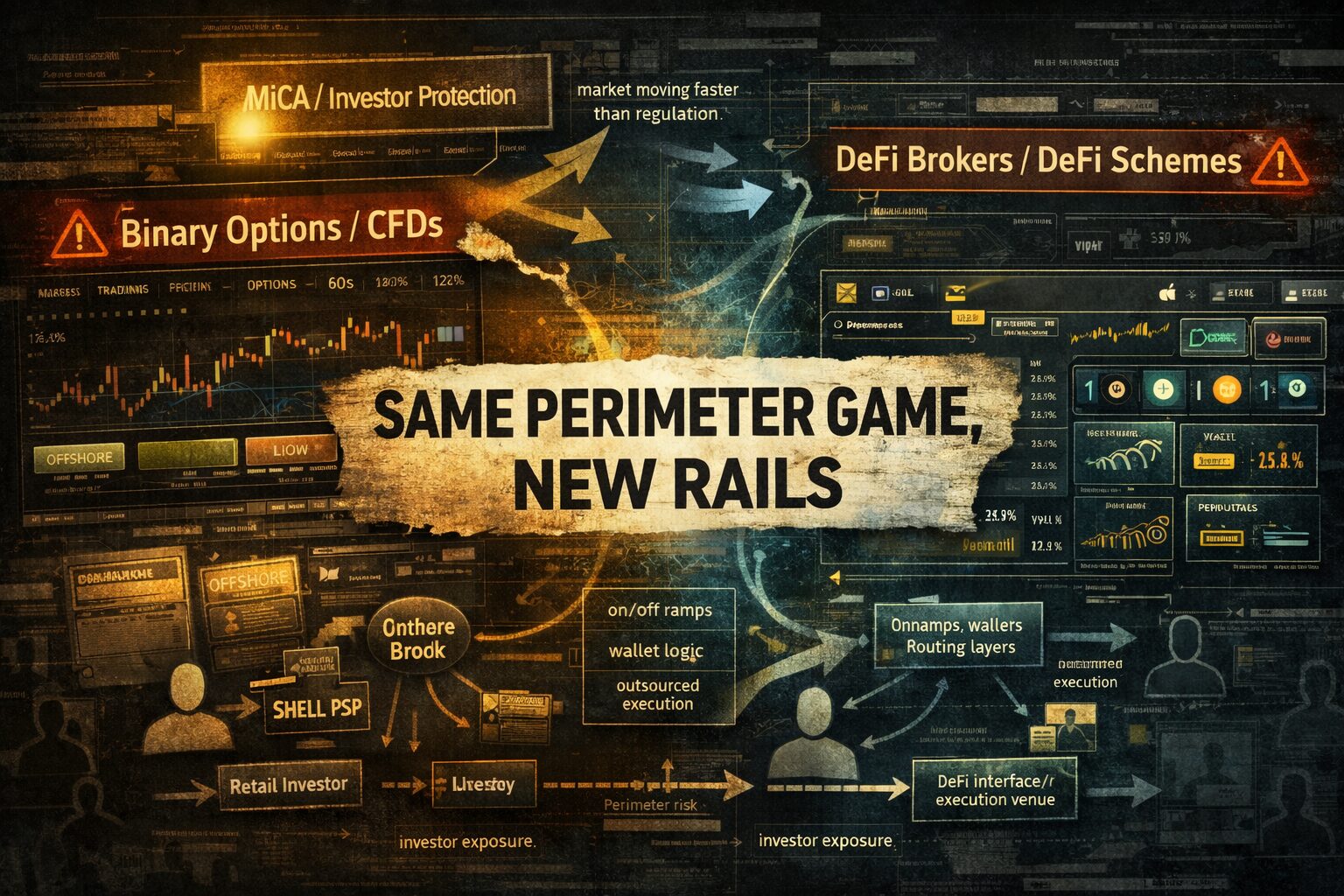
FinTelegram is expanding its compliance coverage. Alongside offshore casinos and their payment processors, we will increasingly focus on DeFi brokers and DeFi investment schemes. The reason is straightforward: the old perimeter game has not disappeared. It has evolved. Where binary options and offshore CFD brokers once used shell structures, payment agents, and weakly supervised cross-border rails, a new generation of platforms now uses DeFi branding, wallet-based onboarding, on/off-ramp layers, perpetuals venues, and “interface-only” narratives to reach retail users. MiCA was designed to address parts of this new reality, but the market is already moving faster than regulation and investor protection once again.
Key Findings
- FinTelegram sees a clear strategic continuity between the old binary options / CFD perimeter game and the emerging DeFi broker model.
- ESMA intervened against binary options and CFDs in 2018 because of serious investor detriment, including a prohibition on the marketing, distribution, or sale of binary options to retail investors and restrictions on CFDs.
- MiCA does not exempt a service merely because part of it is performed in a decentralized manner; Recital 22 says MiCA applies where services are provided or controlled directly or indirectly by identifiable persons, and only fully decentralized services without an intermediary fall outside scope.
- EBA and ESMA have already warned that DeFi labels are not legal conclusions and that DeFi-related models present significant AML/CFT and other risks.
- FinTelegram’s recent reporting on Hyperliquid-related perimeter questions and AXIOM’s funding architecture shows that DeFi brokers and DeFi investment schemes deserve dedicated, systematic scrutiny.
- FinTelegram’s future coverage will therefore place greater emphasis on DeFi brokers, DeFi investment schemes, and the supporting rails that move users from fiat into high-risk crypto trading environments.
Why FinTelegram Is Expanding Its Coverage
FinTelegram was born in the era of binary options and offshore brokers. Back then, the pattern was painfully familiar: aggressive retail acquisition, opaque operators, outsourced payment flows, weak disclosures, and a business model built around staying one step ahead of regulation. ESMA’s 2018 intervention against binary options and CFDs did not come out of nowhere. It reflected serious investor-protection concerns and concrete market harm. Binary options were prohibited for retail investors, while CFDs were placed under restrictions such as leverage caps, negative balance protection, and standardized risk warnings.
Today, the wrapper has changed, but the perimeter game looks strikingly familiar.
Instead of offshore brokers offering binary options and CFDs through card acquirers, shell PSPs, and introducing agents, we increasingly see DeFi-branded interfaces, perpetuals access layers, wallet-linked trading environments, tokenized “earn” products, and multi-step on/off-ramp architectures. The language is newer and more technical. The legal positioning is more sophisticated. But the retail risk can be the same or worse: leverage, opacity, cross-border reach, and weak accountability.
The Shift From Binary Options To DeFi
The old broker world sold the illusion of easy returns through highly speculative products packaged for retail users. The new DeFi segment often does something similar, but with more layers.
A modern DeFi broker or DeFi investment scheme may present itself as “just an interface,” “non-custodial,” or “decentralized.” Yet the practical user journey often includes a branded front end, a wallet setup, a fiat on-ramp or aggregator, a routing layer, a trading or yield venue, and one or more licensed or semi-regulated service providers embedded in the flow. That architecture makes responsibility harder to pin down. It also creates a false sense of legitimacy. A regulated on-ramp inside the chain does not automatically mean the destination platform itself sits safely inside the regulatory perimeter.
That is precisely why MiCA matters. Recital 22 makes clear that crypto-asset services can still fall within scope even when part of the activity is performed in a decentralized manner. What matters is whether the service is provided or controlled, directly or indirectly, by identifiable persons. Only services that are fully decentralized and operate without any intermediary fall outside scope.
This is the key compliance lens for FinTelegram going forward. The question is not whether a platform calls itself DeFi. The question is who controls the client journey, the money flow, the wallet logic, the fee extraction, and the risk exposure.
New Rails, More Complex Structures
The rails are what make the current phase more dangerous.
In the binary-options era, the core enabling structures were payment processors, acquiring banks, shell companies, and offshore entities. In the DeFi era, the supporting rails are often more complex and harder to understand for ordinary investors. They can include fiat-to-crypto on-rampers, aggregator layers, self-custodial or quasi-custodial wallets, bridge-like mechanics, perpetuals venues, staking wrappers, and “earn” products routed through multiple providers.
This complexity is not a side issue. It is central to the business model. It allows operators to fragment responsibility and tell a story in which nobody appears to be fully accountable. The interface says execution happens elsewhere. The on-ramp says it only processes the fiat leg. The protocol says it is decentralized. The user, meanwhile, sees one seamless trading journey.
That is why recent FinTelegram work on Hyperliquid and AXIOM matters. These reports were not isolated pieces. They were early case studies in a broader structural shift. They showed how broker-like access to leveraged crypto trading can be embedded inside branded interfaces and supported by sophisticated on/off-ramp architecture.
Markets Are Again Moving Faster Than Regulation
This is another familiar lesson from the binary-options years.
By the time regulators imposed emergency restrictions in 2018, the binary-options and CFD sectors had already caused large-scale retail harm. ESMA’s own intervention record shows how serious the investor-detriment problem had become.
The same dynamic risks reappearing in the DeFi segment. Markets innovate faster than legal interpretation, and retail distribution evolves faster than investor-protection mechanisms. Even now, EBA and ESMA are still analyzing DeFi and related crypto models, warning that the term “DeFi” itself should not be treated as a legal conclusion and noting significant ML/TF and broader conduct risks in the sector.
MiCA is an important step, but it is not a magic shield. It provides a regulatory framework, central registers, and authorization architecture for crypto-asset service providers, but the market is already testing the edges of that framework through front ends, access layers, hybrid models, and outsourced execution stacks.
Why Investor Protection Requires Earlier Scrutiny
The binary-options disaster should not be repeated.
That market left a trail of victims, enforcement actions, broken lives, and enormous losses for unsuspecting retail investors. The lesson was not only that the products were risky. The lesson was that opacity, weak perimeter enforcement, and delayed scrutiny allowed those products to spread far too long before decisive action was taken.
FinTelegram’s role is not to wait until the damage is complete. It is to identify risk patterns earlier, map the enabling rails, and make the economic reality of these structures visible before the next retail-investor disaster scales out of control.
That is why DeFi brokers and DeFi investment schemes will now receive more sustained attention alongside offshore casinos. The underlying compliance logic is the same: retail users are being onboarded, monetized, and exposed through weakly supervised or strategically fragmented structures.
What FinTelegram Will Cover
In the months ahead, FinTelegram will expand its compliance coverage across four related lanes:
- DeFi brokers: platforms and interfaces offering leverage, perpetuals access, synthetic exposure, or broker-like crypto trading functionality.
- DeFi investment schemes: yield, staking, vault, “earn,” and other products that function economically like speculative investment schemes.
- On/off-ramp and wallet rails: the funding and conversion architecture that moves users from fiat into high-risk crypto environments.
- Perimeter watch: MiCA boundary cases, interface-only defenses, non-custodial claims, and the role of licensed firms inside higher-risk ecosystems.
This is not anti-crypto coverage. It is compliance and investor-protection coverage. The target is not innovation. The target is perimeter gaming, opacity, and the monetization of retail risk without clear accountability.
Summary Compliance Statement
FinTelegram believes that DeFi brokers and DeFi investment schemes represent the next major perimeter challenge in digital finance. The migration from binary options and offshore brokers to DeFi-branded trading and investment structures does not reduce compliance risk. In many cases, it increases it by adding technical complexity, outsourced execution layers, and fragmented accountability. MiCA has created an important framework, but supervisory and investor-protection questions remain open, especially where identifiable operators organize access to crypto-asset services through branded interfaces and supporting rails. FinTelegram will therefore intensify its scrutiny of this segment in the same spirit that once drove its coverage of binary options, offshore brokers, and their payment enablers.
Call To Whistleblowers And DeFi Investors
If you are a DeFi investor, trader, insider, developer, service provider, or former employee with relevant information, contact FinTelegram confidentially via Whistle42.
We are particularly interested in:
- internal compliance assessments,
- wallet and routing logic,
- on/off-ramp integration structures,
- KYC/AML workflows,
- hidden operators and control persons,
- partner contracts,
- geo-targeting practices,
- leverage and liquidation mechanics,
- and investor complaints or internal risk discussions.
Together, we can monitor and track this evolving DeFi segment in the interest of investor protection.
Because the lesson from binary options was clear: when markets evolve faster than transparency, retail investors pay the price.