



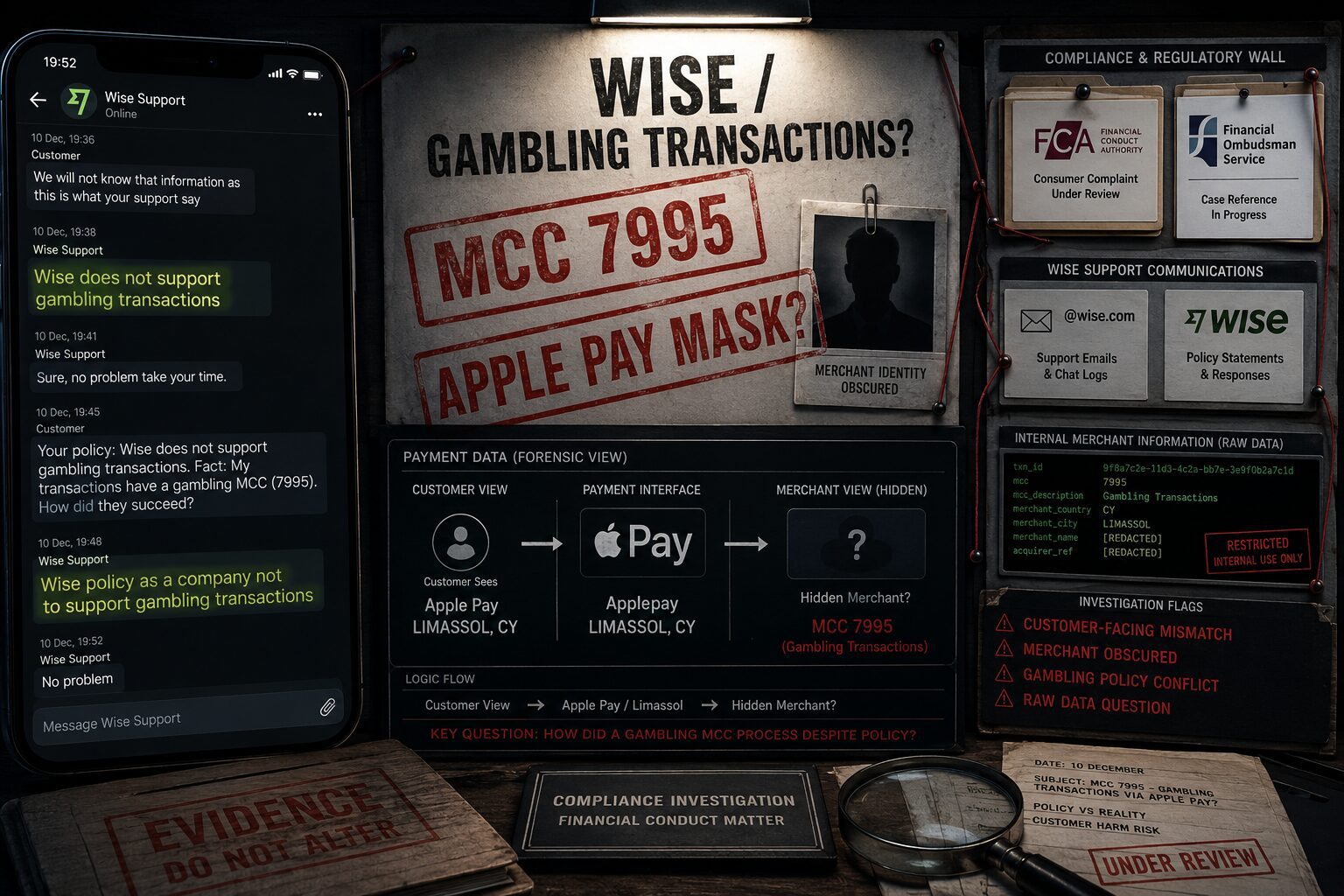
A Wise customer has accused the fintech of obscuring gambling-related card transactions by displaying Apple Pay or incomplete merchant information instead of the real payee, even though the transactions allegedly carried MCC 7995, the card-network code for gambling. The customer has already escalated the matter to the FCA and the Financial Ombudsman Service. FinTelegram has reviewed substantial material and sees a serious contradiction worth investigating: if Wise says it does not support gambling transactions, why did gambling-coded payments go through at all? And if they did, what exactly did Wise know internally about the real merchant?
Key Findings
- The customer alleges that disputed Wise card transactions were internally associated with MCC 7995 (Gambling Transactions) while the customer-facing view did not clearly identify the underlying merchant.
- In support exchanges reviewed by FinTelegram, Wise support allegedly stated that Wise does not support gambling transactions.
- The same material appears to show internal-style merchant information referencing Applepay, Limassol, CY, and MCC 7995, raising questions about what Wise knew internally versus what was shown to the customer.
- The customer claims Wise relied on incomplete or simplified presentation layers, including Apple Pay / Applepay, while the true merchant remained obscured during the support process.
- Wise’s public documentation presents a more nuanced policy position than an absolute ban, including restrictions on gambling-related transfers and a statement that users cannot receive money to their Wise card from gambling or betting institutions.
- FinTelegram has received additional evidence that is still under review, including materials suggesting links between the gambling-side payment chain and Cyprus-linked processing environments.
Article draft
Wise & Gambling: If Wise Does Not Support Gambling Transactions, Why Did MCC 7995 Payments Go Through?
A dispute between Wise and one of its customers is raising uncomfortable questions about how “clean” fintechs actually handle gambling-related payments. The payments cited by the player in the Wise case involve deposits made via a Wise card to casinos operating illegally in the EU and the UK. As the player’s documents show, these deposits were orchestrated through Payabl, which is regulated as an EMI in the UK and Cyprus.
The recipients included, among others, the Irish company Zentoria Ltd and the Cypriot company NovaForge, which act as payment agents for casinos operating illegally and are merchants of Payabl.

According to extensive materials reviewed by FinTelegram, the customer repeatedly challenged Wise over a series of card transactions that were classified with MCC 7995 — Gambling Transactions but were not clearly presented to him as gambling payments at the customer-facing level.
Instead, the disputed transactions allegedly appeared in a blurred or misleading way, including references such as Apple Pay or Applepay / Limassol, rather than a clear underlying merchant identity.
That matters because, in support communications reviewed by FinTelegram, Wise support allegedly told the customer that Wise “does not support gambling transactions.” At the same time, the customer says his disputed transactions carried MCC 7995, the standard card-network category for gambling. If both things are true, then one obvious question follows: how did those transactions get through in the first place?
Wise’s public materials present a more nuanced position than a simple blanket ban. Wise says gambling-related transfers must not involve certain listed countries under its position on gambling. Its Acceptable Use Policy also states that some unsupported-business restrictions do not apply to lawful transactions using the Wise Multi-Currency Card, while Wise separately says users cannot receive money to their Wise card from gambling or betting institutions.
Data Manipulation Allegations
The customer’s allegation goes further. He claims Wise did not simply mishandle the case, but obscured or manipulated the transaction information shown to him. The core allegation is not that backend data did not exist. It is that Wise allegedly had access to deeper merchant-level information — including merchant identifiers, structured merchant data, and gambling classification — while the customer-facing view remained vague, incomplete, or misleading.
In materials reviewed by FinTelegram, the customer points to internal-style merchant information showing Applepay, Limassol, CY, and MCC 7995, while the real merchant allegedly remained hidden during the support process.
This is where the case becomes genuinely interesting.
If Wise publicly presents itself as a compliant, low-risk financial institution that does not support non-licensed and thus illegal gambling transactions, then it would have an obvious incentive to avoid a customer-facing record that openly shows a Cyprus-linked gambling merchant. In that context, the alleged appearance of Apple Pay as a front-facing label, while the real merchant allegedly sat behind a processor chain in Limassol, stops looking random and starts looking functional. It would make reputational and compliance sense. Whether that was legitimate wallet-display simplification, poor internal handling, or something more serious is the question.
Wise & Illegal Casino Activities?
The customer’s logic is not absurd. If Wise processed gambling-coded transactions related to illegal casino actitivies while publicly distancing itself from gambling, then concealing the true merchant behind Apple Pay, or reducing merchant visibility in the customer view, would at least have a motive. And motive matters.
The material reviewed by FinTelegram suggests a widening contradiction:
- Wise allegedly says it does not support gambling transactions;
- the customer’s disputed transactions allegedly carry MCC 7995;
- internal-style merchant information allegedly pointed to Applepay / Limassol / Gambling Transactions;
- and the customer says he was left to reconstruct the merchant trail himself.
The customer has already escalated the matter to the FCA and the Financial Ombudsman Service, and FinTelegram has received substantial further material that is still under review. At this stage, the Wise case should be seen as an initial warning signal, not a final verdict.
But if it turns out that Wise was in fact handling illegal gambling-related payments while publicly presenting itself as a company that does not support gambling — and if it further turns out that customer-facing transaction data was shaped in a way that concealed the real merchant — then this would not be a minor support failure. It would be a major compliance scandal with the potential to damage Wise’s carefully cultivated clean-cut image.
FinTelegram will continue to review the evidence. Further reports will follow.
Share Information
If you are a player, former employee, payments insider, or compliance professional with information about gambling-related transactions processed through Wise, Payabl, or related merchant/payment-agent structures, contact FinTelegram confidentially via Whistle42.