


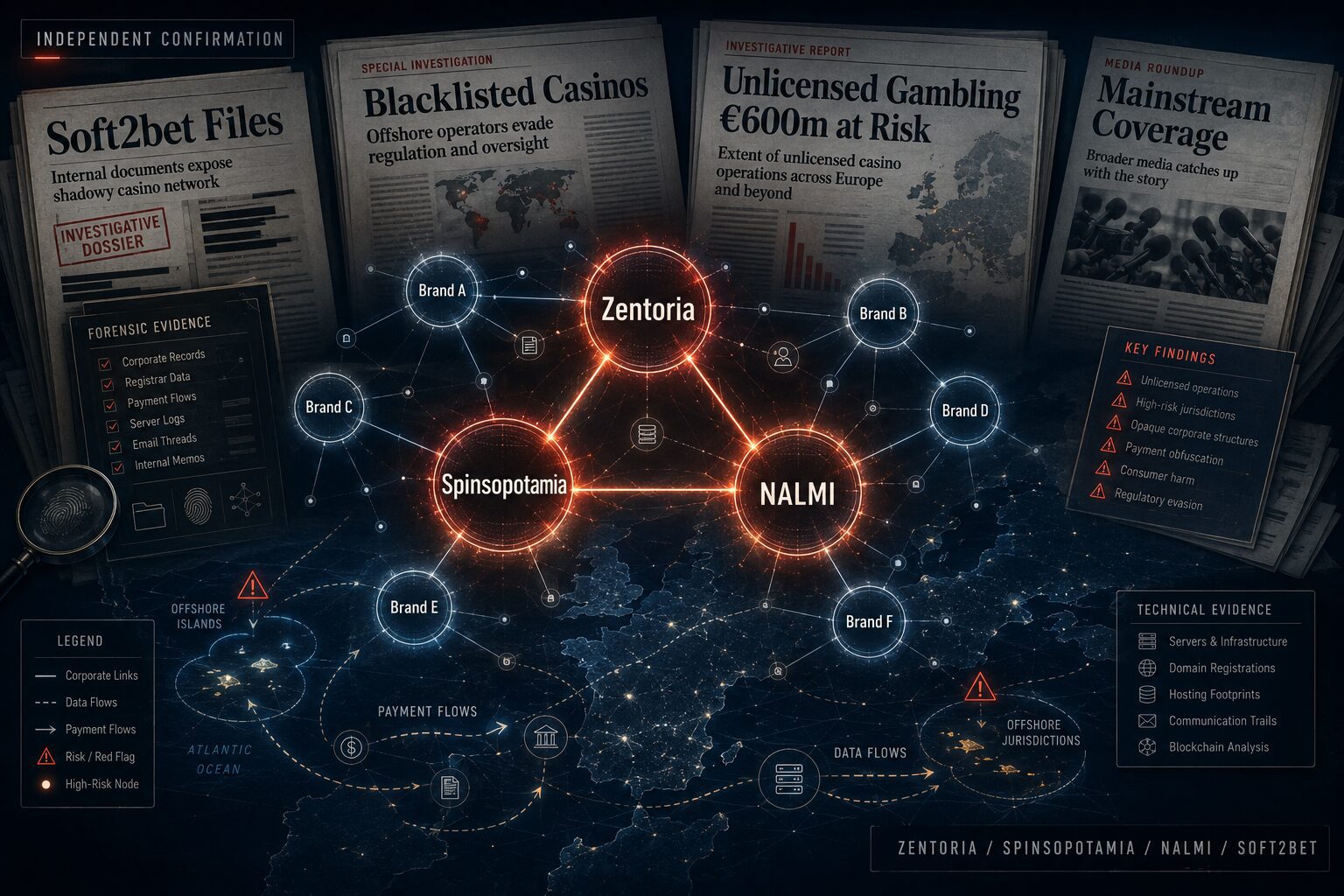
FinTelegram’s Zentoria compliance reporting is no longer a lonely warning shot. New investigations by Investigate Europe and Times of Malta independently reinforce the core structure already mapped in FinTelegram’s Zentoria / Spinsopotamia and the NALMI Casino Network report and the subsequent Technical Annex: an EU-facing layer, a wider offshore casino ecosystem, aggressive blacklisted brands, and payment or descriptor structures that blur the line between regulated presentation and unlicensed underlying activity.
That matters for two reasons. First, it shows that the issues raised by FinTelegram are not speculative fringe claims but part of a broader investigative picture now being advanced by serious cross-border journalism organisations and established mainstream media partners. Second, it materially weakens the usual legal-threat playbook of casino operators, payment facilitators, and service providers who prefer to dismiss FinTelegram’s findings as isolated or exaggerated. Once multiple independent investigations begin tracing the same routes, the problem is no longer the messenger; it is the structure itself.
Key findings
- Independent convergence is now unmistakable: Investigate Europe and Times of Malta substantially reinforce the same offshore gambling and payment architecture previously mapped by FinTelegram around Zentoria, Spinsopotamia, and the NALMI environment.
- The overlap is structural, not cosmetic: The brands, shell structures, payment entities, and regulatory themes described by these outlets materially overlap with the entities, descriptors, and domain clusters already identified in FinTelegram’s compliance reporting.
- Zentoria remains a critical clue: Investigate Europe’s reporting of an Onlyspins payment allegedly routed to Zentoria in Ireland aligns closely with FinTelegram’s descriptor and payment-facade narrative around Spinsopotamia and the wider casino network.
- Different sources, same direction: FinTelegram’s public-source technical and compliance analysis, Investigate Europe’s leaked-payment and former-employee material, and Times of Malta’s publication of the same Soft2bet Files all point toward the same broader architecture of offshore gambling operations and layered payment intermediation.
- Mainstream validation raises the cost of denial: When a serious outlet such as Times of Malta republishes or advances the same investigative universe, it becomes materially harder for affected operators or payment facilitators to portray FinTelegram’s work as isolated, reckless, or methodologically weak.
- Regulatory urgency increases: The combined reporting now points not just to risky domains or questionable descriptors, but to a broader cross-border model of offshore casino operation, payment intermediation, and regulatory arbitrage.
What Investigate Europe adds
Investigate Europe‘s two Soft2bet reports push the story beyond infrastructure and public-source OSINT into the money-flow, shell-company, and labour-practice layers. The July 2026 article describes a gambling network that allegedly generated more than €600 million from unlicensed casinos using predatory retention tactics, leaked payment data, former-employee testimony, court filings, and regulator correspondence. The March 2025 article documents dozens of blacklisted gambling sites connected to Soft2bet-linked entities and traces the use of Curaçao companies, Anjouan licences, trademark transfers, and cross-border corporate vehicles to sustain the network.
For FinTelegram readers, the key point is that Investigate Europe independently arrived at the same broad architecture: a licensed or respectable-facing European layer sitting above a much darker offshore machinery of casino brands, payment entities, shell structures, and market-by-market evasion.
What Times of Malta changes
The Times of Malta report matters because it shifts the story from specialist investigative circles into a more conventional mainstream-news environment. Its article, based on the same Investigate Europe leak set, states that leaked financial records linked a Malta-based Soft2bet group and related entities to €600 million from offshore casinos blacklisted by European regulators, and describes funds moving through payment agents and corporate layers toward Soft2bet and associated companies.
This is strategically important for FinTelegram. Operators and facilitators may try to dismiss a specialist compliance outlet as biased or overly aggressive. That defence becomes harder when a long-established national newspaper in an EU member state publishes substantially the same universe of facts: offshore casinos, blacklisted sites, shell-company chains, payment intermediaries, and regulatory failure to contain the model.
The Zentoria overlap
The overlap with FinTelegram’s Zentoria reporting is too substantial to ignore. FinTelegram had already placed Spinsopotamia and the Zentoria-facing layer inside the narrow NALMI / AS213846 – 185.207.196.0/22 casino-domain environment and had documented preserved HTML markers, shared CSPER and SEON identifiers, an 83-domain strict configuration cluster, cross-domain API dependencies, and broader application-build superclusters.
Investigate Europe reaches the same theatre from a different entry point. Its Soft2bet reporting discusses brands and structures that substantially overlap with names and clusters already appearing in the FinTelegram technical evidence universe, including brands such as Boomerang, MyEmpire, Bankonbet, Rabona, Wazamba, Malina, and others associated with Soft2bet-linked or adjacent environments. It also reports a particularly important real-world payment observation: an Onlyspins deposit in Belgium reportedly routing to Zentoria in Ireland, which aligns strikingly with FinTelegram’s earlier descriptor and payment-facade narrative around Zentoria and Spinsopotamia.
This is the point that should make nervous operators and service providers stop pretending that the Zentoria story was just a FinTelegram obsession. One independent outlet mapped the public infrastructure and descriptor layer. Another independent outlet reached into leaked payments, ex-staff testimony, and regulatory records. A mainstream newspaper then published the Soft2bet Files to a broader audience. The convergence is no longer deniable.
Compliance takeaway
The compliance lesson is blunt. Zentoria was never just about one Irish company, one domain, or one payment descriptor. The wider story is about how licensed or EU-facing entities can function as trust wrappers, payment bridges, or reputational shields inside an offshore casino architecture that is technically concentrated, commercially aggressive, and structurally evasive.
Now that Investigate Europe and Times of Malta have pushed the same universe into broader cross-border and mainstream reporting, the burden shifts to regulators and payment institutions. They can no longer say the warnings came from only one outlet. The findings are converging. The names are repeating. The brands are recurring. The shell layers are visible. The payment trails are starting to surface. And the longer institutions wait, the more implausible ignorance becomes.
Whistleblower call
FinTelegram calls on whistleblowers, former employees, PSP insiders, acquirer staff, compliance officers, hosting and infrastructure personnel, and affected players to submit further information about Zentoria, Spinsopotamia, NALMI, Soft2bet-linked entities, offshore shell structures, merchant routing, and payment facilitators through Whistle42.
Particularly valuable materials include:
- Merchant IDs, route IDs, acquirer mappings, and settlement-beneficiary information.
- Internal emails, onboarding files, compliance reviews, and risk escalations involving Zentoria, Lornioco, Spinsopotamia, Soft2bet-linked brands, or related payment entities.
- Cloudflare, hosting, DNS, API, or platform records identifying who controlled the relevant domains, tenants, and technical configurations.
- Statements, cashier screenshots, receipts, and descriptor evidence showing how deposits were routed or disguised across casino brands and payment fronts.