


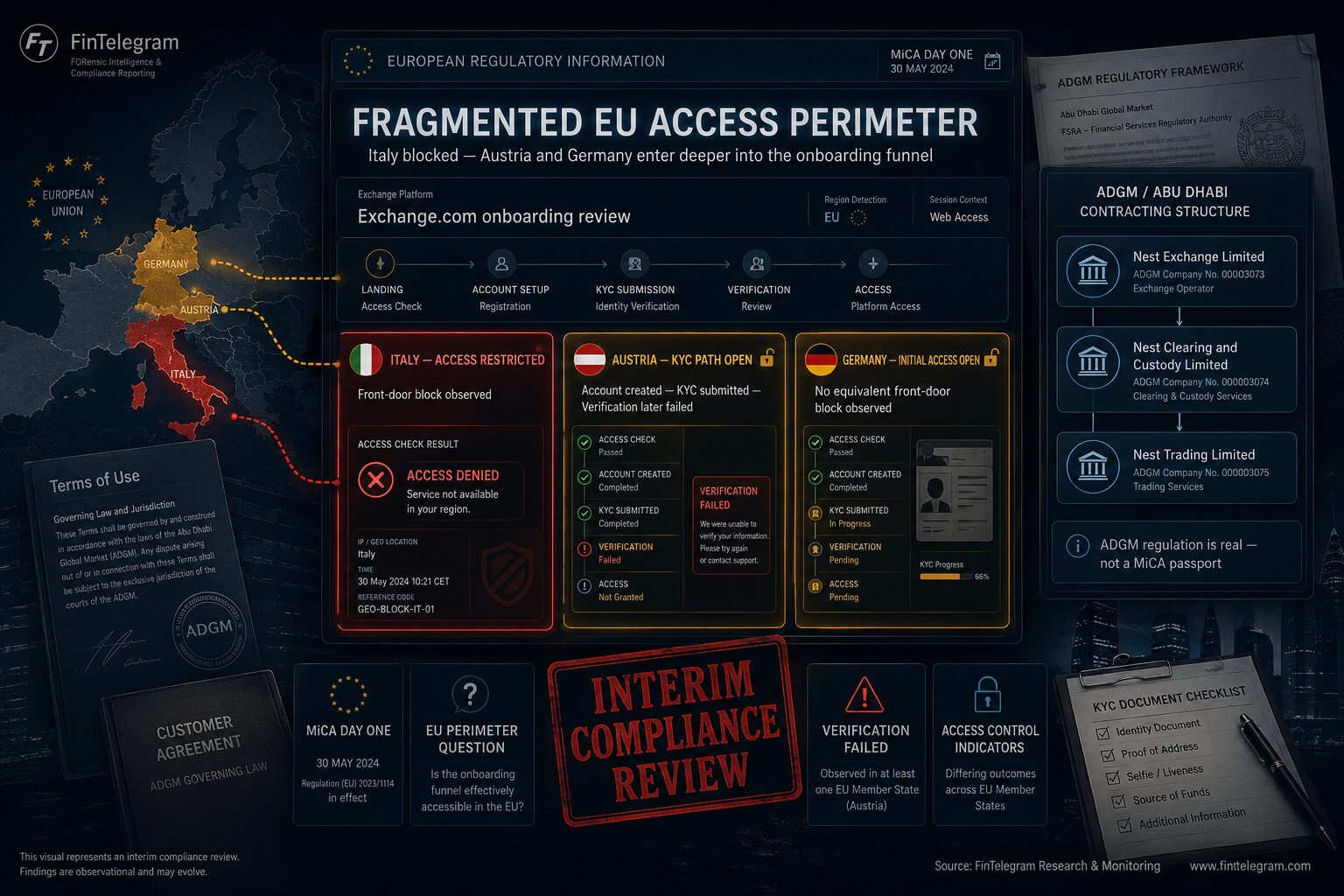
A FinTelegram post-MiCA test conducted on 6 July 2026 found sharply different access outcomes inside the EU. An Italian residence selection triggered an immediate “Access Restricted” message. Austria and Germany did not. Austrian & German nationals and residents were able to create a Binance.com account, enter KYC and submit identity documentation under a platform environment pointing to Binance’s regulated Abu Dhabi structure — before verification ultimately failed and deposits remained unavailable. The result does not establish successful EU onboarding. It does expose a fragmented and unresolved post-MiCA access architecture.
The Key Point
Five days after the end of the MiCA transitional period, FinTelegram conducted a first controlled review of Binance.com’s EU access and onboarding perimeter. The result was not a simple open-or-closed outcome. It was fragmented.
When Italy was selected as the user’s residence, Binance displayed:
Access Restricted
The Binance.com platform is not available in your region
When the selected residence was changed to Austria, the same front-door restriction did not appear. FinTelegram was able to create an account, receive an activation email and proceed into Binance’s identity-verification process.
A German residence selection likewise did not produce the Italian-style front-door block during the initial access test. The German and Austrian tests went considerably further.
FinTelegram submitted KYC information for a person who was both:
- an Austrian / German national; and
- an Austrian / German resident.
The platform processed the application, displayed the Austrian country context and placed the verification into review. At the same time, the Binance interface displayed a prominent notice:
“European Regulatory Information: If you have questions regarding European regulatory developments or your Binance account, our Customer Support team is available to assist.”
Approximately one hour later, verification was unsuccessful. No specific reason was provided to FinTelegram. The account remained accessible, but deposits were not available. The evidence therefore supports a narrow but significant conclusion:
Binance’s post-MiCA EU access controls appear fragmented: Italy is blocked upfront, while Austria and Germany can enter deeper into the onboarding architecture — with an Austrian user reaching KYC under an ADGM-based contractual framework before verification ultimately failed.
FinTelegram does not conclude that Binance successfully onboarded a new Austrian EU client after 1 July 2026. That distinction is central to this report.
The Regulatory Clock Has Run Out
The timing matters. ESMA stated that the MiCA transitional period would end across the EU on 1 July 2026 and called on unauthorised CASPs to wind down in an orderly manner. Its public statement says such providers should, among other things, cease onboarding new EU clients and restrict their activities to what is necessary for an orderly exit.
Binance entered that deadline without completing its previously pursued Greek MiCA route. On 24 June 2026, Binance announced that it had withdrawn its MiCA application with the Hellenic Capital Market Commission and would seek authorisation in another EU Member State. Significantly for FinTelegram’s findings, Binance itself said that some users might be affected depending on their country and account status.
That statement now deserves close attention. Because FinTelegram’s first post-deadline test appears to show precisely such country-level differentiation.
Italy: Blocked at the Front Door
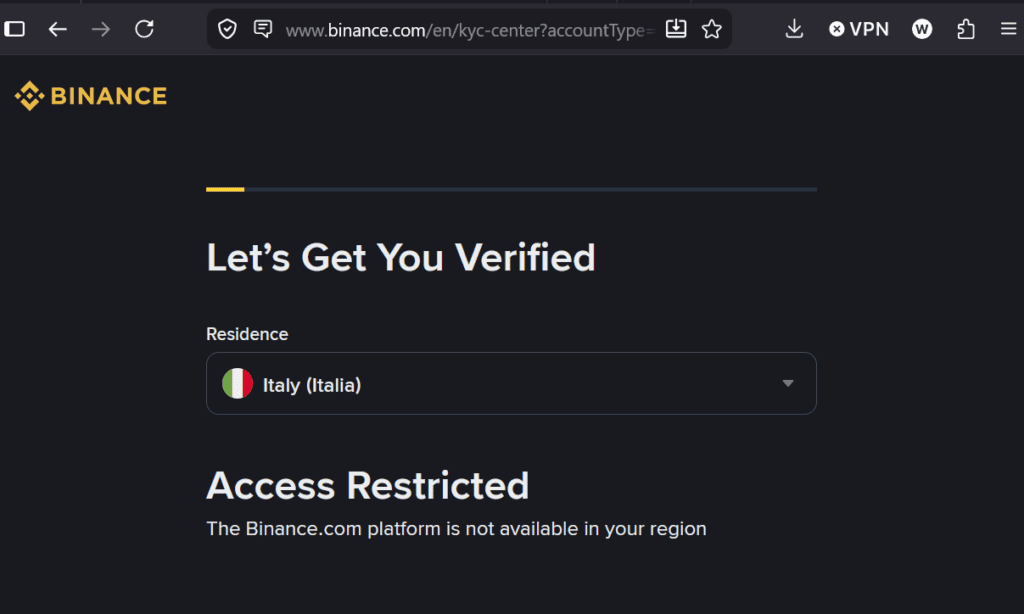
The Italian result was the clearest. During the tested KYC-entry journey, selecting Italy as residence caused Binance.com to display an explicit restriction message:
Access Restricted
The Binance.com platform is not available in your region
This was not an inference from Terms of Use or a regulatory warning. It was a direct platform response observed and captured by FinTelegram on 6 July 2026.
Evidence status: Strong Technical / Documentary Indicator.
At this stage, FinTelegram does not claim to know why Italy is treated this way. Possible explanations include:
- country-specific Binance policy;
- local regulatory or supervisory constraints;
- legacy entity issues;
- internal risk classification;
- MiCA transition arrangements;
- or another legal or operational basis.
Those possibilities remain hypotheses until clarified by Binance. But the observed fact is straightforward:
Italy was blocked upfront in the tested journey.
Austria & Germany: Account Creation and KYC Were Possible
The Austrian & Germany tests produced a materially different result. After Austria was selected as the relevant country context, FinTelegram was able to:
- create a Binance.com account;
- receive an account activation code by email;
- access a user dashboard;
- enter the KYC process;
- submit identity information;
- identify the test person as Austrian / German national and resident;
- place the verification into an “Under Review” state.
The Binance dashboard also invited the user to complete a deposit as part of the trading journey, although deposits were not actually available while verification remained incomplete.
This matters because it shows that the Austrian-linked user was not rejected at the initial account-creation gate.
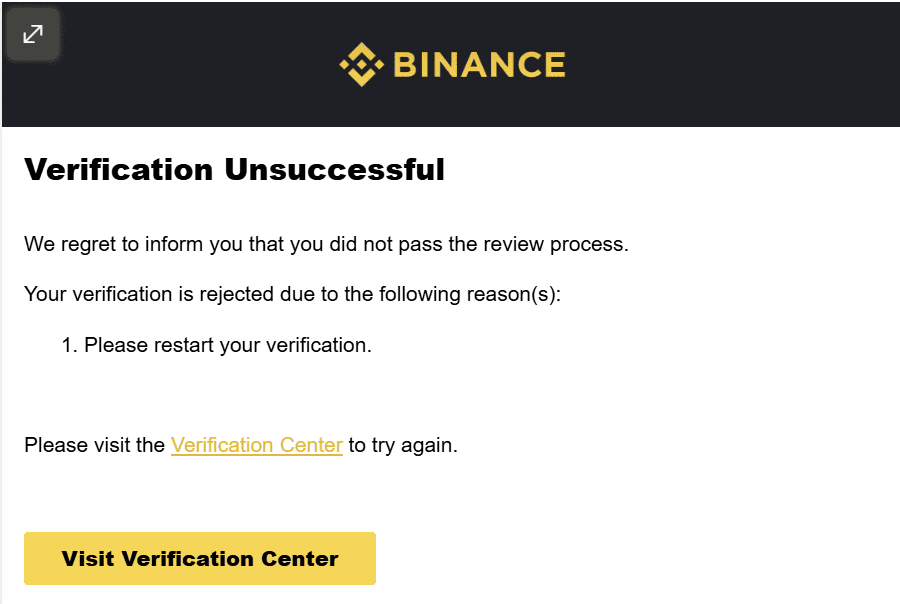
But the evidentiary limit is equally important. After approximately one hour, the KYC verification was unsuccessful. FinTelegram received no substantive explanation establishing whether the failure resulted from:
- an EU/MiCA eligibility rule;
- a country restriction;
- document quality;
- identity matching;
- technical KYC controls;
- liveness checks;
- or another reason.
Accordingly: Successful post-MiCA onboarding of a new Austrian or German client is not established. What is established is that a prospective Austrian & German EU user was able to open a Binance account and thus move considerably deeper into the Binance onboarding architecture than the tested Italian user.
Evidence status: Strong Technical / Documentary Indicator as to account creation, KYC entry and review; Open Question as to the reason for final verification failure.
The Abu Dhabi Layer: A Real Regulatory Architecture
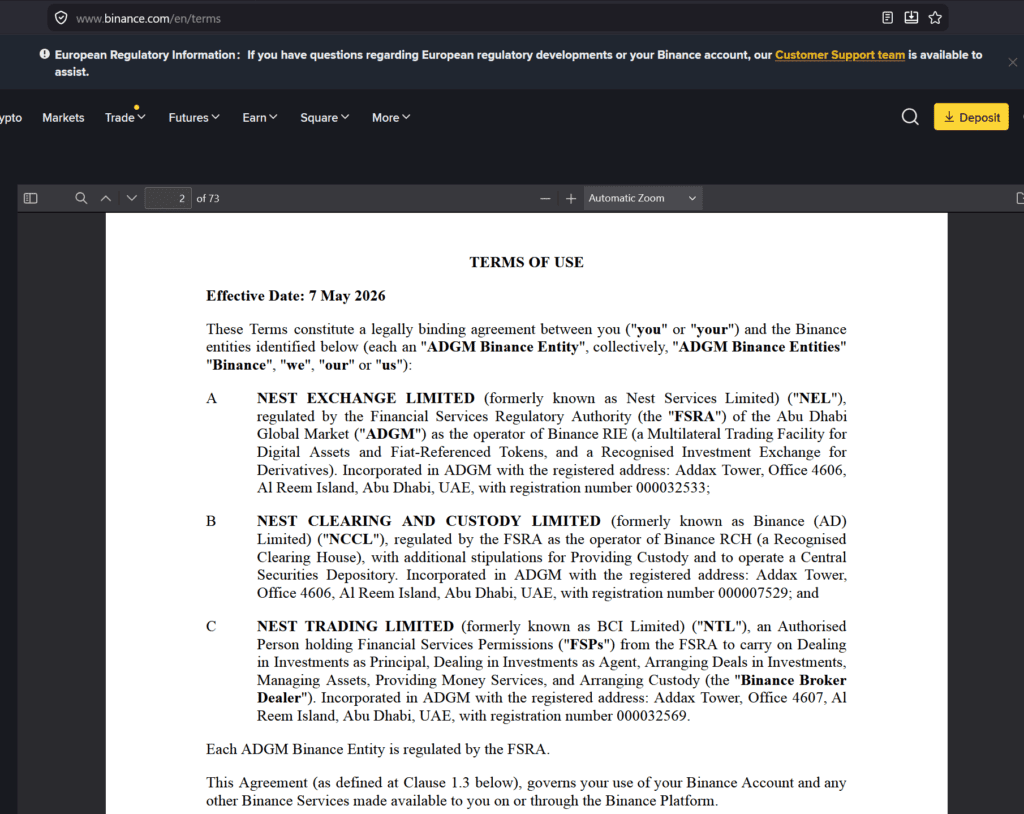
The second major finding concerns the legal architecture behind Binance.com. During the tested journey, Binance prominently informed users that Binance.com is now regulated in the Abu Dhabi Global Market (ADGM).
That statement has a real regulatory basis.
ADGM announced in December 2025 that the global Binance.com platform would operate through three separately regulated entities:
with distinct roles across exchange activities, clearing and custody, and broker-dealer or off-exchange services.
The current Binance Terms reviewed by FinTelegram likewise identify the ADGM entities and their respective FSRA-regulated roles.
The ADGM public register independently confirms, for example, Nest Trading Limited as an active ADGM financial firm with an FSP date of 5 January 2026 and Binance.com as its website.
So there should be no confusion:
The ADGM regulation is real.
But another distinction is equally important:
ADGM regulation is not MiCA authorisation and does not constitute an EEA passport.
The existence of a sophisticated third-country regulatory framework therefore does not by itself answer the question of the legal basis on which a prospective Austrian or German EU resident may enter the Binance.com onboarding process after the MiCA deadline.
An Austrian EU User Inside an ADGM-Based Contracting Environment
This is the most significant issue arising from FinTelegram’s first test. The Terms presented in the Binance.com environment identify the three Abu Dhabi entities as part of the legal framework governing use of the platform:
Nest Exchange Limited
The exchange layer.
Nest Clearing and Custody Limited
The clearing, settlement and custody layer.
Nest Trading Limited
The broker-dealer and off-exchange services layer.
Binance’s current Terms and ADGM’s own announcement describe these regulated functions. FinTelegram’s tested users, however, were not Abu Dhabi residents but Austrian and Germans. That creates the central Phase I question:
Why can a prospective Austrian / German EU user enter an ADGM-based Binance.com onboarding funnel after MiCA Day One, while an Italian resident is blocked at the front door?
At present, FinTelegram does not claim to know the answer.
Three Competing Explanations
The observed architecture currently supports at least three plausible explanations.
Scenario A — Effective Late-Stage Regulatory Gating
Binance may allow technical account creation and collection of KYC information before applying a final legal-eligibility rule.
Under this scenario, the Austrian verification failure could indicate that Binance’s compliance controls ultimately prevented activation of a user it could not lawfully serve.
If demonstrated, that would materially change the compliance assessment in Binance’s favour. The current evidence does not establish this explanation.
Scenario B — Ordinary KYC Failure
The rejection may have had nothing to do with MiCA or EU residence.
It could have resulted from an ordinary KYC issue, including:
- identity-data mismatch;
- document validation;
- image quality;
- liveness;
- technical checks;
- or another onboarding-control failure.
Under this scenario, another Austrian applicant might receive a different outcome. The current evidence does not exclude this explanation.
Scenario C — Fragmented Country-Level EU Routing
Binance may operate differentiated eligibility rules across EU Member States.
Under this scenario:
- Italy is blocked upfront;
- Austria and Germany enter further into the funnel;
- final activation depends on additional country, entity, product or account-status rules.
This scenario would be broadly consistent with Binance’s own 24 June statement that impacts may vary depending on a user’s country and account status.
But consistency is not proof. Further testing is required.
Why the Fragmentation Matters
MiCA was designed to create a harmonised EU framework.
The first FinTelegram test suggests that practical access to Binance.com may nevertheless be differentiated at Member State level.
That raises several questions.
1. Is account creation itself part of the regulatory gate?
If a provider should not establish new EU client relationships, when exactly is the relevant relationship formed?
At:
- email registration;
- acceptance of Terms;
- creation of a User ID;
- KYC submission;
- KYC approval;
- first deposit;
- or first regulated service?
This is a legal and factual question, not one FinTelegram resolves merely from the screenshots.
2. Why does Italy receive earlier rejection?
If Italy is restricted at country selection while Austria proceeds to KYC, what regulatory or contractual distinction explains the difference?
3. Which entity would serve an approved Austrian user?
Would the final client relationship remain within the ADGM architecture identified in the Terms?
Or would another local or EU entity intervene?
4. Is final KYC approval functioning as a MiCA control?
If so, why is that not explained transparently to the user?
5. Does product access differ?
A user might theoretically be restricted from one service while still accessing another.
The treatment of:
- spot trading;
- custody;
- Earn;
- staking;
- P2P;
- Futures;
- options;
- and fiat services
must therefore be tested separately.
Preliminary Evidence Matrix
| Finding | Evidence status | FinTelegram assessment |
|---|---|---|
| Italy produced “Access Restricted” | Strong Technical / Documentary Indicator | Clear tested front-door restriction |
| Austria did not produce equivalent initial restriction | Strong Technical Indicator | Deeper access path observed |
| Germany did not produce equivalent initial restriction | Preliminary Technical Indicator | Full KYC not yet tested |
| Austrian-linked account created | Strong Documentary Indicator | Established in test |
| Activation email received | Strong Documentary Indicator | Established in test |
| Austrian / German KYC submitted | Strong Documentary Indicator | Established in test |
| Verification entered review | Strong Documentary Indicator | Established in test |
| European regulatory banner displayed | Strong Technical Indicator | Relevant context |
| Final Austrian / German verification failed | Strong Documentary Indicator | Established in test |
| Failure resulted from MiCA/EU rules | Open Question | Not established |
| Successful Austrian / German client onboarding | Not Established | FinTelegram does not claim it |
| Deposit capability became available | Not Established | It did not in tested account |
| ADGM entities form current Binance.com regulatory architecture | Established Fact | Confirmed by ADGM and Binance |
| ADGM status equals MiCA authorisation | No | Separate regulatory perimeter |
| Current legal basis for prospective EU access | Open Question | Requires clarification |
The Binance Statement Makes the Test More Relevant
Binance’s 24 June announcement adds important context. The exchange confirmed that it had withdrawn its Greek MiCA application, would seek authorisation in another EU Member State and was contacting EU users individually. Binance specifically warned that effects might vary depending on country and account status.
That means the fragmented country outcomes observed by FinTelegram cannot simply be dismissed as an irrelevant technical curiosity. They require explanation.
At the same time, Binance’s statement also supports an alternative, less adverse interpretation: the company may already be implementing precisely the differentiated transition controls it told users to expect. The evidence is not yet sufficient to decide between those interpretations.
What Comes Next
This report is Phase I of FinTelegram’s Binance MiCA Day One review.
The next stages will examine:
Phase II — EU Access and Entity Mapping
Controlled tests across additional Member States and identification of the precise contracting entities.
Phase III — Payment Rails and Custody
Fiat deposits, cards, bank transfers, third-party processors, custody and settlement.
Phase IV — Product and Perimeter Review
Spot, Earn, staking, P2P, Futures, derivatives and the possible MiFID II overlay.
The objective is not to force the Binance case into the MEXC template.
The evidence may lead somewhere different.
That is exactly why the investigation matters.
Whistleblower Call
FinTelegram invites current and former:
- Binance employees;
- compliance officers;
- MLROs;
- KYC and onboarding staff;
- legal advisers;
- payment partners;
- banks;
- CASPs;
- contractors;
- and regulators
to provide information concerning Binance’s post-MiCA EU strategy.
We are particularly interested in:
- country restriction lists;
- EU onboarding rules;
- KYC eligibility logic;
- internal MiCA guidance;
- ADGM migration documents;
- contracting-entity allocation;
- Austria/Germany/Italy treatment;
- pending MiCA applications;
- EU payment rails;
- custody structures;
- product restrictions;
- and internal communications concerning the 1 July 2026 deadline.
Share information securely through Whistle42.
Help us map the real post-MiCA perimeter — not merely the one described in public statements.
FinTelegram’s assessments are editorial compliance analyses, not findings by a court or regulator. This interim review does not allege criminal conduct and does not conclude that Binance successfully onboarded a new Austrian client after 1 July 2026. All named parties are invited to submit corrections and statements.