



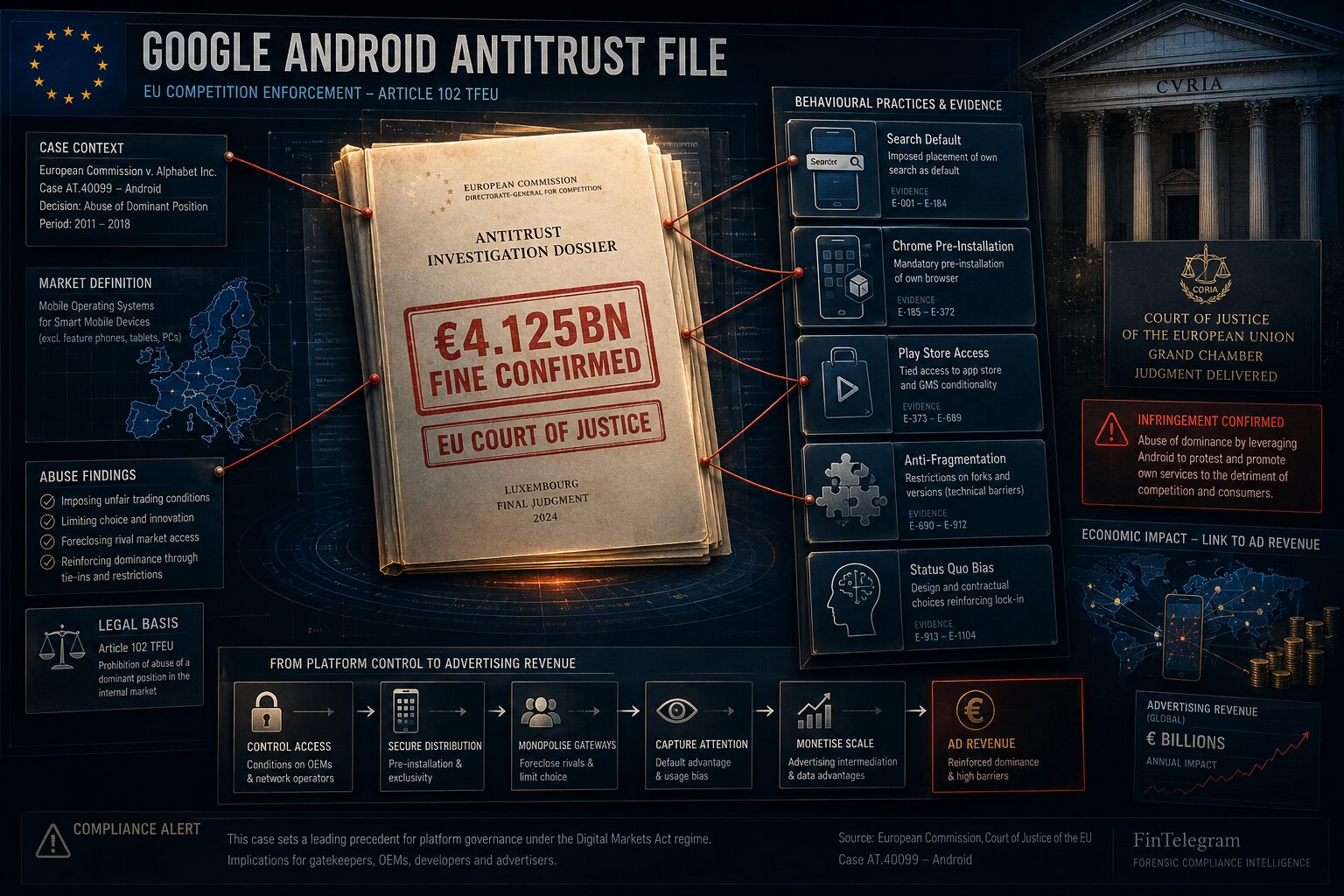
Google and Alphabet have lost their final appeal before the EU’s top court over the record Android antitrust fine. The €4.125 billion penalty confirms Brussels’ long-standing view that Google used Android licensing, pre-installation requirements and ecosystem control to protect its search dominance. For Big Tech, the ruling is another warning that platform power is no longer merely a business model — it is a compliance risk.
€4.1 Billion Android Fine Becomes Big Tech Compliance Landmark
The European Court of Justice has dismissed the appeal brought by Google and its parent company Alphabet in the long-running Android antitrust case, confirming the €4.125 billion fine imposed by the EU after the General Court reduced the original €4.343 billion penalty in 2022. The case goes back to the European Commission’s 2018 finding that Google abused its dominant position by using Android-related restrictions to protect and strengthen Google Search.
At the heart of the case was not Android as software, but Android as a distribution machine. According to the Commission’s case theory, manufacturers could obtain access to the Play Store only if they pre-installed Google Search and Chrome; they were restricted from selling devices with non-approved Android variants; and revenue-sharing arrangements were linked to not pre-installing competing search services. The Commission described these practices as a single and continuous infringement aimed at protecting Google’s search advertising business at a time when mobile internet usage was becoming strategically decisive.
Google’s defense narrative has always been familiar: Android, it argued, created choice, innovation and a free operating system for manufacturers, developers and users. That argument did not carry the day. The EU courts essentially treated pre-installation and default positioning as powerful competition levers. The logic is simple but important: in digital ecosystems, user inertia and “status quo bias” can be just as commercially decisive as formal exclusivity. The Advocate General’s earlier opinion had already emphasized that competitors could not realistically offset the advantage created by Google’s pre-installation strategy and network effects.
This is therefore more than a legacy Android case. It confirms the EU’s broader enforcement philosophy: dominant digital platforms cannot use control over operating systems, app stores, browsers, search functions or advertising rails to lock in adjacent markets. In FinTelegram terms, this is an ecosystem-control case — the same structural issue now shaping enforcement under the Digital Markets Act, app-store investigations and adtech proceedings.
The ruling also lands in a wider enforcement pattern. Google has faced several major EU competition cases, including the Google Shopping fine and the 2025 €2.95 billion adtech fine over alleged abusive practices in online advertising technology. The Android ruling now strengthens the Commission’s position in future disputes over self-preferencing, default settings, app-store terms and data-driven market power.
From a compliance perspective, the message is brutal but clear: free products are not free from competition law. A platform may offer a service at no direct monetary cost and still abuse dominance if it uses contractual architecture, defaults and ecosystem dependency to foreclose rivals. For Big Tech, the old playbook — bundle, default, scale, monetize — is now an enforcement trigger in Brussels.
Google says it already adapted its agreements after the 2018 decision and remains focused on openness and innovation. That may be true operationally, but legally the damage is done. After eight years of litigation, the Android case has become a landmark warning: in the EU, dominance is tolerated; engineered dependency is not.
Key Data
| Item | Details |
|---|---|
| Company | Google LLC / |
| Case | Google Android |
| EU case reference | AT.40099 / C-738/22 P |
| Original Commission fine | Approx. €4.343 billion |
| Final confirmed fine | Approx. €4.125 billion |
| Core allegation | Abuse of dominant position through Android-related restrictions |
| Main conduct | Pre-installation of Google Search and Chrome, anti-fragmentation restrictions, revenue-sharing conditions |
| Legal basis | EU abuse of dominance rules, Article 102 TFEU |
| Compliance meaning | Default settings, bundling and ecosystem control are high-risk practices for dominant platforms |
FinTelegram Takeaway
This ruling is a compliance earthquake disguised as an old antitrust case. The EU has confirmed that Big Tech dominance is not illegal by itself — but using that dominance to hardwire market outcomes through defaults, bundles and ecosystem dependency can become a multibillion-euro liability.
Whistleblower Call
FinTelegram invites insiders, former employees, competitors, app developers, device manufacturers and adtech professionals with relevant information about Big Tech platform practices, app-store restrictions, default settings, advertising technology or digital market abuse to contact us confidentially via Whistle42.