


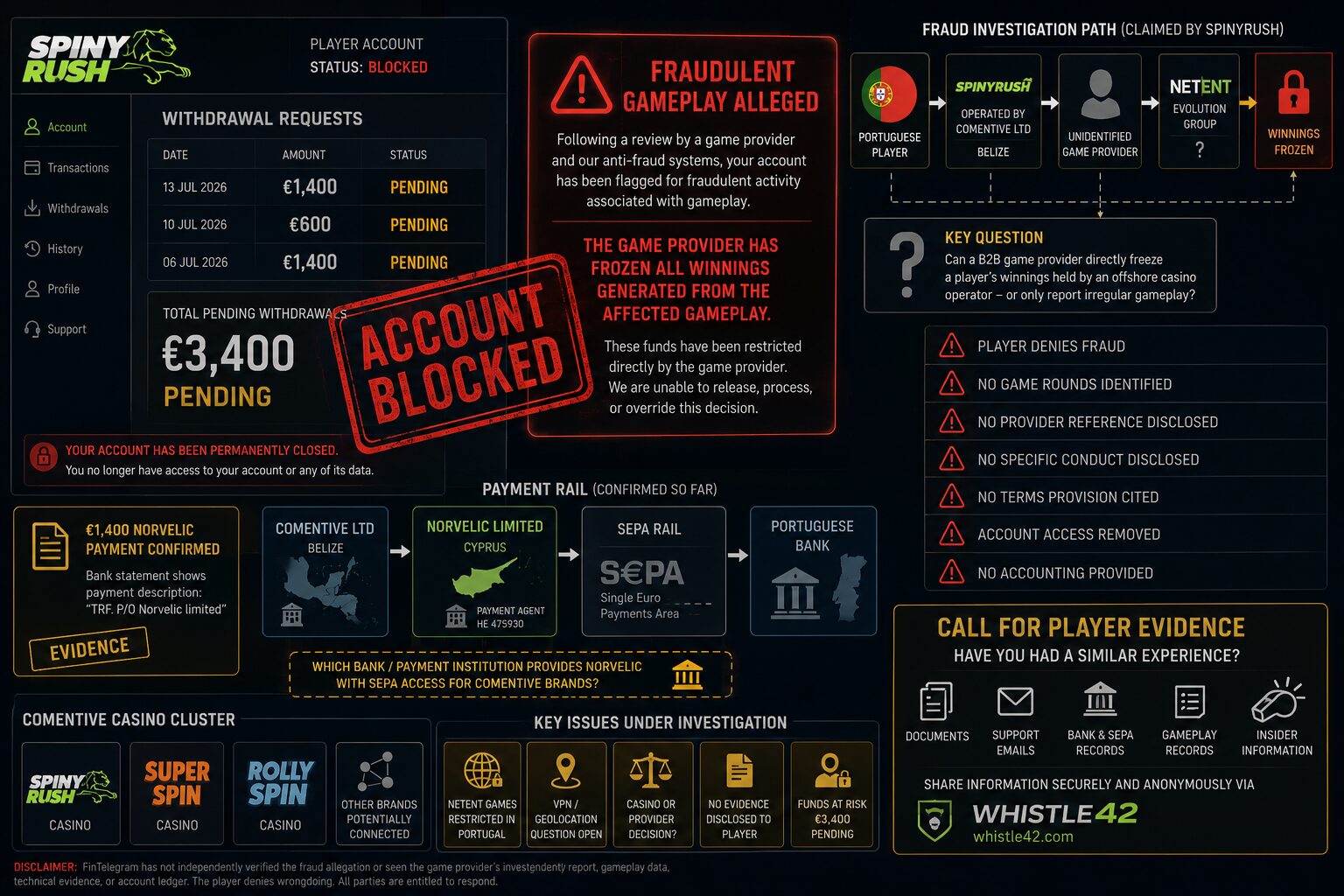
After FinTelegram reported a Portuguese player’s pending withdrawals, SpinyRush changed its explanation: the casino now alleges fraudulent gameplay, says an unidentified game provider directly froze the winnings, and has permanently blocked the player’s account. The player denies wrongdoing, and FinTelegram has not seen evidence substantiating the fraud allegation.
Key Findings
- SpinyRush has escalated the dispute from an unexplained withdrawal delay to an allegation of “fraudulent gameplay,” the announced confiscation of €3,400, and the permanent closure of the player’s account. The Portuguese player denies any wrongdoing.
- The fraud allegation emerged only after the player had repeatedly challenged the delayed withdrawals. Before that, SpinyRush support described the three withdrawals merely as pending, under review, or waiting in a processing queue. No fraud investigation, bonus breach, KYC failure, AML concern, multiple-account issue, VPN use, or manipulated gameplay had been communicated to her.
- SpinyRush has not substantiated its accusation. The casino has not identified the allegedly fraudulent conduct, the affected game rounds, the relevant dates, the provider’s incident reference, the evidence relied upon, or the specific contractual provision allegedly breached.
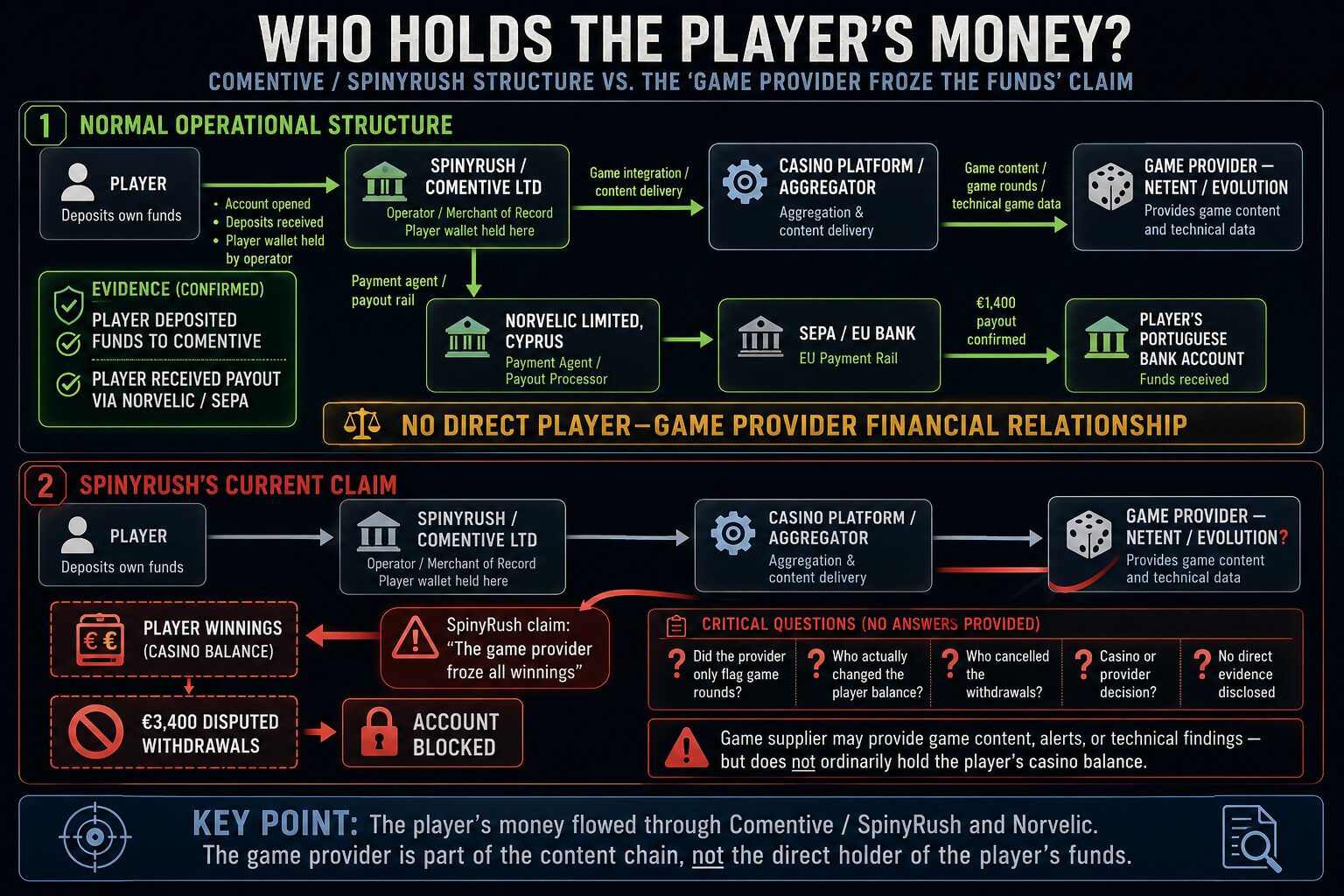
- SpinyRush claims that an unidentified game provider directly froze the player’s winnings and that the casino cannot release or override the decision. This explanation appears inconsistent with the normal B2B supplier model and with Evolution’s own statement that it does not handle players or player money.
- A game supplier may flag suspicious or invalid gameplay, challenge specific rounds, or require technical corrections. It does not ordinarily hold the casino customer’s balance. The cancellation of withdrawals, removal of €3,400, and closure of the account therefore had to be implemented by Comentive, SpinyRush, its platform operator, or another entity controlling the player wallet.
- SpinyRush’s attempt to shift responsibility entirely to an unnamed supplier is therefore unconvincing without documentary evidence. Comentive should disclose whether the provider merely issued a technical finding or whether it allegedly issued a binding contractual instruction—and identify who actually changed the player balance and confiscated the funds.
- The player says she played only a NetEnt title described as “Quest of Immortality.” NetEnt/Evolution has not confirmed that it investigated her gameplay, invalidated any rounds, or instructed Comentive to withhold or confiscate the €3,400.
- SpinyRush’s own terms state that NetEnt games are unavailable in Portugal and prohibit the use of VPNs or similar tools to bypass geographic restrictions. FinTelegram has not yet established whether the player used any VPN, proxy, privacy relay, remote desktop, or location-spoofing technology. This remains an open evidentiary question.
- A bank-generated Millennium bcp record confirms that the player previously received €1,400 through a transaction carrying the description “TRF. P/O Norvelic limited.” This materially strengthens the evidence that Cyprus-registered Norvelic Limited is operationally involved in payouts connected to Comentive’s casino network.
- The payment document does not yet identify Norvelic’s bank or payment institution. The debtor IBAN, BIC, SEPA End-to-End reference, and underlying regulated payment provider remain central to FinTelegram’s payment-rail investigation.
- The account block prevents the player from accessing her transaction history, gameplay records, deposits, withdrawals, and account ledger. SpinyRush has not provided a complete accounting showing which game rounds were voided, how the €3,400 was calculated, or how the player’s reported €900 in deposits was treated.
- FinTelegram has not independently verified the fraud allegation and has seen no provider report, server logs, IP records, device data, round-level evidence, or investigation reference supporting it. Until Comentive produces such evidence, the accusation remains unsubstantiated from FinTelegram’s perspective.
- The wider compliance issue remains significant: a Portuguese player was accepted and paid through an offshore casino structure involving Belize-based Comentive, an Anjouan licence, Cyprus-based Norvelic, and European SEPA rails, while SpinyRush does not appear to hold a Portuguese SRIJ licence.
- FinTelegram is seeking further evidence from players, insiders, game suppliers, platform providers, banks, PSPs, and compliance professionals concerning SpinyRush, Comentive, Norvelic, Super Spin, Rolly Spin, disputed gameplay investigations, account closures, and casino payment rails.
From a Withdrawal Queue to a Fraud Allegation
On 17 July 2026, FinTelegram reported that a verified Portuguese player had submitted screenshots showing three pending SpinyRush withdrawals totaling €3,400. The documented withdrawal requests were dated 6, 10, and 13 July 2026.
At the time of FinTelegram’s first report, SpinyRush had not told the player that the delay was connected to fraud, bonus abuse, KYC, AML, multiple accounts, manipulated gameplay, or VPN use. Support repeatedly told the player that the withdrawals were being reviewed, processed, or waiting in a queue. The case has now escalated.
In a new communication reviewed by FinTelegram, SpinyRush told the player that a “comprehensive investigation” involving a game provider and its anti-fraud systems had allegedly identified fraudulent gameplay. The casino stated that:
“The game provider has frozen all winnings generated from the affected gameplay.”
SpinyRush further claimed that the funds had been restricted directly by the game provider and that the casino was therefore unable to release, process, or override the decision. According to the communication, the disputed winnings will be removed and the player account permanently closed.
The player categorically denies engaging in fraudulent activity.
Account Access Removed
A newly submitted screenshot shows a Portuguese-language notification stating that the player’s account is blocked. The player says she can no longer access:
- her withdrawal history;
- deposit history;
- transaction records;
- gameplay and round history;
- account balance;
- or communications and records stored within the player account.
The screenshot establishes that access has been blocked. It does not, by itself, establish precisely how the €3,400 was booked internally or whether the three withdrawals have technically been cancelled, rejected, reversed, or confiscated. SpinyRush has not, in the correspondence reviewed by FinTelegram, provided a final account statement showing how the disputed amount was calculated.
An Unspecified Fraud Allegation
The new SpinyRush notice does not identify:
- the allegedly fraudulent conduct;
- the affected game sessions or rounds;
- the dates and times of the relevant gameplay;
- the game provider involved;
- the investigation or incident reference;
- the contractual provision allegedly breached;
- or the evidence relied upon.
It also does not say whether the allegation concerns:
- VPN or geolocation circumvention;
- multiple accounts;
- automated gameplay;
- collusion;
- bonus abuse;
- exploitation of a technical malfunction;
- irregular betting patterns;
- chargebacks;
- or another suspected activity.
The player has formally disputed the allegation and requested a substantive explanation, preservation of all records, a full account statement, and details of any appeal process.
A Game Supplier Does Not Hold the Player’s Money
SpinyRush’s explanation appears to misrepresent the normal division of responsibility between a B2B game supplier and a casino operator.
Evolution, the owner of the NetEnt brand, has expressly stated that it does not handle players or any of the players’ money. According to Evolution, the game supplier provides its content to B2C casino operators or B2B aggregators, while the operator maintains the player relationship, determines which players may access the games, and handles all bets and limits.
A game supplier may analyse gameplay, identify technical irregularities, flag suspicious rounds, block access to its content, or inform an operator that particular game results should be treated as invalid. It may also have contractual rights requiring an operator or aggregator to reverse affected game transactions. That is not the same as directly holding or freezing money in a casino player’s account.
The player balance, withdrawal requests, and customer funds are controlled by the casino operator or by a wallet or platform provider acting for the operator. Accordingly, even if NetEnt or another supplier challenged particular game rounds, the decision to cancel the three withdrawals, remove €3,400 from the account, and permanently close the player account would have to be implemented by Comentive, SpinyRush, or its platform operator.
SpinyRush nevertheless told the player: “The game provider has frozen all winnings generated from the affected gameplay.” It further claimed: “As these funds have been restricted directly by the game provider, we are unable to release, process, or override this decision.”
On the basis of Evolution’s own description of its B2B business model, that explanation appears at least materially misleading if NetEnt/Evolution is the supplier concerned. The more plausible operational scenario is that a supplier or aggregator allegedly flagged or invalidated certain game rounds and that Comentive subsequently decided—or considered itself contractually required—to cancel the withdrawals and remove the disputed balance.
Comentive should therefore disclose:
- the identity of the game supplier;
- the exact game and affected round IDs;
- the supplier’s report or incident reference;
- whether the supplier merely issued a technical finding or a contractual instruction;
- which entity actually changed the player balance;
- which entity cancelled or confiscated the €3,400;
- and the contractual provision under which Comentive claims it had no discretion.
SpinyRush’s attempt to portray itself as unable to act because the game provider directly froze the money is inconsistent with Evolution’s own description of its role. A supplier may challenge game rounds; it does not hold the casino customer’s money.
SpinyRush’s Own Terms Point Back to the Casino
SpinyRush’s terms state that the casino is the final decision-maker on whether a player has violated its terms in a way that results in suspension or permanent exclusion. The same terms give the casino extensive powers to suspend accounts, retain payments, discard winnings, and confiscate funds in cases of suspected or established fraud.
That creates an apparent tension between “The casino is the final decision-maker” and “The game provider froze the funds directly, and the casino cannot override it.“
FinTelegram has therefore asked for evidence showing the exact legal, contractual, and technical role of the game provider in this case.
The NetEnt and Portugal Problem
The player says that she played only one game on SpinyRush: the NetEnt game Quest of Immortality. SpinyRush’s current terms contain a potentially critical restriction. They state that NetEnt games are unavailable in Portugal. The terms also prohibit VPNs and other tools used to bypass game-provider geographical restrictions and warn that circumvention may result in confiscation of winnings.
This produces two competing lines of inquiry.
- No circumvention: Should the player have accessed SpinyRush from Portugal without using a VPN or other location-masking technology, the question would be why SpinyRush, its platform, or its game aggregator made a restricted NetEnt title available to a verified Portuguese customer. The operator would also need to explain why it accepted the stakes and permitted the gameplay before later attributing the confiscation to the game provider.
- Possible circumvention: Should the player have used a VPN, proxy, privacy relay, location-spoofing application, remote desktop service, or another tool that caused her location to appear outside Portugal, SpinyRush may have a relevant contractual argument under its published terms.
The player denies fraudulent activity.
Norvelic Payment Rail Confirmed
The latest evidence package also materially strengthens the payment-rail component of the investigation. FinTelegram reviewed a bank-generated Millennium bcp transaction document showing that the Portuguese player received €1,400 on 6 July 2026. The transaction description reads:
“TRF. P/O Norvelic limited”
This confirms that Norvelic Limited appeared in the banking record associated with the completed payout. SpinyRush’s own legal disclosure identifies Belize-registered Comentive LTD as the owner and operator and Cyprus-registered Norvelic Limited, HE 475930, as Comentive’s payment agent.
It therefore confirms Norvelic’s appearance in a real payout but does not yet identify the regulated financial institution providing the underlying SEPA access. That remains a central FinTelegram investigation question:
Which bank, EMI, or payment institution provides Norvelic Limited with the accounts and infrastructure used for payouts connected to Comentive’s offshore casino brands?
Player Funds and the Missing Accounting
According to the player, she deposited a total of €900 into her SpinyRush account. The evidence reviewed by FinTelegram shows that she subsequently received one completed payout of €1,400. A bank-generated Millennium bcp document records that payment with the description: “TRF. P/O Norvelic limited.”
She then submitted three further withdrawal requests:
| Withdrawal request | Amount |
|---|---|
| First pending withdrawal | €1,400 |
| Second pending withdrawal | €600 |
| Third pending withdrawal | €1,400 |
| Total disputed withdrawals | €3,400 |
On the player’s account, the complete financial picture is therefore:
- Total deposited: €900
- Already received: €1,400
- Further withdrawals claimed: €3,400
- Total payouts received or requested: €4,800
SpinyRush has now announced that the winnings will be removed because of alleged “fraudulent activity associated with gameplay.” However, the casino has not provided a transaction-level accounting showing:
- which game rounds it considers invalid;
- how much was won in each disputed round;
- how the €3,400 confiscation amount was calculated;
- whether the three withdrawals were cancelled, rejected, or reversed;
- whether any part of the player’s own funds remained unused in the account;
- and what the final account balance was when access was blocked.
The player has also requested the return of her €900 in deposits if SpinyRush refuses to pay the winnings. That request requires a proper accounting.
Once deposited funds have been wagered, they are generally no longer held as a separate, untouched pool of money. Some of the €900 may have been lost through gameplay, while other amounts may have formed part of the balance that later generated the disputed winnings. It is therefore not possible, on the current evidence, simply to conclude that the entire €900 remains separately refundable.
Comentive should nevertheless provide a complete ledger reconciling:
Opening balance + deposits − stakes + losses + winnings − completed withdrawals − reversals = final balance
Without that accounting, neither the player nor FinTelegram can verify how SpinyRush arrived at the proposed confiscation or whether any portion of the player’s own deposited funds is also being withheld.
GDPR Access Request
After being locked out of the account, the player submitted a formal Data Subject Access Request to SpinyRush and Comentive LTD. She requested access to personal data connected to:
- her account;
- deposits and withdrawals;
- gameplay records;
- login and IP records;
- device identifiers;
- KYC documents;
- fraud flags and risk scores;
- internal account notes;
- provider communications concerning her;
- and any automated decision-making or profiling involved in the account closure and restriction of funds.
SpinyRush’s privacy policy states that it collects transaction, device, IP, KYC, and account information, processes data for fraud prevention and game integrity, and may share information with payment processors, gaming operators, banks, card schemes, and authorities. The same policy expressly refers to GDPR complaint rights.
Evolution’s current privacy policy provides a dedicated contact for data-protection inquiries. However, the extent to which Evolution or NetEnt processed this particular player’s personal data and whether it acted as controller, joint controller, or processor in any fraud assessment remains unknown.
Portugal Market Access Remains an Issue
SpinyRush accepted and verified a Portuguese resident and completed at least one payment into her Portuguese bank account. Portugal’s SRIJ states that only entities licensed by the Portuguese regulator may offer online gambling in Portugal. SpinyRush and Comentive are not identified on the current SRIJ licensed-operator list.
The SRIJ further states that websites accessible from Portugal that offer online gambling without the necessary Portuguese licence are acting illegally. The regulator may notify operators, request website blocking by internet service providers, and refer cases to prosecutors. An Anjouan licence does not replace the Portuguese licence required to target or serve the Portuguese market.
Right to Reply and Questions for Comentive
FinTelegram invites SpinyRush, Comentive LTD, and Norvelic Limited to provide a substantive response. In particular:
- What exact conduct does Comentive allege constituted fraudulent gameplay?
- Was the alleged infringement related to VPN use, geolocation, multiple accounts, automation, collusion, a software error, bonus abuse, chargebacks, or another issue?
- Which specific game, game sessions, dates, and round IDs are affected?
- Which contractual provisions were applied?
- Was NetEnt or another Evolution entity the game provider referred to?
- Did the provider issue an alert, recommendation, contractual instruction, or binding determination?
- Did the provider directly control the player’s balance, or did Comentive decide to cancel the withdrawals and remove the winnings?
- What is the provider’s investigation or incident reference?
- When did the alleged investigation begin?
- Why was the player repeatedly told that the withdrawals were merely waiting in a processing queue?
- How was a NetEnt game made available to a Portuguese player when SpinyRush’s own terms state that NetEnt games are unavailable in Portugal?
- Is Comentive alleging that the player used a VPN or another location-masking technology?
- Which game rounds have been voided, and how was the €3,400 amount calculated?
- What happened to the player’s three withdrawal requests?
- Which bank or payment institution processed the earlier €1,400 payment carrying the Norvelic description?
- What appeal or independent dispute-resolution procedure is available to the player?
Questions for Evolution and NetEnt
FinTelegram also invites Evolution/NetEnt to clarify:
- Whether it received or analysed gameplay data connected to this player;
- whether it identified suspicious, manipulated, invalid, or geographically restricted gameplay;
- whether it issued any instruction or recommendation concerning the player’s winnings;
- whether it can directly freeze money held in a third-party casino player account;
- whether Comentive or SpinyRush was directly or indirectly authorised to offer the relevant NetEnt game;
- which game aggregator or platform delivered the NetEnt content to SpinyRush;
- whether the game was permitted to be offered to a player located in Portugal;
- and whether all relevant gameplay, technical, geolocation, and investigation records will be preserved.
FinTelegram will update its reporting if substantive responses or supporting evidence are received.
Call for Evidence: SpinyRush and the Comentive Casino Cluster
FinTelegram is expanding its investigation into SpinyRush, Comentive LTD, Norvelic Limited, and associated casino, game-supply, and payment infrastructure. We are asking players, former employees, game-provider staff, platform operators, payment professionals, banks, compliance officers, and other knowledgeable sources to provide information. Information may be submitted discreetly and, where preferred, anonymously through Whistle42.
Whistle42 accepts screenshots, documents, emails, transaction references, technical identifiers, and structured timelines. Sources control what they disclose and whether they identify themselves.