

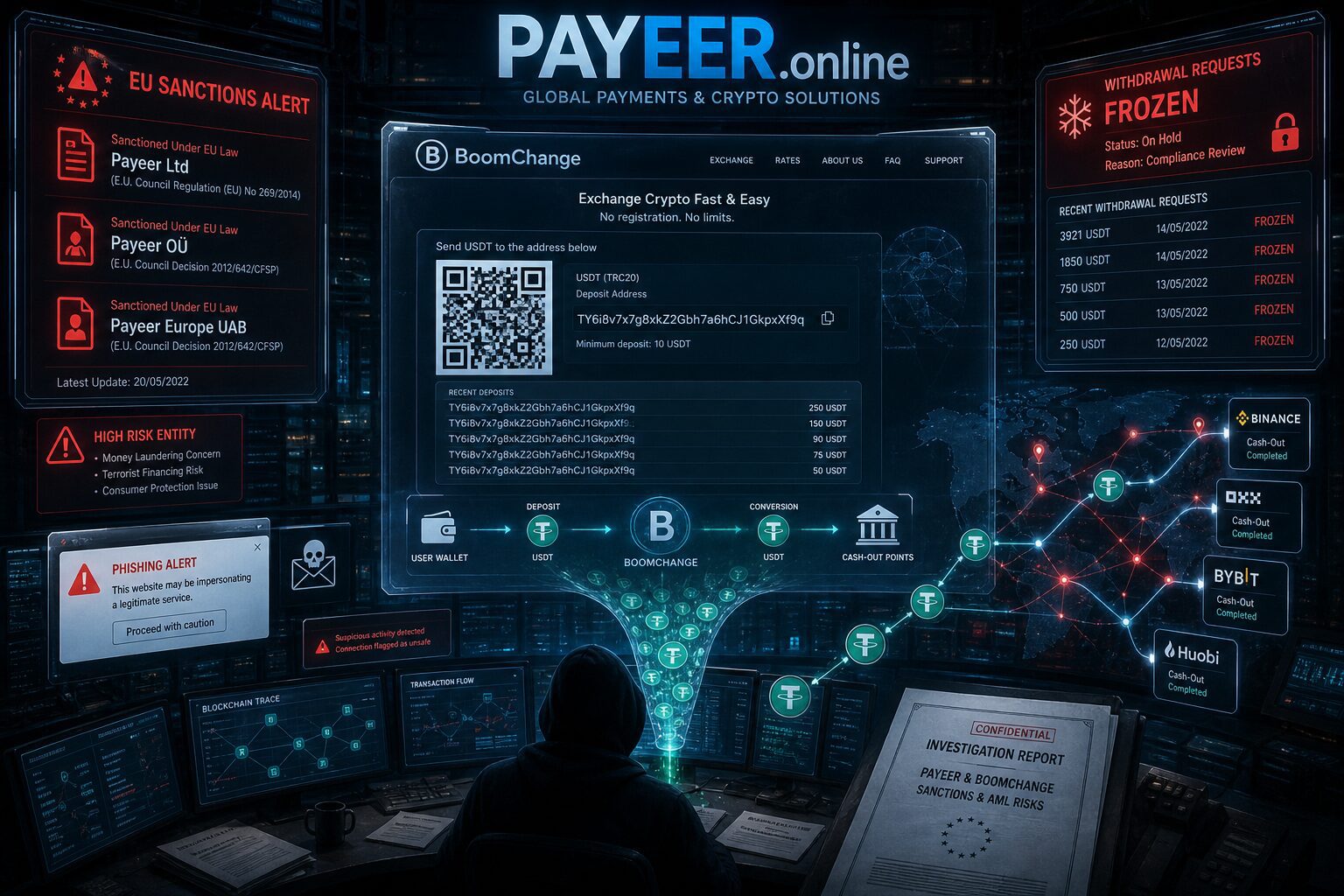
A June 2026 promotional article on openPR explains how users can transfer USDT into Payeer through BoomChange, even though Payeer has been linked to EU sanctions measures, Lithuanian sanctions and AML enforcement, and persistent customer complaints over blocked withdrawals. Evidence from a detailed Bitcointalk scam thread materially escalates the risk profile of BoomChange, which is presented not merely as an opaque crypto intermediary but as a suspected fake exchange operation tied to static deposit addresses, phishing-style behavior, and wallet flows allegedly ending at Binance.
Key Findings
- The openPR press release explicitly promotes a 2026 workflow for sending USDT into Payeer via BoomChange and presents that path as a normal convenience service for online users and remote workers.
- Specialist sanctions and compliance sources report that Payeer was targeted under the EU’s 19th sanctions package, with a transaction ban or equivalent transaction prohibition taking effect in November 2025 after a short wind-down period.
- Lithuanian FCIS/FNTT enforcement reportedly imposed roughly €9.3 million in penalties on Payeer for sanctions breaches and AML failures, including dealings involving sanctioned Russian banks.
- FinTelegram has documented repeated complaints from Payeer users about frozen balances, blocked accounts, and failed withdrawals during the sanctions-driven shutdown phase.
- Payeer no longer appears reachable on the legacy domain
payeer.com, which now returns an NXDOMAIN error in live retrieval, while the currently active public-facing site ispayeer.online. - The current payeer.online site presents itself as a global payment gateway based around merchant acquiring, cards, PayPal, crypto, WeChat Pay, and Alipay rather than the older wallet-centered interface historically associated with payeer.com.
- The Bitcointalk thread on BoomChange alleges that boomchange.com, boomchange.io, and boomchange.net operate as fake exchanges using static deposit addresses that route victim funds into operator-controlled wallets.
- The same Bitcointalk report links BoomChange to an Armenia footprint, identifies multiple email addresses, phone numbers, IP addresses, social-media accounts, and hosting or registrar changes, but none of this amounts to transparent corporate disclosure or verified beneficial ownership.
- No verifiable legal operator or beneficial owner for BoomChange was identified on its public website, which remains a severe compliance red flag for a platform routing crypto into payment environments such as Payeer.
- In risk terms, the BoomChange-Payeer pathway combines sanctions exposure, AML deficiencies, consumer harm, and scam indicators in a single transaction chain.
Press Release Analysis
The openPR article titled “How to Transfer USDT into Payeer in 2026” is framed as a simple user guide for moving stablecoins into a payment account. It positions BoomChange as the transfer mechanism and Payeer as the destination platform, while naming additional payment brands such as Skrill, Wise, Payoneer, PayPal, and Cash App to normalize the route.
The article is problematic because it is not merely descriptive. It is operational marketing that guides users from USDT into Payeer without mentioning the sanctions, enforcement, withdrawal, or consumer-risk issues now associated with the Payeer ecosystem.
After incorporating the Bitcointalk material, the omission becomes even more serious. The release does not just promote access to a sanctioned or restricted payment rail; it appears to direct users through a platform that has been publicly accused of functioning as a fake exchange scam using static wallet infrastructure and phishing-style collection mechanisms.
Payeer: Sanctions, Enforcement, and Domain Shift
EU sanctions and shutdown context
Specialist sanctions and crypto-compliance reporting states that Payeer was included in the EU’s 19th sanctions package against Russia, with the measures taking effect in November 2025 after a limited wind-down period. These reports characterize the measure as a ban on transactions involving Payeer and highlight the significance of the case because it directly touches the crypto and payment-services perimeter.
That matters for any intermediary touching the flow. If a third-party exchanger, wallet service, PSP, acquirer, or banking partner enables funds to be routed into Payeer after the prohibition became effective, the risk shifts from abstract association to possible direct or indirect facilitation.
Lithuanian enforcement and complaint pattern
Lithuanian FCIS/FNTT reporting described major sanctions and AML failures at Payeer and imposed penalties totaling approximately EUR 9.3 million. Public reports say the findings included transactions involving sanctioned Russian banks, weaknesses in customer due diligence, and failures connected to suspicious transaction monitoring and reporting.
FinTelegram’s reporting adds the practical consumer dimension. It documents complaints from users whose withdrawals were blocked or delayed and whose balances became trapped as the sanctions-driven exit period unfolded.
From payeer.com to payeer.online
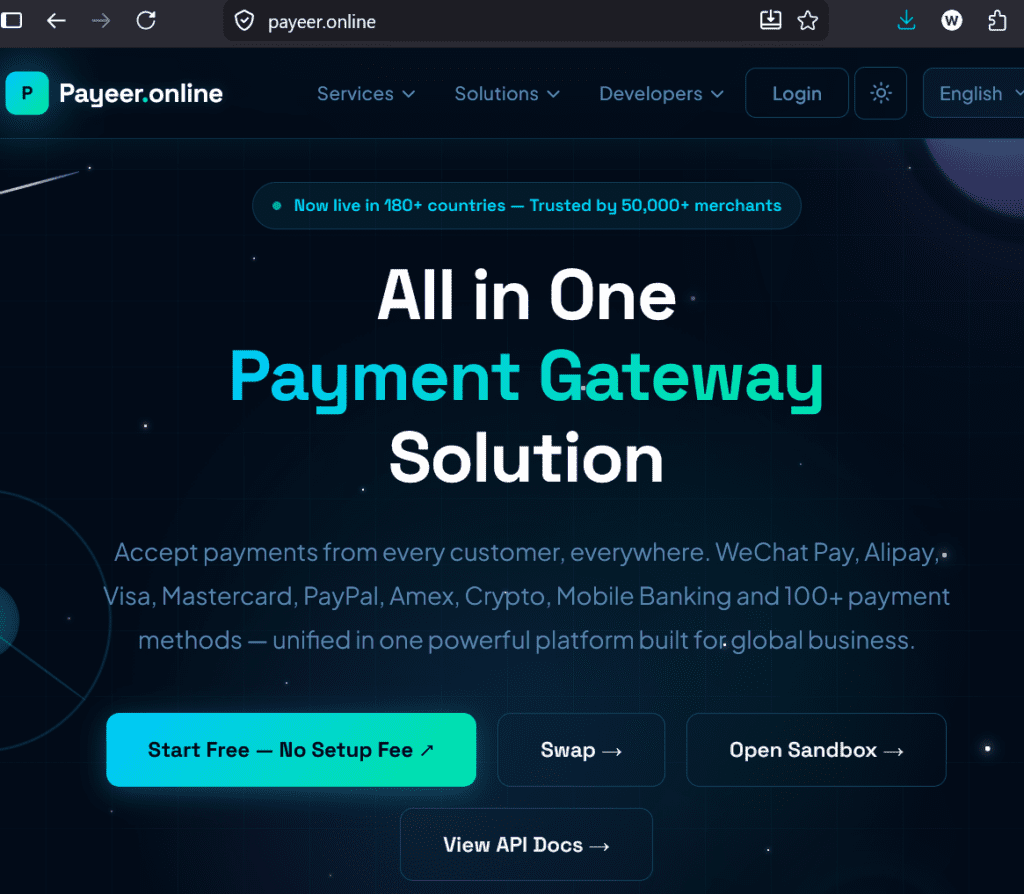
A live retrieval of payeer.com now returns a DNS error, indicating that the legacy domain is no longer reachable at the time of review. In contrast, payeer.online is active and currently markets itself as an all-in-one international payment gateway offering cards, PayPal, crypto, WeChat Pay, Alipay, API integration, and merchant services in more than 180 countries.
This domain change is analytically important. It indicates that Payeer’s current web presence has shifted away from the older payeer.com brand entry point and toward a new domain with a different public presentation, one that emphasizes merchant acquiring, global coverage, and broad payment-method support rather than the historic wallet image widely associated with Payeer.
That does not reduce the underlying compliance concern. If anything, a post-enforcement rebranding or domain migration can make customer screening, adverse-media detection, and sanctions controls harder unless institutions actively map historical domains, trade names, and legacy references to the currently active infrastructure.
BoomChange: Scam Indicators and Ownership Clues
Public website and transparency failures
BoomChange’s public website presents the service as an instant crypto exchange with fast execution, no-registration usage, and multiple conversion paths involving crypto and payment destinations. It does not clearly identify a legal operator, jurisdiction of incorporation, licensing authority, directors, or beneficial owners in a way expected from a regulated CASP or payment intermediary.
That alone already justified a high-risk classification. After reviewing the Bitcointalk evidence, however, the risk assessment must be strengthened from opaque intermediary to suspected fake-exchange scam operation.
Bitcointalk scam evidence
The Bitcointalk thread titled “SCAM – Boomchange.com / Boomchange.io / Boomchange.net – Fake Crypto Exchanges” contains a detailed allegation set backed by wallet addresses, archived pages, social-media references, and transaction links. The core allegation is that BoomChange uses static order pages and repeatedly shows the same deposit addresses to different visitors, which is inconsistent with how legitimate instant-exchange order management normally works.
The thread lists numerous crypto addresses across Bitcoin, Ethereum, Litecoin, Solana, Tron, BNB, Perfect Money, and other networks, and alleges that victim funds were consolidated and then moved onward, in many cited cases to Binance-linked destinations. It also notes that MetaMask’s phishing-warning list and several scam-reporting services had already flagged BoomChange-related domains or addresses.
As a matter of editorial caution, the Bitcointalk material is community-sourced and accusatory in tone. Even so, the density of technical indicators, the consistency of the allegations, and the overlap with BoomChange’s missing ownership transparency make the thread highly relevant adverse-media evidence that cannot be ignored in a compliance analysis.
Operators and beneficial ownership
The Bitcointalk post attributes BoomChange to an operator in Yerevan, Armenia and identifies a cluster of contact points including email addresses such as [email protected], [email protected], [email protected], [email protected], [email protected], and [email protected], as well as the phone number +1 850 280 0803 used on social and messaging channels. It also references Armenian IP addresses, Ucom and Telecom AM connectivity, hosting via Koddos/Amarutu Technology, and registrar changes from Namecheap to Nicenic and later Internet Domain Service BS Corp.
Those indicators point to an operational footprint, but they do not establish verified beneficial ownership in a corporate-law sense. At present, the evidence supports describing BoomChange as a suspected Armenia-linked scam operation with identified digital traces, not as a transparently owned or lawfully disclosed business.
The thread also mentions a possible link to Smartweb.am and to another project, iptvleopard.com, through overlapping promotion patterns and archived content. Those links are investigatively relevant and may justify further OSINT work, but they should be presented as leads rather than settled findings unless confirmed through company records, domain control evidence, payment data, or insider documentation.
Compliance Analysis
Sanctions risk
The sanctions issue is straightforward. Any service route that enables users to move value into Payeer after the EU prohibition took effect creates a direct or indirect sanctions exposure for the user and for any intermediary facilitating the chain.
This is precisely why the BoomChange link is so troubling. A suspected scam exchange with weak or absent transparency is being used in promotional content as the bridge into a payment environment already burdened by sanctions and enforcement findings.
AML and fraud risk
The AML risk profile is compounded rather than additive. Payeer carries a documented history of sanctions and AML enforcement, while BoomChange now shows significant public scam indicators including static deposit addresses, alleged phishing behavior, and address-level abuse reporting.
For compliance teams, this combination should trigger enhanced due diligence, counterparty restrictions, wallet screening, transaction monitoring, and partner review at the highest risk level. Institutions that continue to process related flows without tracing destination logic, domain relationships, and adverse-media indicators would be exposed not only to financial crime risk but also to serious supervisory criticism.
Consumer protection and market integrity
The consumer-harm narrative is no longer limited to frozen Payeer withdrawals. If users are directed first into BoomChange and then onward into Payeer, they face the risk of losing funds at two separate points in the chain: first to a suspected scam exchanger, and second to a sanctioned or shutdown-affected payment platform with documented withdrawal complaints.
That makes the openPR article especially problematic from a market-integrity perspective. It presents a high-risk transaction route as a routine financial convenience while suppressing material facts that would likely alter user behavior and partner risk assessments.
Key Data Table
Whistleblower Call
Whistleblowers, former staff, banking and PSP partners, vendors, hosting providers, domain registrars, exchange compliance officers, and affected customers with information on Payeer or BoomChange should submit evidence to Whistle42 and FinTelegram. Especially valuable are internal communications, KYC and sanctions procedures, merchant or affiliate contracts, wallet-cluster data, registrar and hosting records, beneficial ownership documents, and evidence showing how customer or victim funds were routed.
Submissions are particularly important where they help identify the real operators behind BoomChange, explain the shift from payeer.com to payeer.online, document any continuing service relationships after sanctions took effect, or prove the use of third-party exchanges and payment rails to keep restricted flows alive.