



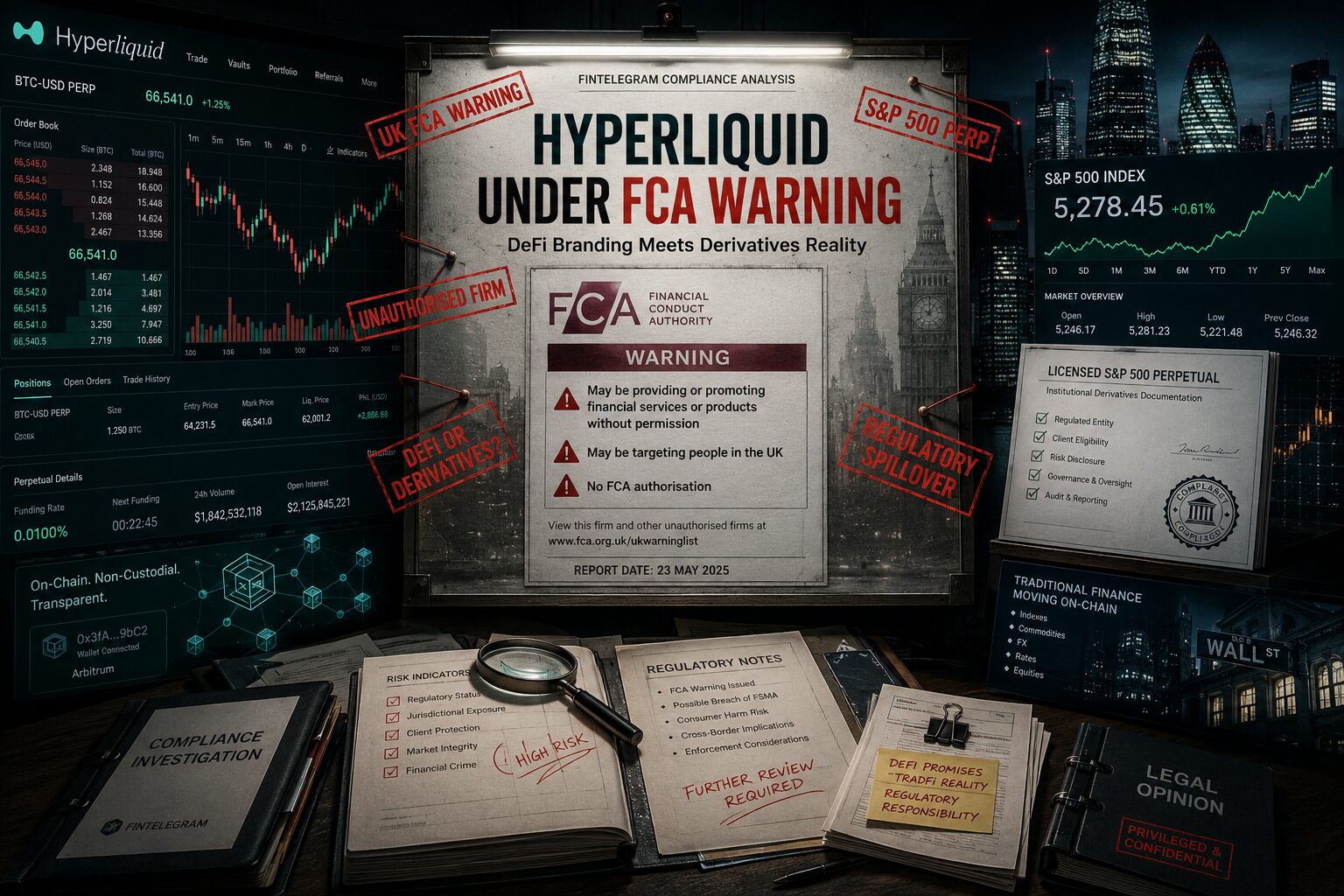
The UK Financial Conduct Authority (FCA) has placed Hyperliquid on its Warning List. The warning was first published on 21 May 2026 and updated on 7 June 2026. The FCA states that Hyperliquid may be providing or promoting financial services or products without FCA permission, and that the firm is not authorised and may be targeting people in the UK. The warning expressly lists hyperfoundation.org, app.hyperliquid.xyz, and Hyperliquid’s social channels as relevant contact points.
This is not merely a consumer warning. From a compliance perspective, it is a regulatory classification signal: the FCA appears to treat Hyperliquid’s activities not as neutral software, but as potentially unauthorised financial services or financial promotions directed at UK users.
Executive Summary
Hyperliquid has built one of the most successful on-chain perpetual futures venues by positioning itself as a decentralised exchange infrastructure rather than a traditional broker, exchange, or custodian. However, that distinction is becoming less persuasive for regulators. The platform enables leveraged perpetual derivatives, including crypto and real-world-asset-linked markets. These products are economically comparable to regulated derivatives, regardless of whether users maintain self-custody of their wallets.
The FCA warning therefore exposes the core regulatory issue: decentralisation does not neutralise financial product regulation. If a platform facilitates leveraged long/short exposure, margining, liquidation, funding payments, order execution, and market access, regulators may look at the economic substance rather than the technological wrapper.
The warning is especially sensitive because Hyperliquid has moved beyond crypto-native markets. In March 2026, S&P Dow Jones Indices licensed the S&P 500 to Trade[XYZ] for a perpetual derivative contract on Hyperliquid, described by S&P DJI as the first officially licensed S&P 500 perpetual powered directly by institutional-grade index data. The announcement states that Trade[XYZ] launched the market on Hyperliquid and that eligible non-US investors could gain leveraged exposure to the S&P 500 through the product.
That development changes the regulatory optics. Hyperliquid is no longer only a DeFi venue for crypto perps. It is becoming an on-chain infrastructure layer for synthetic exposure to traditional financial benchmarks.
Key Compliance Findings
| Issue | FinTelegram Assessment |
|---|---|
| FCA Status | Hyperliquid is now publicly listed by the FCA as an unauthorised firm that may be providing or promoting financial services or products without permission. |
| Product Classification | Hyperliquid perps are economically derivatives: leveraged, cash-settled, no fixed expiry, long/short exposure, margining, liquidation and funding mechanics. |
| Custody Argument | The fact that Hyperliquid may be non-custodial does not remove the regulatory character of the traded product or the activity of operating/promoting access to it. |
| UK Retail Risk | The UK has banned the sale of crypto-derivatives and ETNs referencing certain cryptoassets to retail consumers since January 2021. The FCA has stated that firms offering such services to retail consumers are likely to be scams. |
| Financial Promotion Risk | UK cryptoasset financial promotion rules apply broadly to firms marketing qualifying cryptoassets to UK consumers, including overseas firms and technology-based delivery models. |
| EU / MiFID Risk | In the EU, crypto-linked derivatives are not simply “MiCA products.” ESMA has clarified that cryptoassets can serve as underlying assets for derivative contracts, and such derivatives may fall under MiFID-style financial instrument analysis. |
| U.S. Regulatory Pressure | The CFTC has recently approved regulated perpetual futures paths for U.S. venues such as Kalshi, while CME and ICE have reportedly urged scrutiny of Hyperliquid over market manipulation and sanctions-evasion concerns. |
Why the FCA Warning Matters
The FCA warning is short, but its implications are broad. The regulator states that almost all firms and individuals must be authorised or registered to carry out or promote financial services in the UK, and that Hyperliquid is not authorised. It also warns users that they will not have access to the Financial Ombudsman Service or Financial Services Compensation Scheme if they deal with the firm.
For FinTelegram, the important point is not whether Hyperliquid calls itself DeFi. The question is whether the platform enables access to regulated-style financial products for users in regulated jurisdictions. On that test, Hyperliquid’s position is vulnerable.
Perpetual futures are not ordinary crypto tokens. They are leveraged derivatives. Their key features include no fixed expiry, synthetic exposure to an underlying asset, margin requirements, funding-rate mechanisms, forced liquidations and long/short trading. S&P DJI’s own announcement describes perpetual derivatives as instruments allowing eligible investors to take leveraged long or short positions without fixed expiry.
That is precisely the language of financial derivatives.
The DeFi Defence: Weakening Under Regulatory Scrutiny
Hyperliquid’s implicit defence has been the familiar DeFi argument: the protocol is decentralised, users connect wallets, and the platform may not take custody of assets in the traditional sense. But this argument is increasingly insufficient. Regulators are likely to focus on the following questions:
- Who designed and maintains the interface?
The FCA warning specifically names the Hyperliquid website, application interface and social channels. - Who promotes the product or ecosystem?
A DeFi protocol with active marketing, public social channels, branded access points and coordinated ecosystem messaging may be treated differently from passive open-source code. - Who controls listing, margin, liquidation and risk architecture?
Hyperliquid’s own documentation indicates that builder-deployed perpetual markets involve market definition, oracle definitions, contract specifications, leverage limits and settlement responsibilities. - Are users receiving access to a regulated economic exposure?
Whether the collateral sits in a non-custodial wallet does not alter the fact that the user is trading a leveraged derivative.
In other words: self-custody may reduce custody-regulation exposure, but it does not eliminate derivatives, market infrastructure, financial promotion, AML, sanctions, consumer protection or market abuse issues.
The S&P 500 Perpetual: A Strategic Breakthrough — and a Regulatory Trigger
The S&P 500 perpetual product is a major credibility signal for Hyperliquid’s ecosystem. But it is also a regulatory trigger.
S&P DJI announced that it licensed the S&P 500 to Trade[XYZ], not directly to Hyperliquid, for a perpetual derivative contract on Hyperliquid. The announcement describes Trade[XYZ] as a provider of real-world-asset markets via perpetual derivatives on Hyperliquid and says XYZ markets had exceeded $100 billion in volume since October 2025, with an annualised run rate above $600 billion.
This matters because the product links a major traditional finance benchmark to a decentralised derivatives venue. It invites regulators to ask whether global retail or semi-professional users can access leveraged synthetic exposure to major equity indices outside traditional exchange, clearing, conduct and investor-protection frameworks.
For FinTelegram, this is the inflection point: Hyperliquid is no longer merely a crypto-native DeFi venue. It is becoming a shadow derivatives infrastructure for traditional market exposure.
UK Compliance Situation After the FCA Warning
The UK position is now materially adverse for Hyperliquid.
First, the FCA warning means that UK consumers, regulated firms, payment partners, service providers, affiliates and media partners are on notice. Any party facilitating access, promotion, payments, referrals or onboarding for Hyperliquid in the UK now faces enhanced compliance risk.
Second, the UK already has a restrictive stance on crypto derivatives. The FCA’s ban on the sale of crypto-derivatives and ETNs referencing certain cryptoassets to retail consumers came into effect in January 2021. The FCA stated that any firm offering such services to retail consumers is likely to be a scam.
Third, the UK financial promotion regime captures cryptoasset promotions to UK consumers even when the firm is based overseas or uses technology-based delivery.
This creates a three-layer UK problem for Hyperliquid:
| UK Risk Layer | Compliance Impact |
|---|---|
| Authorisation Risk | Possible unauthorised provision or promotion of financial services. |
| Retail Derivatives Risk | Crypto-derivative access for UK retail users is especially problematic. |
| Promotion Risk | Websites, apps, social media and referral content may constitute financial promotions. |
The FCA warning does not itself prove illegality. But it creates a strong regulatory presumption that Hyperliquid is not operating inside the UK perimeter in a way the FCA accepts.
Potential Spillover Into Other Regulatory Regimes
1. European Union: MiCA Will Not Save Derivatives Platforms
In the EU, many crypto firms try to frame their activities under MiCA. But leveraged perpetual derivatives are unlikely to be neatly contained within MiCA. ESMA has made clear that cryptoassets can serve as underlying assets for derivatives and that authorities must distinguish between cryptoassets under MiCA and financial instruments under MiFID II.
This is crucial. If Hyperliquid products are treated as derivatives, the relevant framework may be MiFID II / MiFIR, not merely MiCA. That would raise issues around investment firm authorisation, trading venue operation, appropriateness testing, product governance, leverage limits, transaction reporting, market abuse surveillance and investor categorisation.
The likely EU regulatory hypothesis is therefore:
Hyperliquid-style perps are not “just cryptoassets”; they are derivative exposures delivered through crypto infrastructure.
2. United States: Offshore DeFi Under Pressure From Regulated Perps
The U.S. picture is becoming more complex. The CFTC recently approved KalshiEX, a designated contract market, to list a bitcoin perpetual contract as a futures contract.
That is important because it creates a regulated domestic path for perpetual futures. Once regulated U.S. venues can offer approved perpetuals, the tolerance for offshore or decentralised venues serving U.S.-linked users may decline.
At the same time, CME and ICE have reportedly urged U.S. regulators to scrutinise Hyperliquid, citing concerns around anonymous round-the-clock perpetual futures trading, manipulation risk and sanctions evasion.
The U.S. risk is therefore not only investor protection. It is also market integrity: whether on-chain perpetuals referencing oil, equities, indices or cryptoassets can distort benchmarks or provide a venue for manipulation outside regulated surveillance systems.
3. IOSCO / Global Standards: Cross-Border Coordination Risk
The FCA warning may become a reference point for other regulators. Warnings by major regulators often serve as soft signals for national competent authorities, banks, payment processors and compliance teams. Once one Tier-1 regulator publicly identifies a platform as unauthorised, the burden shifts to the platform to demonstrate jurisdictional controls, geo-blocking, user restrictions, legal opinions and regulatory permissions.
For Hyperliquid, this could affect:
- fiat on/off-ramp partners;
- institutional market makers;
- index and data partners;
- wallet and frontend integrations;
- affiliates and influencers;
- regulated entities offering copy-trading or structured exposure to Hyperliquid strategies.
Regulatory Red Flags for Hyperliquid
| Red Flag | Why It Matters |
|---|---|
| No visible UK authorisation | FCA says Hyperliquid is not authorised and may be targeting UK users. |
| Leveraged perpetual derivatives | These resemble regulated derivatives, not simple token swaps. |
| No KYC / wallet-based access model | Raises AML, sanctions, investor classification and jurisdictional control concerns. |
| 24/7 global access | Makes territorial restrictions harder to enforce. |
| RWA and index-linked products | Increases traditional finance regulatory exposure. |
| Social media and app promotion | May trigger financial promotion rules. |
| Liquidation and funding mechanics | Raise conduct, fairness, transparency and systemic-risk concerns. |
| Potential UK retail access | Highly sensitive given UK crypto-derivatives restrictions. |
FinTelegram Compliance Hypothesis
The FCA warning marks the beginning of a new regulatory phase for Hyperliquid. The platform’s DeFi architecture may have allowed it to scale rapidly without conventional authorisation, but the product reality is now too visible to ignore.
Hyperliquid’s core activity is not simply decentralised token exchange. It is the operation of a high-performance, on-chain derivatives environment offering leveraged perpetual exposure to cryptoassets and increasingly to traditional financial benchmarks. From a compliance standpoint, the decisive question is not:
“Is Hyperliquid decentralised?”
The decisive question is:
“Who is enabling, promoting and monetising access to leveraged financial instruments in regulated jurisdictions?”
That question brings Hyperliquid into the perimeter of financial regulation, even if the answer differs across jurisdictions.
FinTelegram Conclusion
The FCA warning against Hyperliquid should be treated as a serious regulatory escalation. It signals that regulators are increasingly unwilling to accept “DeFi” as a blanket exemption from financial services law.
For the UK, Hyperliquid is now an unauthorised-firm risk. For the EU, Hyperliquid-style perpetuals may fall closer to MiFID derivatives regulation than MiCA cryptoasset regulation. For the U.S., the approval of regulated perpetual futures may increase pressure on offshore and decentralised competitors. For global compliance teams, the platform now belongs on enhanced monitoring lists.
The broader message is clear: perpetual derivatives do not become unregulated because they are traded through a wallet. A derivative remains a derivative, even when wrapped in DeFi infrastructure.
FinTelegram will continue to monitor Hyperliquid, Trade[XYZ], index-linked perpetuals, and the regulatory response from the FCA, ESMA, CFTC and other national authorities.