
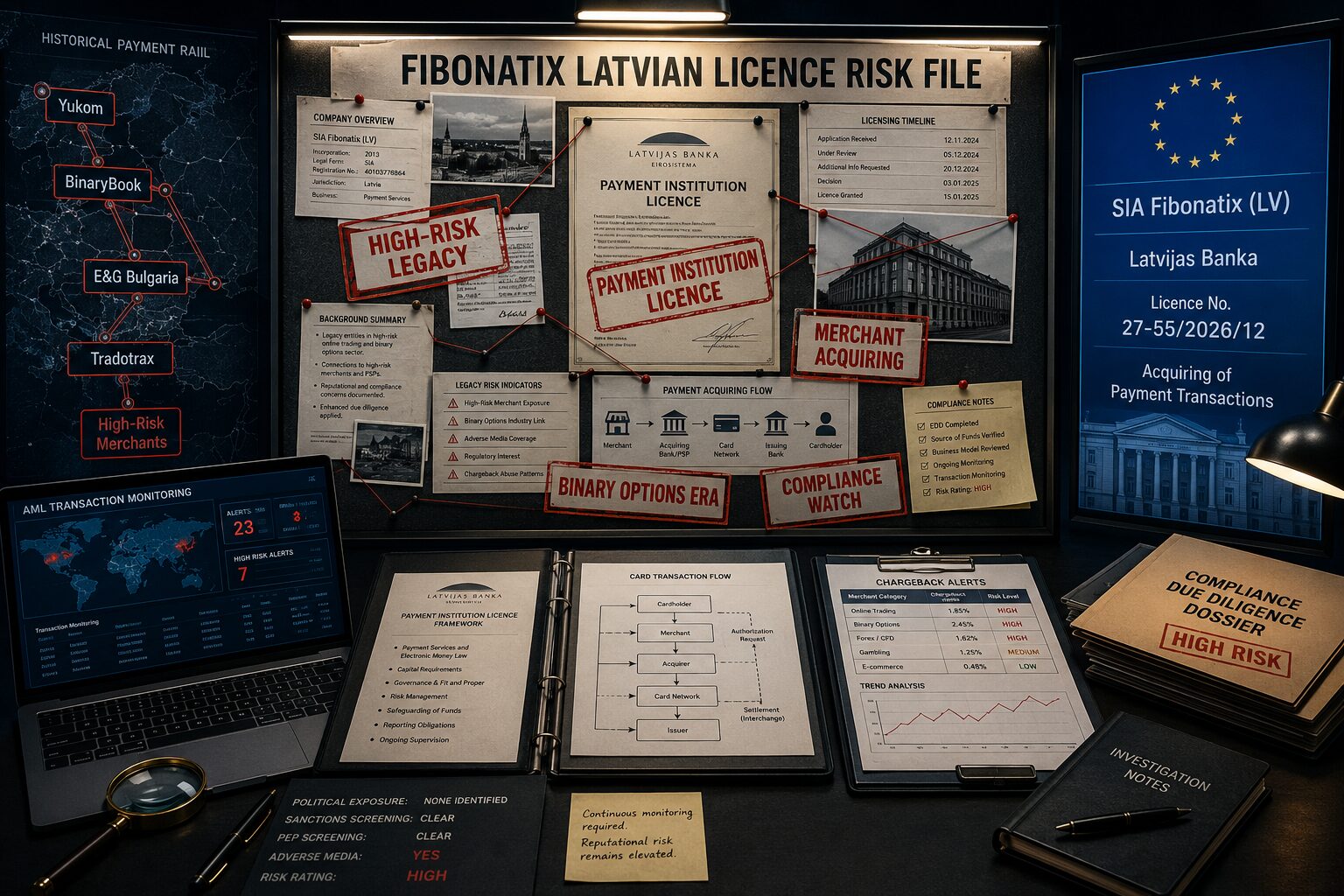
Latvijas Banka has issued a payment institution licence to SIA Fibonatix (LV), authorising the company to provide payment acceptance and acquiring services for merchants. On paper, this is another fintech licensing success story for Latvia. From FinTelegram’s compliance perspective, however, the decision deserves a much closer look.
FinTelegram has monitored Fibonatix for years as a high-risk payment processor with historical exposure to the binary options and broker-scam era. Earlier FinTelegram reports linked Fibonatix to payment flows around the Yukom/BinaryBook binary options fraud case and later to the ecosystem around Gal Barak’s E&G Bulgaria and related high-risk broker structures. A new EU licence does not erase that legacy. It increases the supervisory relevance of the legacy.
Key Data
| Item | Information |
|---|---|
| Licensed entity | SIA Fibonatix (LV) |
| Regulator | Latvijas Banka |
| Licence status | Authorized Payment Institution |
| Licence No. | 27-55/2026/12 |
| Valid from | 11 June 2026 |
| Permitted activity | Acquiring of payment transactions / payment acceptance services |
| Target clients | high-risk Merchants |
| Known group footprint | Fibonatix has historically operated through UK, German and Israeli-linked structures |
| FinTelegram status | High-Risk Legacy Processor — Under Monitoring |
The Licensing Event
According to Latvijas Banka, its Supervision Committee issued the licence to SIA Fibonatix (LV) on 11 June 2026. The licence allows the Latvian entity to provide payment acceptance services to merchants. In the official register, the entity is listed as an authorised payment institution with permission for acquiring of payment transactions.
This is a meaningful development. Payment acquiring is a critical chokepoint in the financial system. It determines which merchants can accept card and other electronic payments, how risk is monitored, how chargebacks are handled, and how suspicious transaction patterns are detected or ignored.
For a normal low-risk merchant acquirer, the licence would be a routine fintech item. For Fibonatix, the historical context makes it a compliance story.
The FinTelegram Background
FinTelegram first reported on Fibonatix in the context of the Yukom Enterprise binary options fraud case. The FinTelegram money-flow analysis identified payment service providers and facilitators that allegedly enabled deposits into brands such as BinaryBook, BigOption, and BinaryOnline. Fibonatix appeared in that context as one of the processors around the payment infrastructure used by the scheme.
Read our Fibonatix reports here.
FinTelegram later reported that Fibonatix had been active in high-risk verticals such as binary options, forex, gambling, gaming, and cryptocurrencies. In the December 2021 and September 2022 updates, FinTelegram described Fibonatix as a notorious high-risk payment processor and referred to its exposure to Yukom, E&G Bulgaria, Tradotrax, Alpha Capital House, and other broker-scam environments.
These reports do not mean that the newly licensed Latvian entity has committed wrongdoing. They do, however, form part of the relevant compliance history. A regulator assessing fitness, governance, AML controls, merchant onboarding, and risk appetite should not treat this history as irrelevant.
The Core Compliance Question
The central question is not whether Fibonatix can be licensed. Latvijas Banka has made that decision. The question is whether a payment group with such a high-risk legacy can now demonstrate a materially different governance, compliance, onboarding, monitoring, and reporting culture.
For high-risk processors, the critical test is not the licence itself. The critical test is the merchant book after licensing.
FinTelegram would expect particular attention to the following areas:
- Merchant onboarding controls
Which merchant verticals will Fibonatix (LV) accept? Will it process for gaming, gambling, crypto, forex, investment platforms, lead-generation networks, affiliate-driven offers, or other high-risk merchants? - Legacy and related-party review
Did the licensing process include a structured review of the historical Fibonatix group activities, including its binary options-era exposure and prior FinTelegram reports? - Cross-border acquiring model
Will the Latvian licence be used mainly for Latvian merchants, or as a broader EU acquiring hub for international high-risk merchants? - Transaction monitoring and chargeback intelligence
How will Fibonatix detect fraud patterns, refund abuse, victim complaints, mismatched merchant descriptors, and suspicious chargeback spikes? - Regulatory cooperation
Given the prior UK, German and Israeli-linked footprint of the Fibonatix brand, will Latvijas Banka coordinate with other supervisory authorities where relevant?
Why This Matters
The binary options era showed that payment processors were not neutral bystanders. In many broker-scam cases, the processors were the operational gatekeepers that allowed fraudulent platforms to collect money from victims across borders. Without payment access, many of these schemes could not have scaled.
That is why FinTelegram has long argued that payment rails are accountability rails. Licensing a historically high-risk payment processor creates a public-interest question: has the business genuinely changed, or has it simply moved into a new regulated jurisdiction?
Latvia has positioned itself as a fintech-friendly jurisdiction. That strategy can be legitimate and economically useful. But fintech licensing must not become regulatory rehabilitation without public transparency. A licence should be the beginning of enhanced scrutiny, not the end of the discussion.
FinTelegram Assessment
FinTelegram classifies the Latvian licensing of SIA Fibonatix (LV) as a Compliance Watch event.
The licence may represent a legitimate new regulatory chapter for Fibonatix. However, given the historical FinTelegram reporting, the binary options-era exposure, and the high-risk merchant acquiring context, the case deserves close monitoring by regulators, banks, card schemes, merchant partners, and compliance officers.
A regulated payment institution is not automatically a low-risk payment institution. In the case of Fibonatix, the opposite question must be asked: can a historically high-risk processor prove that its new regulated structure has moved beyond the practices and networks of the past?
Call for Information
FinTelegram invites former employees, merchants, payment partners, victims, compliance officers, banks, acquirers, and insiders with knowledge of Fibonatix, its merchant portfolio, historic payment flows, or current Latvian acquiring setup to share information confidentially via Whistle42.
We are particularly interested in information about merchant onboarding, high-risk vertical exposure, processing partners, chargeback patterns, related entities, and cross-border acquiring activity.
FinTelegram will continue to monitor Fibonatix and the broader payment-processing infrastructure serving high-risk merchants in Europe.