




Softon Ltd’s offshore casino is not only a licensing problem. Technical evidence reviewed by FinTelegram suggests that Betzter may also operate a player-behaviour intelligence stack capable of linking identity, session replay, account events and sportsbook infrastructure outside the EU’s licensed gambling perimeter. Betzter is not only a gambling-licence story. It is a data-protection story, a player-protection story, a behavioural-surveillance story, and a payment-transparency story.
Betzter.com, publicly operated by Cyprus-registered SOFTON LTD (HE 463977), presents itself as an Anjouan-licensed online casino. But the compliance problem may go far beyond gambling licensing. According to technical evidence reviewed by FinTelegram, Betzter’s public application layer exposes a reported telemetry stack involving FullStory, Sentry Replay and Pusher / Laravel Echo private player-account channels. If confirmed, the configuration could enable identity-linked behavioural session recording, realtime balance and account-event tracking, and player-level profiling in an offshore casino environment outside the EU’s licensed gambling and self-exclusion perimeter.
Key Findings
- Operator anchor confirmed. Betzter.com publicly identifies SOFTON LTD, Cyprus registration number HE 463977, Nicosia, Cyprus, as owner/operator. This is the cleanest legal-operator anchor currently available for Betzter.
- Anjouan licence claim, not EU market access. Betzter publicly displays an Anjouan licence/seal surface referencing ALSI-202409012-FI1 and a unique seal identifier. FinTelegram treats this as a confirmed public licence claim, not as confirmation of licence validity, scope, covered domains, or authorisation to serve regulated EU markets.
- Reported dual session-replay stack. Technical evidence reviewed by FinTelegram reports the presence of FullStory and Sentry Replay in the Betzter application layer. This finding should be treated as a technical-source lead pending independent reproduction and preservation.
- Reported Sentry masking concern. According to the technical source, Sentry Replay was configured with maskAllInputs:false, maskAllText:false and blockAllMedia:false. If confirmed, this would represent a high-risk configuration for an online casino environment, particularly where player identity or account context is present.
- Identity linkage risk. The reported FullStory integration checks or maps player.uuid and player.email, potentially converting behavioural telemetry into an account-linked player dossier rather than anonymous analytics.
- Realtime account-event stream. The Network Engineer Report identifies Pusher / Laravel Echo private player-account channel architecture, including playerAccount-style channels and account/betting event logic. This suggests that Betzter is not a static casino facade but a realtime account and player-event application.
- Sportsbook / infrastructure bridge. Sentry configuration references sptpub.com and ui.invisiblesport.com, creating a sportsbook/infrastructure bridge lead. This is not ownership proof, but it expands the data-perimeter and disclosure-target question.
- GDPR and player-protection risk. The central issue is not merely that Betzter appears to operate outside EU gambling licensing regimes. The further issue is whether EU players are being observed, replayed, profiled and account-linked by an offshore operator outside the official CRUKS/OASIS self-exclusion architecture.
- Payment and AML black box remains. The public/static evidence identifies visible payment-method branding but does not identify the cashier provider, PSP, merchant ID, gateway ID, connector ID, route UUID, acquirer or settlement bank. This makes the telemetry stack even more sensitive: player behaviour may be visible, while the supervised payment and KYC/CDD chain remains opaque.
Executive Summary
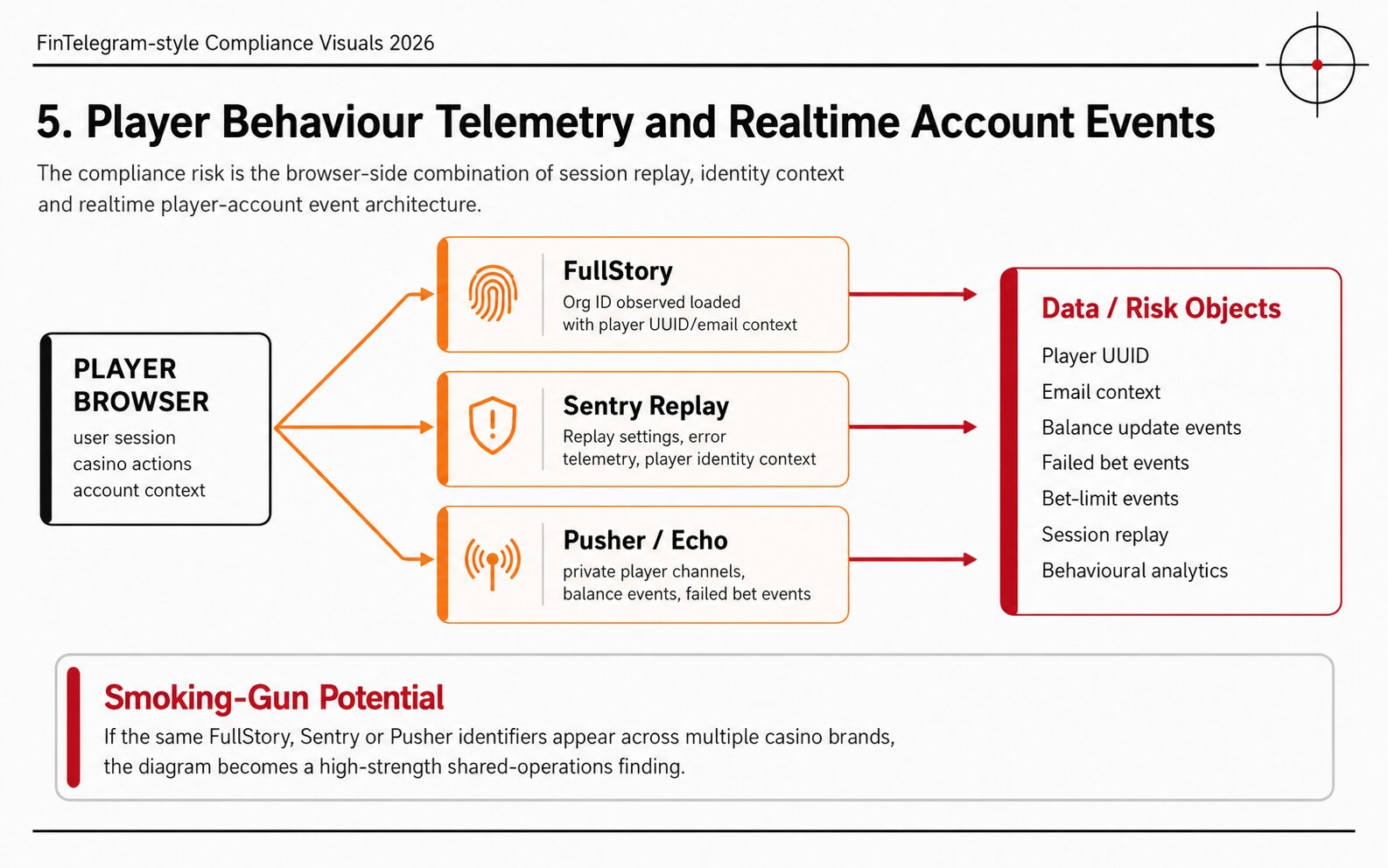
FinTelegram’s is currently investigating the casino operator SOFTON LTD: a Cyprus company, an Anjouan licence narrative, EU-facing casino access, and unresolved payment infrastructure. This first report addresses a second, under-reported layer: player surveillance infrastructure. According to technical evidence reviewed by FinTelegram, Betzter’s public application layer reportedly includes a combination of:
- FullStory behavioural session analytics;
- Sentry Replay error/session replay telemetry;
- Pusher / Laravel Echo realtime private player-account channels;
- player UUID and email-context logic;
- sportsbook/infrastructure markers referencing SPTPub and InvisibleSport.
This architecture would allow reconstruction of what a player did, saw, clicked, typed, attempted, failed, deposited, lost, won or triggered at account-event level — while that player may be interacting with an offshore casino outside the EU’s licensed gambling perimeter. This is the core FinTelegram finding:
The illegal-casino problem is only the first layer. The second layer is the behavioural-surveillance problem.
An offshore operator that is not licensed in the Netherlands, Germany, Austria or other regulated EU markets may nevertheless maintain persistent player identities, session histories, behavioural patterns, balance updates and betting-event data. In other words, the operator may know the player in extraordinary detail — without being integrated into the official player-protection systems designed to protect that player.
FinTelegram does not allege that SOFTON LTD has committed a criminal offence or that the telemetry was misused. The issue is the risk architecture: a high-risk gambling environment, reported identity-linked session replay, reported masking-disabled replay configuration, private realtime account channels, and an unresolved payment/KYC chain.
That combination should concern data-protection authorities, gambling regulators, payment supervisors and consumer-protection agencies.
Why Session Replay Matters In Online Gambling
Session replay is not ordinary page analytics. Properly configured, it may help a website operator debug errors, improve user experience and detect friction. Poorly governed, it can reconstruct a user’s digital behaviour at individual-session level: clicks, scrolls, navigation paths, visible text, form interactions, error states and interface context. In ordinary e-commerce, that is already sensitive. In online gambling, it becomes far more serious. A casino session is not a normal shopping journey. It may reveal:
- impulsive betting behaviour;
- failed deposits;
- repeated failed bets;
- bonus-seeking or loss-chasing patterns;
- account balance changes;
- betting limits;
- session duration and late-night play;
- payment attempts;
- withdrawal friction;
- possible indicators of gambling disorder;
- identity-linked emotional or behavioural vulnerability.
In a licensed environment, gambling regulators impose controls around player protection, responsible gambling, self-exclusion, affordability, AML and complaint handling. In an offshore casino environment, those protections may be absent or structurally weakened.
That is why the reported Betzter stack matters.
The Reported Player-Telemetry Stack
| Data Layer | Reported Tool / Mechanism | Why It Matters | Evidentiary Status |
|---|---|---|---|
| Session behaviour | FullStory | Potentially reconstructs clicks, scrolls, navigation and user interaction sequence | Technical-source lead |
| Error/session replay | Sentry Replay | Reconstructs user sessions around errors and events; privacy depends heavily on masking configuration | Technical-source lead |
| Identity mapping | player.uuid / player.email | May convert behavioural telemetry into account-linked player data | Technical-source lead |
| Realtime account events | Pusher / Laravel Echo private channels | Supports balance updates, session events, failed-bet events and account-state signals | Primary technical evidence |
| Sportsbook bridge | sptpub.com / ui.invisiblesport.com | Extends the infrastructure/data perimeter beyond Betzter’s own domain | Primary technical lead |
| Payment surface | Card/crypto/alternative payment branding | Public payment methods visible but cashier/PSP route remains undisclosed | Primary gap |
| Cashier/PSP route | Unknown | Merchant ID, gateway ID, connector ID, acquirer and settlement path not visible | Missing nuclear evidence |
The critical point is the combination. A single analytics tool can be lawful and legitimate. Realtime account events can be normal. Error monitoring can be necessary. But when these tools operate together in an offshore casino environment, with reported identity mapping and unclear masking, the compliance risk changes. The system becomes capable of creating an identity-linked behavioural dossier on each player.
GDPR Risk Assessment
Assessed against Regulation (EU) 2016/679 as initial regulatory risk, not a legal opinion. Two parallel session-replay systems are hard to reconcile with data minimisation (Art. 5(1)(c)); a single, properly masked system would satisfy any UX or debugging purpose. The reported masking-disabled Sentry configuration runs against the expectation — expressed by the CNIL and other EU authorities — that individual-level session replay is high-risk processing requiring comprehensive masking and, ordinarily, prior consent (Art. 6). The reported absence of any consent or disclosure layer on the public surface is a material transparency concern (Arts. 13–14), and disabling masking by default inverts data-protection-by-default (Art. 25).
Routing email/UUID to US processors is not unlawful per se. The EU–US Data Privacy Framework remains a valid adequacy decision — it survived the Latombe challenge before the General Court in September 2025 and is under appeal to the CJEU (Case C-703/25 P). Transfers are lawful where the recipient is DPF-certified or covered by SCCs plus a transfer impact assessment. The genuine risk is the absence of any disclosed transfer mechanism and FullStory’s public documentation still citing the defunct Privacy Shield rather than current DPF certification. Large-scale, systematic, identity-linked behavioural monitoring in a high-risk sector squarely triggers the Art. 35 DPIA obligation.
Here are our questions in this context:
1. Lawful Basis
The first question is simple: on what lawful basis does SOFTON LTD process session-replay and player-level behavioural telemetry?
For a normal analytics cookie, consent may be required depending on local implementation and ePrivacy rules. For identity-linked session replay in a gambling context, legitimate interest becomes much harder to sustain without a detailed balancing test, clear disclosure, strict minimisation and robust masking.
A high-risk offshore casino cannot treat behavioural session reconstruction as invisible background plumbing.
2. Transparency
Players must be told what is being collected, by whom, for what purpose, for how long, and with whom the data is shared.
If Betzter’s public surface does not clearly disclose the use of session replay, behavioural analytics, realtime account-event monitoring and processors such as FullStory, Sentry or Pusher, the transparency risk is serious.
The fact that a tool is common in software development does not remove the controller’s GDPR transparency obligations.
3. Data Minimisation
The reported dual-replay setup raises a basic minimisation question:
Why would a casino need both FullStory and Sentry Replay running in parallel on player sessions?
A single properly masked tool may be sufficient for debugging or user-experience analysis. Two overlapping systems may create redundancy, but redundancy is not the same as necessity.
Under GDPR, the operator must be able to explain why the data is adequate, relevant and limited to what is necessary.
4. Masking and Data Protection by Default
According to the technical source, Sentry Replay was configured with:
- maskAllInputs:false;
- maskAllText:false;
- blockAllMedia:false.
If confirmed, this would be a major red flag.
Sentry’s own privacy-oriented baseline masks text and blocks media by default. Turning masking and blocking off, especially in an online casino interface, materially increases the risk that player-visible text, account context, balance information, interface states or other sensitive data could be reconstructed.
This does not prove that passwords, payment credentials or documents were captured. It does mean that the operator and processor must explain the configuration, masking rules, field exclusions and actual data captured.
5. DPIA Requirement
Large-scale, systematic, identity-linked behavioural monitoring in an online gambling environment should trigger serious consideration of a GDPR Article 35 Data Protection Impact Assessment.
The DPIA question is unavoidable:
- Was a DPIA conducted?
- Did it assess session replay?
- Did it assess identity mapping?
- Did it assess gambling vulnerability?
- Did it assess EU player exposure?
- Did it assess international transfers?
- Did it assess processor access?
- Did it assess retention and deletion?
If no DPIA exists, that would be a significant governance failure.
6. International Transfers
The transfer issue should be framed accurately.
The use of U.S.-linked processors such as FullStory or Sentry is not automatically unlawful. The EU-U.S. Data Privacy Framework remains in force following the General Court’s September 2025 Latombe judgment, although an appeal is pending before the Court of Justice of the European Union. Transfers may be lawful where the recipient is DPF-certified or where Standard Contractual Clauses and a transfer impact assessment are properly implemented.
The relevant question is not whether every U.S.-linked processor transfer is per se unlawful. The relevant question is whether SOFTON LTD disclosed the transfer mechanism, identified the processors, documented the legal basis, and implemented adequate masking and minimisation controls for high-risk gambling telemetry.
GDPR Risk Rating
Overall GDPR Risk: HIGH
Escalation to CRITICAL if independently confirmed:
- Sentry Replay masking disabled;
- FullStory identity mapping to player.email and player.uuid;
- absence of player-facing disclosure or consent;
- absence of DPIA;
- broad processor access to EU-origin gambling behavioural data.
Self-Exclusion and Player-Protection Risk
The concern is not that the telemetry stack proves active circumvention of CRUKS or OASIS. The concern is more structural. CRUKS in the Netherlands and OASIS in Germany are official self-exclusion frameworks within licensed gambling markets. Offshore operators outside those licensed perimeters are typically not integrated into these systems.
If Betzter reaches EU players without local licences, it sits outside the very protection architecture designed to prevent self-excluded or vulnerable individuals from gambling. At the same time, according to the technical evidence reviewed by FinTelegram, the operator may maintain its own persistent player identity, session history and account-event stream. This creates the paradox:
The regulator may not see the player — but the offshore casino may see everything.
A player excluded from a licensed market could still be tracked by an offshore operator through email, UUID, session replay, account events and behaviour patterns. That does not prove exploitation. It does show why unlicensed casino telemetry is a consumer-protection problem, not merely a privacy topic.
Player-Protection Risk Rating
HIGH
The risk is highest where the same system can identify player behaviour, account state, betting failures, balance changes, and session patterns without being subject to licensed-market responsible-gambling controls.
AML and Payment-Transparency Risk

The AML concern is not that session replay is a laundering tool. The concern is that the same environment which appears capable of maintaining identity-linked behavioural and account-event data does not disclose, at public level, the supervised payment, KYC/CDD, merchant-of-record and settlement chain. The Network Engineer Report identifies a payment black box:
- payment methods are visible;
- cashier provider not identified;
- PSP not identified;
- MID not identified;
- gateway ID not identified;
- connector ID not identified;
- route UUID not identified;
- acquirer not identified;
- Apple Pay merchant ID not identified.
In an offshore gambling environment, this opacity prevents external assessment of whether player identity, deposits, withdrawals, AML risk signals, chargebacks, refunds and complaints are subject to proper regulated monitoring.
A licensed operator should be able to explain who processes payments, who holds merchant accounts, what merchant category code is used, who performs KYC/CDD, and which regulator supervises the payment chain.
AML / Payment Risk Rating
MEDIUM–HIGH
The high component is structural: offshore gambling, visible payment surface, hidden payment route, and identity-linked account architecture. The telemetry-specific AML inference remains medium-confidence until payment and KYC flows are obtained.
The SPTPub / InvisibleSport Perimeter Question
The Network Engineer Report identifies references to sptpub.com and ui.invisiblesport.com in the Betzter technical layer. It also identifies api.sptpub.com resolving to a direct Hetzner infrastructure lead in Germany.
This matters for privacy and compliance because it expands the perimeter.
A player may believe they are interacting with Betzter. In technical terms, the application may involve multiple infrastructure and telemetry parties. Without processor disclosure, contractual transparency and data-flow mapping, neither players nor regulators can assess:
- who receives data;
- who controls the processing;
- which processors are involved;
- where data is hosted;
- what retention applies;
- whether data is used across brands;
- whether sportsbook, casino, CRM and payment systems share identifiers.
FinTelegram does not claim that SPTPub or InvisibleSport owns Betzter. They are disclosure targets.
Regulatory Referral Recommendations
Dutch Autoriteit Persoonsgegevens
The AP should assess whether Dutch data subjects are exposed to session replay, identity-linked behavioural telemetry or private account-event monitoring by an offshore casino operator outside the licensed Dutch gambling perimeter.
Cypriot Commissioner for Personal Data Protection
SOFTON LTD is a Cyprus company. The Cypriot data protection authority should assess controller status, processor disclosures, DPIA, session-replay safeguards, transfer mechanisms, and whether the one-stop-shop framework is applicable.
Irish Data Protection Commission
If FullStory, Sentry or other processors rely on an Irish establishment for EU processing operations, the DPC may be relevant for processor-side compliance, transfer documentation and cross-border coordination.
Dutch Kansspelautoriteit
The KSA should assess whether Betzter reaches Dutch consumers without a Dutch licence and whether its telemetry architecture creates additional risks for self-excluded or vulnerable players outside CRUKS.
German GGL
The GGL should assess the German self-exclusion and player-protection dimension, including whether German players can access Betzter or related brands outside the OASIS framework.
European Data Protection Board
The EDPB should consider the broader policy issue: session replay and identity-linked behavioural monitoring in unlicensed or offshore gambling environments that serve EU data subjects.
Europol EC3
EC3 should be notified of the broader cyberfinancial structure: offshore casino, Cyprus operator, direct infrastructure lead, telemetry stack, undisclosed payment route, and potential cross-brand operational pattern.
Questions for SOFTON LTD / Betzter
- Does SOFTON LTD confirm that it operates Betzter.com?
- Which domains and casino brands are operated by SOFTON LTD?
- What licence covers Betzter, and which domains and markets are included?
- Does Betzter use FullStory?
- Does Betzter use Sentry Replay?
- Does Betzter use Pusher / Laravel Echo private player-account channels?
- What data fields are mapped to session replay or behavioural analytics?
- Is player.email mapped to FullStory or Sentry context?
- Is player.uuid mapped to FullStory or Sentry context?
- Are session-replay fields masked by default?
- Why are two session-replay or replay-like tools necessary?
- Was a GDPR Article 35 DPIA conducted?
- Which processors receive player behavioural data?
- Which international transfer mechanisms apply?
- What is the retention period for session replay and player-event data?
- Are EU players informed before session recording begins?
- Which PSP, cashier, acquirer and payment gateway process deposits?
- What safeguards exist for self-excluded or vulnerable players?
Coming Next: The Full Softon Compliance Report
This Betzter telemetry review is only one layer of a broader FinTelegram investigation. In the coming days, FinTelegram will publish an extensive Softon Compliance Report mapping the wider casino infrastructure around SOFTON LTD, including its Cyprus corporate structure, Anjouan licence narrative, related casino brands, SPTPub/InvisibleSport infrastructure leads, Hetzner-hosted API exposure, unresolved cashier and PSP routing, and the broader question of how offshore casino operators use EU-facing corporate, data and payment infrastructure while remaining outside national gambling supervision.
The upcoming report will not focus on one casino skin alone. It will examine the machinery behind the brand: operator anchors, player telemetry, sportsbook infrastructure, hidden payment routes, regulatory gaps and the providers that may hold the missing evidence. FinTelegram invites insiders, payment providers, hosting providers, telemetry vendors, former employees and affected players to submit information via Whistle42 before publication.
Whistleblower Call — Whistle42
Do you have first-hand knowledge of SOFTON LTD, Betzter, FullStory, Sentry, Pusher, SPTPub, InvisibleSport, the Betzter cashier, or the payment/KYC architecture behind this casino cluster?
FinTelegram is seeking:
- unminified JavaScript;
- browser network captures;
- session-replay configuration evidence;
- FullStory, Sentry or Pusher account screenshots;
- processor agreements;
- DPIAs;
- data processing agreements;
- payment routing records;
- cashier provider data;
- PSP contracts;
- merchant IDs;
- gateway IDs;
- connector IDs;
- route UUIDs;
- KYC/CDD records;
- internal responsible-gambling logs;
- customer complaint and refund records;
- evidence of cross-brand telemetry reuse.
Confidential submissions can be made via Whistle42, FinTelegram’s secure whistleblower channel. Sources may remain anonymous. Verifiable technical evidence is especially valuable because it allows FinTelegram to upgrade leads into confirmed findings under its evidentiary standards.