


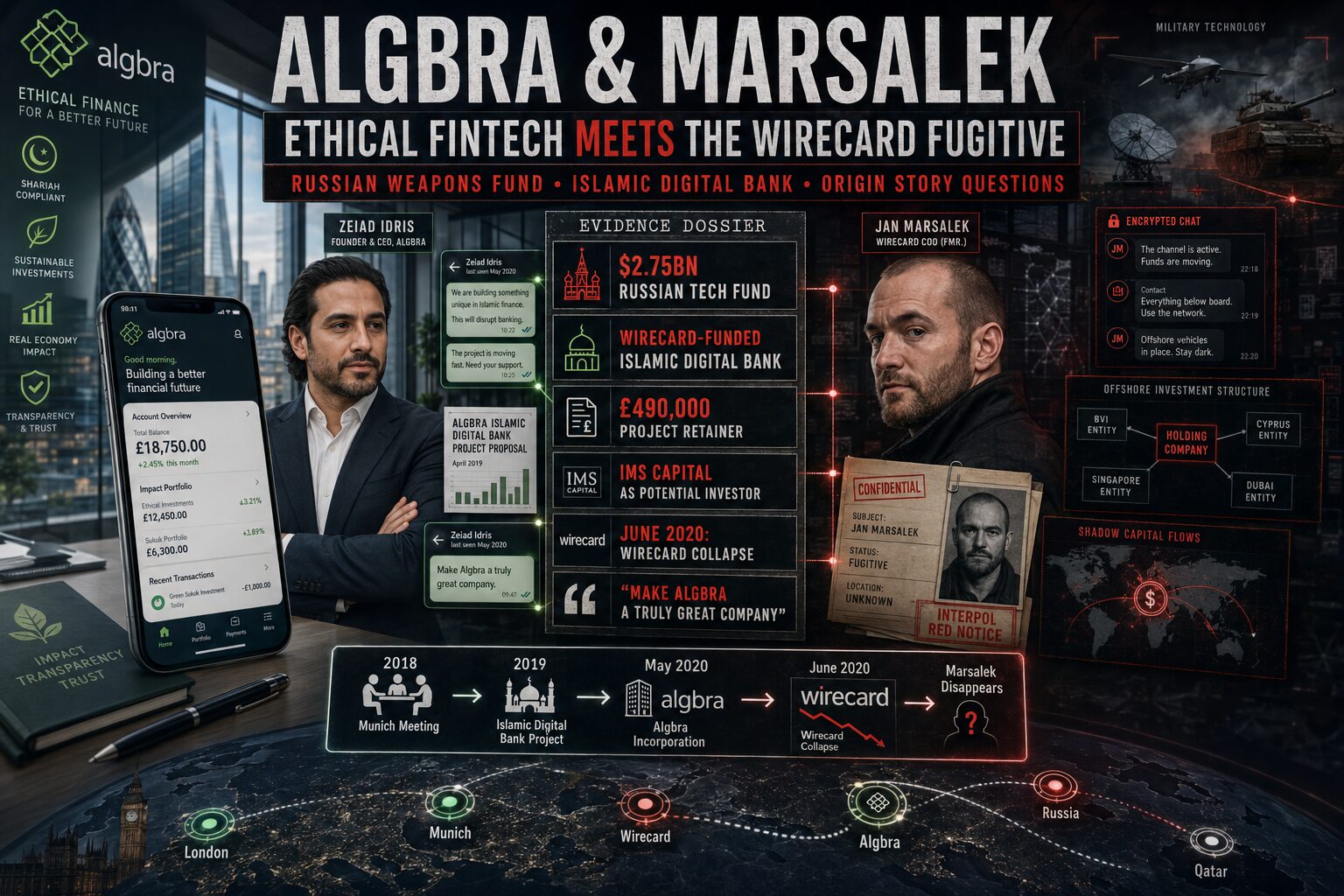
A Financial Times investigation says Algbra founder Zeiad Idris offered to help the fugitive Wirecard executive raise a $2.75 billion fund for Russian military technology — while Marsalek’s network was simultaneously being courted as an early investor in the future “ethical finance” platform.
Few corporate origin stories could produce a more brutal collision of branding and biography. Algbra presents itself as a “people and planet first” fintech built around ethical finance, sustainability and Shariah principles. Its own website promises customers that their money will be protected from “unethical or high-risk investments.”
Now, a Financial Times investigation has placed Algbra founder and CEO Zeiad Idris in a previously undisclosed relationship with Jan Marsalek, the fugitive former Wirecard executive who later emerged as an alleged Russian intelligence operative. According to WhatsApp messages, presentations and contracts reviewed by the FT, Idris discussed helping Marsalek establish a $2.75 billion investment vehicle for Russian military technology.
The $2.75 Billion Weapons Pitch
According to the FT, Marsalek sent Idris a detailed presentation describing a fund that would acquire intellectual property connected to Russian weapons systems and commercialise the technology abroad. The apparent objective was to sell Russian military equipment to Qatar and help the Gulf state achieve military parity with Saudi Arabia.
The presentation reportedly ran to dozens of pages and included technical descriptions of weapons and their battlefield performance. Idris allegedly told Marsalek that he could market the proposed vehicle through his London business and raise capital from his own investor network. He subsequently prepared a presentation for a so-called Global Strategic Technology Fund, referring more discreetly to a Munich team with access to key decision-makers and technology opportunities in Eurasia.
The weapons fund was never launched. The FT reports that Idris’s associates at New World Capital Advisors and its parent, New World Group, were uncomfortable with Marsalek and did not want to become involved.
But the relationship was hardly a passing encounter. In October 2018, Idris travelled to Marsalek’s lavish Munich villa, where the Wirecard executive reportedly displayed a private collection of military memorabilia. Among the exhibits was an evidence bag that Marsalek claimed contained prayer beads held by Osama bin Laden and fabric used to wipe his face after the US operation that killed him. The evening ended at Oktoberfest, with Marsalek buying Idris traditional Bavarian clothing.
Marsalek In Algbra’s Prehistory
The more consequential revelation concerns the origins of the business that later became Algbra. The FT reports that Wirecard began paying New World Capital Advisors in 2019 to develop a business plan for a “global Islamic digital bank.” The total retainer eventually reached approximately £490,000, with Idris personally leading the project and acting as the principal contact with Marsalek.
Marsalek’s self-described family office, IMS Capital Partners, was then approached as a potential anchor investor. In March 2020, IMS reportedly discussed using a complicated offshore trust structure for an investment in order to avoid what it called burdensome KYC questions. Idris allegedly renewed efforts to secure the investment in early June 2020 — only weeks before Wirecard imploded and Marsalek disappeared.
Official UK filings add an important piece to the chronology. The company now operating as Algbra FS UK Limited was incorporated by Idris on 28 May 2020. New World Capital Advisors was installed as its corporate secretary at incorporation and remained in that position until August 2021.
The documents do not establish that Marsalek or IMS ultimately invested in Algbra. They do, however, support the FT’s central finding that the future fintech emerged from the same advisory environment in which Idris had been working directly with Marsalek on the Islamic digital bank project.
A Message From A Fugitive
Wirecard collapsed in June 2020 after admitting that €1.9 billion supposedly held in Asian trust accounts probably did not exist. Marsalek fled Germany and remains internationally wanted in connection with suspected fraud and other offences. German authorities say he served on Wirecard’s management board from 2010 until June 2020.
One of the most extraordinary details in the FT investigation is reportedly Marsalek’s final message to Idris. On 22 June 2020, while already in Minsk and travelling towards his new life under Russian protection, Marsalek allegedly wrote:
“Please make Algbra a truly great company in my absence.”
The sentence does not prove that Marsalek owned, controlled or financed Algbra. It does, however, suggest that he regarded himself as more than an incidental acquaintance watching the project from a distance.
From The Marsalek Circle To The Ethical-Finance Establishment
Algbra subsequently developed into one of Britain’s most highly connected ethical-finance ventures. It is authorised by the Financial Conduct Authority as an electronic money institution, is a principal member of Mastercard and promotes financial products linked to Standard Chartered.
In April 2024, SC Ventures, Standard Chartered’s investment and venture arm, announced a strategic investment in Algbra and a partnership involving the sustainable-finance platform Shoal. Algbra also lists former UK chancellor Lord Philip Hammond among a large group of prominent advisers.
The company maintains a dedicated Values and Ethics Committee and a Board Risk and Compliance Committee. Its public messaging says it is committed to fairness, social welfare, shared prosperity and protecting customers’ money from unethical or high-risk investments.
Against that immaculate ethical façade, the Marsalek revelations could hardly be more awkward.
Idris And Algbra Reject Any Continuing Connection
Idris told the FT that he has had zero contact with Marsalek since the former Wirecard executive disappeared. He said he had been younger when he first encountered Marsalek and had since changed.
Algbra stated that it has had no relationship with either Marsalek or Wirecard since it began trading. The company only launched its consumer operations after Wirecard had collapsed, and the proposed Russian technology fund never became operational. There is currently no suggestion that Idris has been charged with a criminal offence arising from the reported discussions.
FinTelegram Comment
This is not primarily a story about a technical regulatory violation. It is a story about judgment, networks and the selective editing of fintech origin myths.
Marsalek repeatedly appeared at the intersection of respectable finance, geopolitical influence, private intelligence, opaque investment structures and extraordinary personal relationships. The FT investigation suggests that the future founder of a leading ethical-finance platform did not merely cross Marsalek’s path. He reportedly visited his home, discussed fundraising for a multibillion-dollar Russian weapons vehicle, worked on a Wirecard-financed Islamic bank project and sought money from Marsalek’s family-office network until shortly before Wirecard collapsed.
The weapons fund went nowhere. Algbra says Marsalek has never been part of its operating business. Both points matter.
But so does the question now confronting Algbra, its investors and its influential advisers: How much of the company’s early development was shaped by Europe’s most notorious financial fugitive — and how thoroughly was that history examined before the ethical-finance establishment embraced it?