



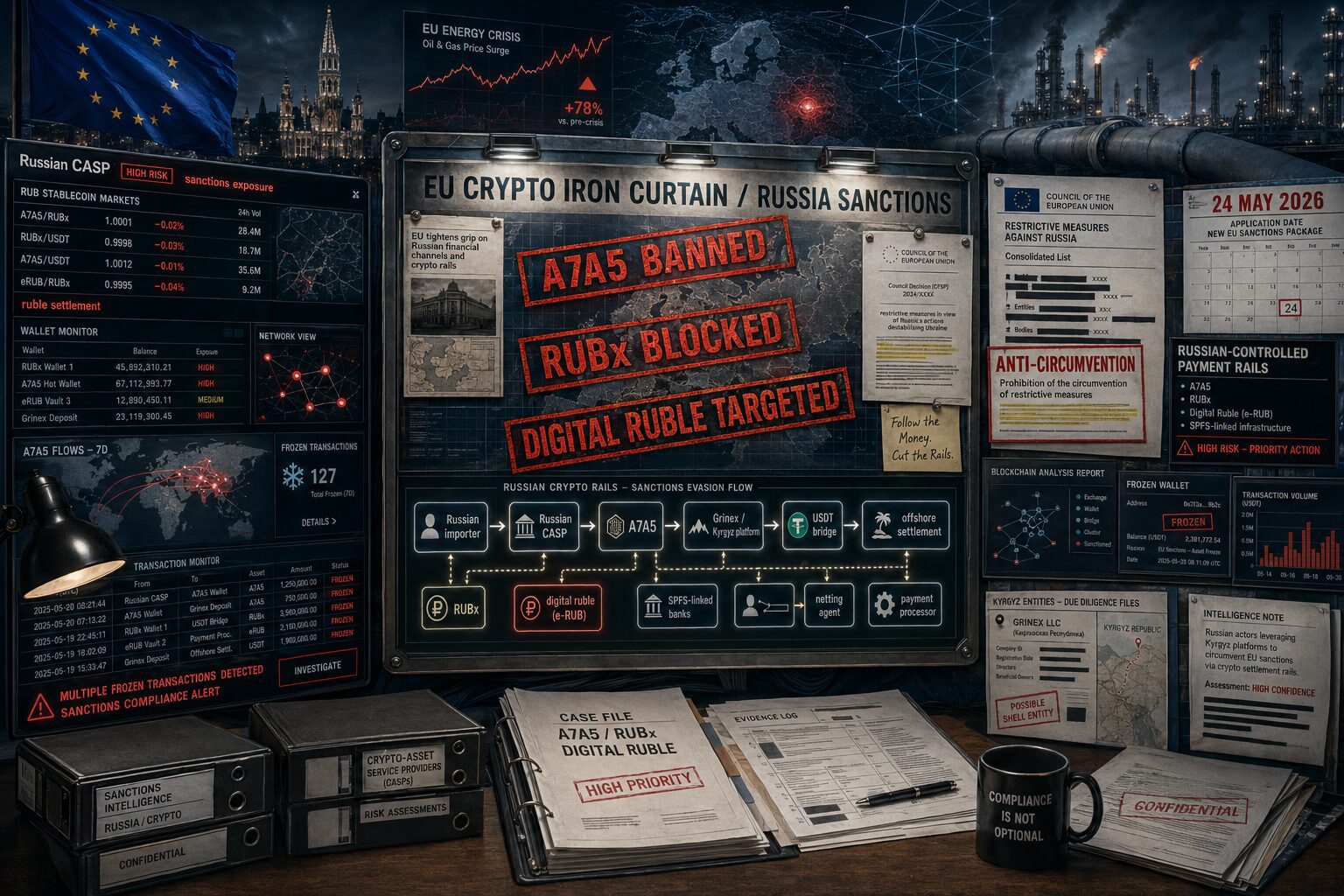
The EU’s latest Russia sanctions package marks a decisive escalation: Brussels is no longer targeting only banks, oil, and oligarchs — it is now attacking Russia’s crypto settlement infrastructure. Russian crypto platforms, ruble-backed tokens, the digital ruble, and A7A5-linked payment rails are being pushed into sanctions quarantine.
Key Findings
- The EU has adopted a new Russia sanctions package targeting energy, finance, trade, shadow-fleet activity, military supply chains — and, crucially, crypto infrastructure.
- Russian crypto providers and platforms are now a core sanctions target. EU persons and firms must avoid Russia-based crypto rails used for transfer, exchange, or settlement.
- RUBx and the digital ruble are explicitly targeted. EU support or transactions involving these instruments create sanctions exposure.
- A7A5 is the key crypto target. The ruble-backed stablecoin reportedly processed massive volumes and appears to function as a shadow settlement rail for Russia-linked cross-border payments.
- Crypto platforms should not cooperate with Russian or Russian-controlled payment processors where these processors are Russia-based, linked to sanctioned parties, involved in ruble-token settlement, or used to bypass EU sanctions.
FinTelegram Compliance Report
The Crypto Sanctions Escalation
The EU’s new Russia sanctions package marks a structural shift. Brussels is no longer treating crypto as a secondary sanctions issue. It now sees crypto as part of Russia’s sanctions-evasion infrastructure.
The package targets Russian crypto-asset providers, Russian crypto platforms, ruble-backed digital assets, and settlement systems designed to replace blocked banking rails. This is effectively a crypto-sector quarantine: EU-regulated firms must not facilitate Russian crypto transfer, exchange, or payment-routing structures.
The A7A5 Stablecoin Attack
A7A5 is not just another obscure stablecoin. It appears to have become a major ruble-backed settlement instrument for Russia-linked cross-border payments.
According to blockchain-analysis reporting, A7A5 is linked to Russian sanctions-evasion structures and has processed very large volumes — reportedly up to $119.7 billion to date. Its relevance lies in its function: it can convert ruble liquidity into crypto liquidity and then into other stablecoins or offshore settlement routes.
That makes A7A5 a potential sanctions-evasion bridge, not a normal retail token.
Its importance for Russia is obvious:
- it helps bypass restricted banking channels;
- it can support trade settlement outside traditional correspondent banking;
- it offers a ruble-to-crypto bridge;
- it can operate through third-country platforms;
- it reduces dependence on Western-controlled financial chokepoints.
The Digital Ruble and RUBx
The targeting of the digital ruble and RUBx is equally significant. The EU is signaling that it will not allow Russian state or state-adjacent digital money to become an alternative settlement layer for sanctioned commerce.
In practice, EU firms should treat digital-ruble infrastructure and RUBx exposure as prohibited or near-prohibited risk areas. This applies not only to direct transactions, but also to technical, liquidity, custody, exchange, or payment support.
Can Crypto Platforms Work With Russian Payment Processors?
In practical compliance terms: no — unless the platform can clearly prove there is no Russian sanctions exposure.
A crypto platform subject to EU jurisdiction should not cooperate with a Russian or Russian-controlled payment processor if that processor:
- is established in Russia;
- facilitates crypto transfer or exchange;
- is linked to sanctioned Russian banks, persons, or entities;
- supports A7A5, RUBx, the digital ruble, or similar ruble-token settlement;
- acts as a payment agent, netting hub, or offshore cut-out for Russian clients;
- routes transactions through third-country structures to hide Russian origin.
The real risk is not only formal ownership. It is functional control. A payment processor in Kyrgyzstan, Dubai, Cyprus, Serbia, Turkey, or another third-country hub may still be a Russian sanctions-evasion rail if it serves Russian settlement needs.
For EU CASPs, banks, EMIs, PSPs, stablecoin issuers and exchanges, the safest rule is simple: no Russian crypto rails, no ruble-stablecoin settlement, no Russian CASP connectivity, no A7A5/RUBx/digital-ruble exposure.
Compliance Red Flags
| Red Flag | Meaning |
|---|---|
| Russia-based CASP or exchange | Sectoral sanctions risk |
| Russian-controlled payment processor | Circumvention risk |
| A7A5 exposure | Ruble-stablecoin sanctions risk |
| RUBx or digital ruble exposure | Direct Russian digital-money risk |
| Kyrgyz or offshore routing | Possible sanctions-evasion structure |
| Ruble-to-USDT conversion | Crypto bridge risk |
| Netting with Russian agents | Anti-circumvention red flag |
| SPFS-linked counterparties | Russian financial-system exposure |
Expected Impact
The sanctions will not destroy Russia’s crypto economy. It will adapt, rebrand, migrate, and move through offshore platforms. But the EU package will make Russian crypto settlement far more toxic for regulated firms.
The likely effects:
- EU-facing exchanges will block or de-risk Russian crypto flows;
- stablecoin issuers will face pressure to freeze linked wallets;
- third-country payment hubs will receive more scrutiny;
- A7A5 liquidity may become fragmented and more offshore;
- Russian actors will move deeper into OTC desks, DeFi routers, and non-compliant CASPs.
FinTelegram Conclusion
The EU’s new Russia sanctions package turns crypto into a frontline sanctions battlefield.
A7A5 exposed the model: ruble liquidity, Russian-linked banking support, third-country issuance, exchange access, conversion into global stablecoins, and commercial settlement use. RUBx and the digital ruble represent the next stage — Russian digital money designed to survive outside Western financial rails.
For EU-regulated crypto platforms, the message is clear: cooperation with Russian or Russian-controlled payment processors is now a high-risk sanctions issue. If the processor is Russia-based, connected to Russian CASPs, linked to sanctioned banks, or involved in A7A5/RUBx/digital-ruble settlement, the compliance answer is not “monitor.” It is block, exit, freeze, and report.
A7A5 may not disappear. But it has become a sanctions-contaminated asset. Any platform touching it risks becoming part of the Russian shadow-payment network.
Whistle42 Call
FinTelegram invites insiders, compliance officers, crypto investigators, payment processors, exchange employees and victims to provide information about Russian crypto rails, A7A5 flows, RUBx exposure, digital-ruble pilots, OTC brokers, third-country payment hubs and sanctions-evasion networks.
Information can be submitted confidentially via Whistle42.