



The Regional Court of Cologne has sentenced German B2G principal Rainer Treuer to two years and four months for unauthorized payment-services activity linked to the notorious B2G payment network. The judgment confirms what FinTelegram warned years ago: B2G was not a harmless consultancy outfit but a payment-collection machine moving victim funds through German bank accounts and onward to foreign recipients. Yet the alleged mastermind, Oleg Shvartsman, was not adjudicated because he could not be reached — leaving the bigger question unresolved: why did German enforcement reduce a vast scam-enabling laundering infrastructure to a licensing case?
Key Findings
- Rainer Treuer convicted: The Regional Court of Cologne sentenced Treuer to two years and four months, with three months deemed served due to excessive duration of proceedings.
- B2G confiscation ordered: The court ordered confiscation against B2G GmbH in the amount of €671,549.52.
- Court confirms illegal payment infrastructure: The judgment describes B2G as opening bank accounts, receiving third-party customer funds, and forwarding them for remuneration without the required authorization.
- Scale matters: According to EFRI’s analysis of the judgment, the B2G operation forwarded €33.57 million through B2G GmbH over roughly one year.
- Shvartsman not tried: Oleg Shvartsman’s case was not decided in this judgment because he did not appear in the proceedings.
- FinTelegram’s position: Based on multiple communications with both Treuer and Shvartsman during the relevant period, FinTelegram can state that Shvartsman was the driving brain behind the B2G structure, while Treuer acted as his loyal German associate.
- EFRI’s role: EFRI filed criminal complaints against Treuer, Shvartsman, B2G GmbH, and related structures and represented victims whose deposits flowed through the B2G rails.
- The core scandal: The judgment confirms unauthorized payment services — but does not fully address the broader money-laundering architecture that enabled binary options and broker scams to scale.
Report
The Verdict: A Conviction, But Not A Reckoning
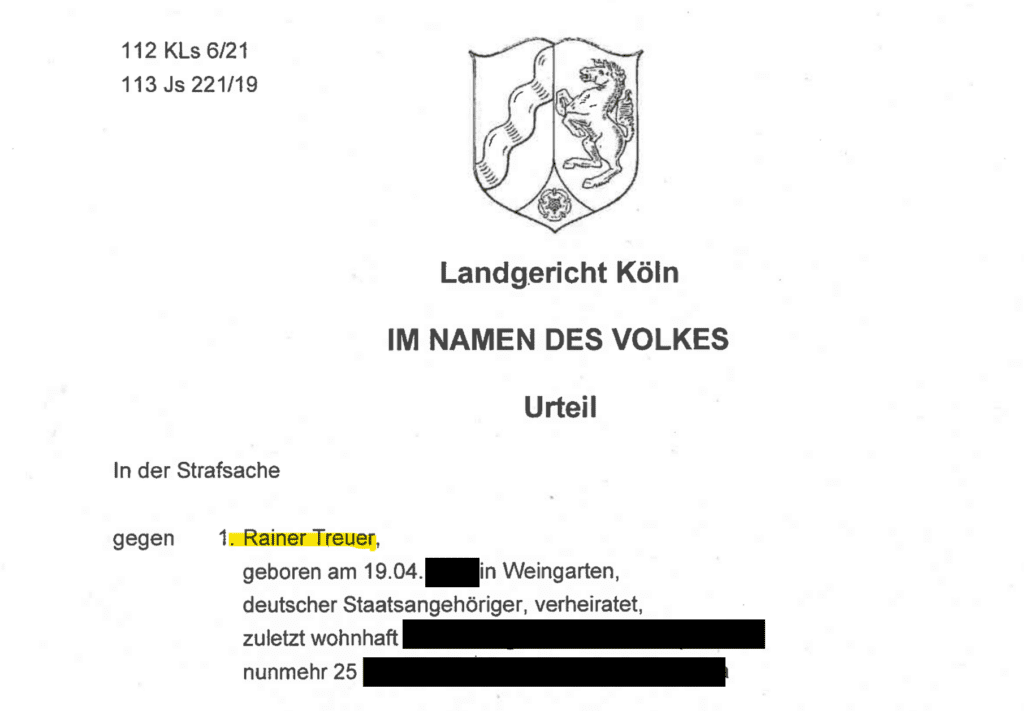
The Regional Court of Cologne has finally delivered a judgment in the long-running B2G matter. According to the judgment dated 27 January 2026, German defendant Rainer Treuer was convicted for intentional unauthorized provision of payment services and incitement to intentional unauthorized provision of payment services.
The court imposed a total custodial sentence of two years and four months, with three months deemed served due to excessive duration of the proceedings. The judgment also orders confiscation against B2G GmbH in the amount of €671,549.52.
EFRI, which has monitored the proceedings for years, summarizes that the Cologne proceedings arose from the B2G and P2P complexes and that Treuer was convicted in connection with B2G GmbH and P2P GmbH, while Oleg Shvartsman’s case was not decided because he did not appear.
This is a milestone. But it is not justice in proportion to the damage. The Cologne court has confirmed the illegal payment-services structure. What remains under-addressed is the true nature of B2G: a scam-enabling payment laundromat for the binary options era.
Read our reports on the B2G Scheme here.
Who Are Rainer Treuer And Oleg Shvartsman?

Rainer Treuer is a German businessman and one of the formal principals of B2G GmbH, the Cologne-based company used as a payment-collection vehicle. The court judgment identifies Treuer as one of the managing directors of B2G GmbH. It also records that he and Shvartsman founded B2G GmbH in September 2016, each holding 50%.
Oleg Shvartsman is the Russian partner behind the B2G structure. FinTelegram has described him for years as the more strategic figure in the operation. The judgment did not decide his case because he was not before the court. But FinTelegram’s direct communications with Shvartsman and Treuer over the years support a clear assessment: Shvartsman was the mastermind, Treuer the German operator and loyal associate.
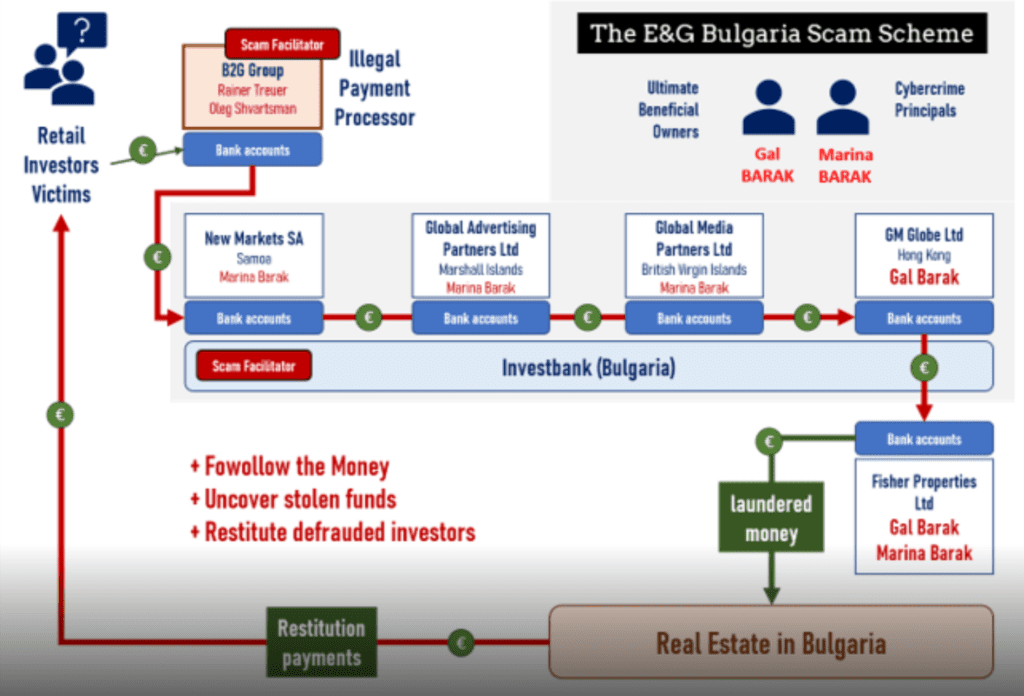
FinTelegram had already reported in 2020 that B2G GmbH, managed by Treuer and Shvartsman, was under investigation across jurisdictions and had facilitated notorious broker scams such as Option888 and Blue Trading. FinTelegram also reported that EFRI had filed a money-laundering complaint against both individuals.
The B2G Model: German Bank Accounts As Scam Intake Pipes
The judgment describes the B2G business model in straightforward terms: Treuer and Shvartsman opened bank accounts in the name of B2G GmbH, made those accounts available to clients, received incoming customer funds, and forwarded those funds — for remuneration — to the clients or to entities named by them. The court found that the money was not simply passed through one-to-one. It was collected, pooled, and then forwarded in larger blocks, often to foreign bank accounts.
EFRI’s summary of the judgment confirms that the court listed bank accounts at Kölner Bank, Sparkasse Koblenz, Deutsche Bank, Südwestbank, and UniCredit/HypoVereinsbank. The same EFRI analysis states that the funds were often bundled and forwarded to foreign recipients and that the court quantified B2G’s forwarded volume at €33,577,475.80.
That is not ordinary consulting. That is payment infrastructure. And in the binary options era, payment infrastructure was the oxygen supply of the scam industry.
Without bank accounts, boiler rooms could not collect deposits. Without payment processors, victims could not be converted into cash. Without laundromats like B2G, the fake trading platforms could not scale across Europe.
The Scam Context: Binary Options Needed Laundromats
FinTelegram warned during the heyday of binary options that illegal broker schemes were not merely “websites.” They were organized fraud systems built from layers: boiler rooms, fake brands, sham platforms, shell merchants, and payment processors. B2G belonged to the payment layer.
FinTelegram’s earlier reporting identified B2G GmbH and B2G s.r.o. as part of the German/Czech payment-processing infrastructure used by binary options and broker scams. In 2021, FinTelegram reported that Cologne prosecutors had filed charges against the individuals behind B2G and described B2G as one of the notorious German laundromats and scam facilitators of the binary options era.
EFRI’s criminal complaint stated that B2G GmbH and its Czech sister company enabled scams including XTraderFX, OptionStarsGlobal, and BlueTrading to intake victims’ money via German and Czech bank accounts, with Treuer and Shvartsman forwarding deposits to scammers after deducting their fees.
This is the real issue: B2G was not a passive company that accidentally handled suspicious payments. It was a collection engine. It gave scam operators the appearance of banking legitimacy and converted victim deposits into movable offshore funds.
The Court’s Narrow Frame: Unauthorized Payment Services
The Cologne court convicted Treuer for unauthorized payment-services conduct under German payment-services law. That matters. It means the court accepted that the B2G structure was not authorized to perform the payment function it performed.
But from a financial-crime perspective, the narrow legal framing is deeply unsatisfactory.
EFRI’s critique is correct: treating B2G mainly as a licensing breach risks understating the true harm. The pattern described in the judgment — multiple bank accounts, victim deposits, pooling, bundling, and forwarding to foreign recipients — is exactly the infrastructure that enables money laundering and large-scale investment fraud. EFRI argues that this judgment is an important procedural milestone but not the full legal reckoning with the broader infrastructure behind online fraud.
FinTelegram agrees. The legal system has again caught the payment pipe but not fully confronted the laundering machine.
The Missing Defendant: Shvartsman
The glaring absence is Oleg Shvartsman.
The judgment does not adjudicate his role because he did not appear. That procedural fact must be respected. However, it does not erase the factual reality around B2G.
EFRI reported that case materials named Shvartsman and Treuer in relation to an alleged unlicensed payment-collection infrastructure that received consumer funds into company-controlled accounts, pooled and relabeled them, and forwarded them to upstream recipients.
FinTelegram’s own historic communications with Shvartsman and Treuer support the assessment that Shvartsman was not a side character. He was the strategic driver, the man behind the structure, while Treuer gave the operation its German corporate and banking face.
The fact that Shvartsman was not in the dock is not a minor procedural footnote. It is the central unfinished business of the B2G case.
The Banks And Supervisory Failure
EFRI has also raised uncomfortable questions about the timing of supervisory and banking action. In a separate report, EFRI stated that BaFin had been aware of the activities of Shvartsman and Treuer since November 2017, while key payment rails allegedly remained open for months. EFRI also reported that Sparkasse Koblenz remained operational until July 2018 even as complaints and refund demands escalated.
EFRI’s research further states that B2G GmbH was used as a key money mule for scams including OptionStarsGlobal, Weiss Finance, InstaFx24, Blue Trading, SafeMarkets, Aspects Financial, MarketsTrading, CentroBanc, and StoxMarket, and that Treuer and Shvartsman also controlled P2P GmbH, another money-mule structure operating German and Dutch bank accounts.
This raises the old FinTelegram question: how many victims could have been protected if banks and regulators had acted faster?
The B2G case is not only a story about two men and a German GmbH. It is a story about Europe’s failure to understand that payment processors are not peripheral actors in online fraud. They are often the decisive enablers.
B2G Scheme — Key Names, Entities, Roles And Connections
| Name / Entity | Role in the B2G Scheme | Connection / Relevance |
|---|---|---|
| Rainer Treuer | German B2G principal; convicted by Regional Court of Cologne | Sentenced to two years and four months for unauthorized payment-services conduct; formal German operator of B2G GmbH |
| Oleg Shvartsman | Russian partner; alleged mastermind behind the B2G structure | Not adjudicated in the Cologne judgment because he did not appear; FinTelegram communications indicate he was the strategic driver |
| B2G GmbH | German payment-collection vehicle | Cologne-based company used to receive and forward victim funds via German bank accounts |
| B2G s.r.o. | Czech sister/related entity | Identified by EFRI and FinTelegram as part of the wider German/Czech B2G payment-processing setup |
| P2P GmbH | Related payment/money-mule structure | EFRI states Treuer and Shvartsman also controlled P2P GmbH; used German and Dutch accounts |
| Kölner Bank / Volksbank Köln-Bonn | Account-holding bank | Listed in the judgment among banks used for B2G payment flows |
| Sparkasse Koblenz | Account-holding bank | EFRI identifies this as a key rail that allegedly remained active for months despite complaints and warning signs |
| Deutsche Bank | Account-holding bank | Listed in the judgment among banks used by B2G |
| Südwestbank | Account-holding bank | Listed in the judgment; EFRI notes BaFin acted swiftly in relation to this banking relationship |
| UniCredit / HypoVereinsbank | Account-holding bank | Listed in the judgment among banks used by B2G |
| EFRI | Victim-representation and enforcement initiative | Filed criminal complaints and represents victims whose deposits flowed through B2G/P2P rails |
| FinTelegram | Investigative reporting and warning platform | Exposed B2G during the binary options era and communicated with Treuer and Shvartsman |
| Gal Barak / E&G Bulgaria ecosystem | Scam ecosystem allegedly served by B2G-related rails | FinTelegram previously reported that B2G laundered funds for Barak-related and other binary options scams |
| Uwe Lenhoff-related schemes | Binary options / broker scam ecosystem | Mentioned in FinTelegram and EFRI context as part of the broader scam environment in which illegal PSPs operated |
| Option888, Blue Trading, XTraderFX, OptionStarsGlobal, SafeMarkets, CentroBanc, StoxMarket and others | Fraudulent or allegedly fraudulent broker/scam brands | EFRI and FinTelegram reports identify these as brands whose victim deposits appeared in B2G/P2P-related payment flows |
FinTelegram Comment
The Cologne verdict is a conviction — but it is not the historical verdict the victims deserved.
For years, FinTelegram warned that B2G was a German laundromat for binary options criminals. The Cologne judgment now confirms the illegal payment-services skeleton of that story. But the flesh and blood of the case — the laundering architecture, the scam brands, the offshore recipients, the role of banks, the regulatory delays, and the missing Shvartsman — remains only partly addressed.
This is the bitter truth: Europe’s scam industry did not scale because fake brokers were clever. It scaled because financial enablers gave them bank accounts, payment pipes, and laundering corridors.
B2G was one of those corridors.
Rainer Treuer has now been convicted. Oleg Shvartsman remains the missing figure. Victims still wait for restitution. And regulators still owe answers.
Conclusion
The B2G judgment should be read as a warning to every financial crime enabler in Europe: the “we only processed payments” defense is dying.
But it should also be read as an indictment of enforcement delay. FinTelegram and EFRI exposed the B2G laundromat years ago. Victims filed evidence. Payment flows were documented. Banks saw complaints. Regulators had tools. Yet millions continued to move.
The binary options era is over, but the infrastructure lesson remains alive in crypto, offshore casinos, DeFi brokers, and high-risk payment gateways: follow the payment rails, and you find the real enablers.
Whistle42 Call For Information
FinTelegram invites former employees, victims, banking insiders, compliance officers, and law-enforcement sources with information about B2G GmbH, B2G s.r.o., P2P GmbH, Rainer Treuer, Oleg Shvartsman, or related payment flows to contact us securely via Whistle42.
We are particularly interested in:
- bank-account opening files and compliance correspondence;
- communications with B2G, P2P, Treuer, or Shvartsman;
- payment instructions from binary options or broker brands;
- records of onward transfers to offshore recipients;
- internal bank or regulator documents concerning B2G-related alerts.