



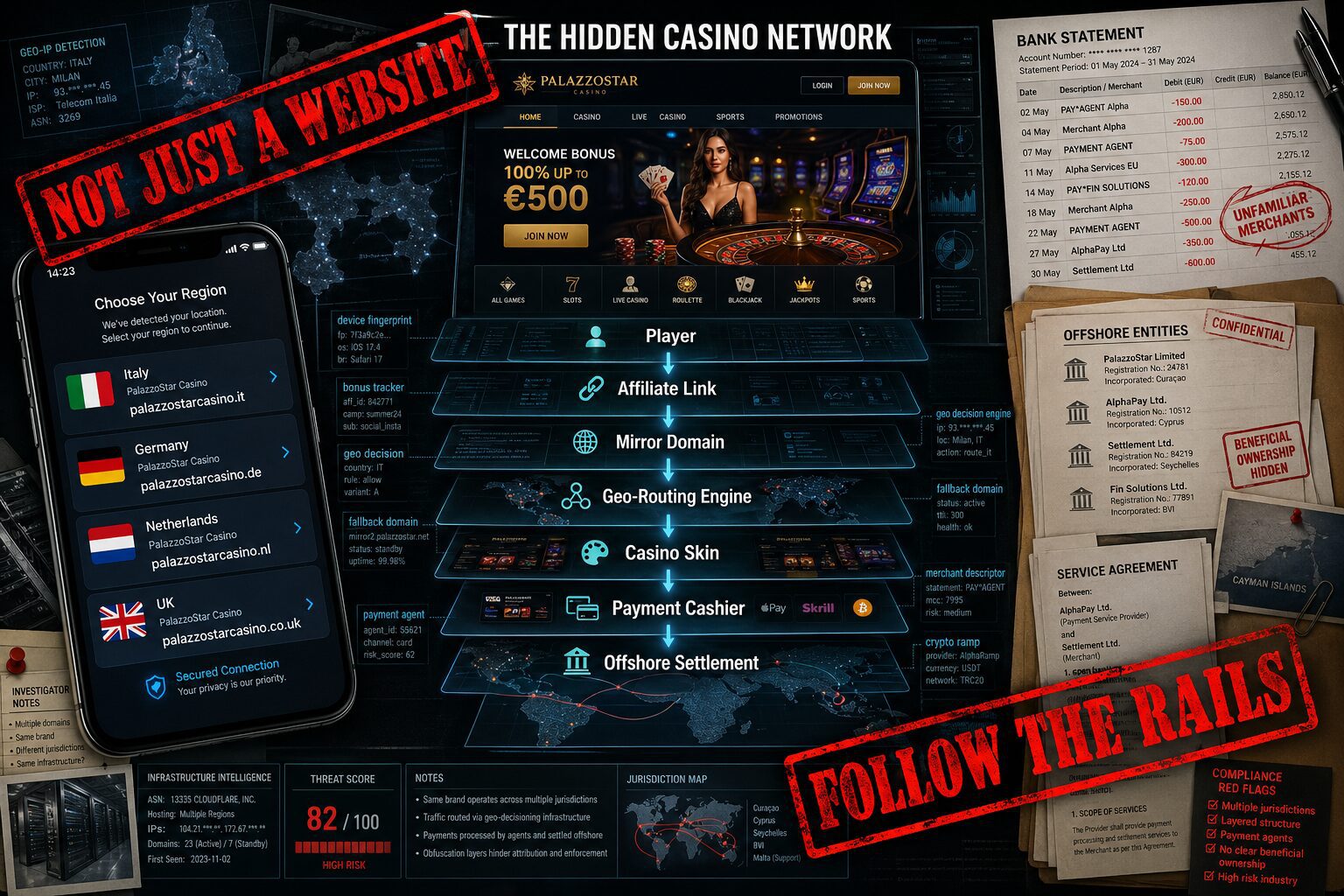
Illegal online casinos increasingly operate like adaptive digital organisms. A player may think they clicked on a single casino brand such as MyStake, Donbet or GoldenBet. In reality, the journey may pass through affiliate funnels, mirror domains, device-fingerprinting systems, geo-routing engines, bonus trackers and location-specific payment gateways before the player even reaches the cashier. The result is a hidden compliance maze where the casino shown to the player, the domain used for access, the payment method offered, and the merchant receiving the money may all change depending on the player’s country, device, bank, language, browser, referral source and prior behaviour.
Key Findings
- Illegal casino brands are often only the visible storefront. Behind the visible domain sits a multi-layer infrastructure of affiliates, mirrors, tracking systems, platform providers and payment agents.
- Geo-routing is central to the model. The same player may be sent to different domains, mirrors or payment channels depending on whether they are in Italy, Germany, the Netherlands, the UK or another restricted market.
- Mirror domains defeat website blackouts. When regulators block one casino domain, the network can activate alternative domains, fallback URLs or near-identical branded “skins” such as
brand123.com,brand-italia.com,brand-vip.comor similar variations. - Payment options are also geo-personalised. A Dutch player may see iDEAL-style or open-banking options; a German player may see instant bank transfer or crypto ramps; an Italian player may see card, voucher, crypto or third-party merchant routes. The casino cashier is not static.
- AI and algorithmic decisioning are likely becoming part of the routing layer. There is no need to prove “full AI control” to understand the risk: even basic machine-learning, rules engines and behavioural analytics can optimise which domain, bonus, payment method and casino skin is shown to each player.
- The player often has no idea who is really processing the payment. The bank statement may show a software company, payment agent, e-wallet, crypto ramp or neutral merchant descriptor — not the casino brand.
- Regulatory compliance becomes fragmented. The gambling regulator sees a blocked domain; the bank sees a payment to a merchant; the affiliate sees conversion data; the player sees a casino; the platform provider sees API traffic. No single layer shows the full picture.
The Hidden Casino: Why The Player Journey Is Misleading
To the player, the process looks simple.
They search for a casino, click a link, land on a site, register, deposit and gamble. That apparent simplicity is the illusion. In many offshore casino networks, the player has not travelled directly from Google, Telegram, TikTok, an affiliate site or a bonus page to a gambling operator. Instead, the player may have passed through several invisible routing systems before the final casino page loads.
The GAMRS / Deal Me Out report on Santeda International B.V. and Ryker B.V. describes this structure in relation to MyStake and related brands. It says the consumer may be unaware that traffic has passed through “multiple intermediary domains” before reaching the operator, including affiliate redirect domains, link-cloaking services, device fingerprinting servers, bonus attribution trackers and geo-routing decision engines. The same section states that these systems can select a mirror domain, fallback website, different operator or version of the site not yet blocked by regulators.
For FinTelegram’s Rail Atlas methodology, this is the decisive point: the casino is not a website; it is a routed network.
Layer 1 — The Visible Casino Brand
The player sees a brand: MyStake, Donbet, GoldenBet, Rolletto, CosmoBet, Velobet or another offshore casino. The brand creates the impression of a standalone gambling business. It has a logo, a cashier, promotions, customer support, terms and conditions, and sometimes a Curaçao, Anjouan or other offshore licence reference.
But the visible brand may be only one skin in a larger network. The GAMRS report states that MyStake should not be viewed as a standalone actor, but as part of a broader multi-entity, multi-domain ecosystem. It identifies shared analytics identifiers, domain churn, coordinated hosting behaviour and links to aggregators as indicators of a wider infrastructure.
For players, this matters because self-exclusion from one brand may not protect them from the wider network. If the same backend, affiliate programme, payment infrastructure or CRM system supports multiple brands, a player who closes an account with one casino may later be targeted by another “sister” brand.
Layer 2 — The Mirror-Domain System
Illegal casino networks frequently use many domains for the same gambling operation. A brand may appear under:
| Domain type | Example pattern | Function |
|---|---|---|
| Main domain | goldenbet.com | Public-facing brand |
| Mirror domain | goldenbet-1234.com | Alternative access route |
| Country variant | goldenbet-it.com | Localised targeting |
| Affiliate landing page | best-bonus-goldenbet.com | Traffic capture |
| Fallback domain | goldenbet-vip.net | Replacement after blocking |
| Temporary shell | unfinished clone / placeholder | Preserves SEO and routing |
This is especially relevant in markets such as Italy, where the ADM maintains lists of blocked unauthorised gambling sites and uses site inhibition as an enforcement tool. The ADM describes its action as identifying and inhibiting websites lacking the required authorisations.
The problem is that domain blocking targets a visible endpoint, while the illegal network controls many endpoints. A recent international analysis of illegal betting-site blocking notes that operators can bypass geo-blocks by creating multiple mirror websites, allowing continued access if authorities block online portals.
The GAMRS report describes this as a “Hydra” model: when one domain is removed, multiple replacements are already created or ready to activate. It also describes replacement shells used to preserve search traffic, affiliate linkages and domain authority while infrastructure is rebuilt in the background.
In simple terms: the regulator blocks one door; the network opens three side doors.
Layer 3 — Affiliate Funnels And Link Cloaking
Affiliate networks are the acquisition engine. They are often the layer that first detects where the player is coming from and decides where to send them.
A player may click on:
- a “non-GamStop casino” article;
- a Telegram bonus link;
- a streamer link;
- a comparison site;
- a “best crypto casino” page;
- a fake review site;
- a country-specific bonus page.
The click may not go directly to the casino. It can pass through a chain of redirect domains. These systems can record the source, device, browser, IP range, language, bonus campaign, country, and whether the player is likely to convert.
The GAMRS report identifies Affision, operated through Legitnine OÜ, as an affiliate programme for a broader network involving Santeda, Ryker and Onyxion, and says it promotes brands including MyStake, GoldenBet, JackBit, FreshBet and 31Bet.
For players, this means the “review site” or “bonus page” may not be independent. It may be part of the same commercial acquisition machine that profits when the player deposits.
Layer 4 — Device Fingerprinting And Geo-Routing
Modern routing systems do not only look at the country of the IP address. They may evaluate a broader technical profile:
| Attribute | Why it matters |
|---|---|
| IP address | Country, city, VPN/proxy signal |
| Browser language | Localisation and market inference |
| Device type | Mobile vs desktop behaviour |
| Operating system | Fraud and conversion profiling |
| Referrer URL | Which affiliate or campaign sent the player |
| Cookies / previous visits | Returning player recognition |
| Payment preference | Which cashier options are likely to work |
| Time zone | Location validation |
| SIM / network indicators | Mobile-location inference |
| Behaviour pattern | Bot, bonus abuse, high-value player or vulnerable player signals |
Geolocation verification in iGaming is used for compliance and fraud prevention, including restricting access to users in permitted jurisdictions. AWS describes geolocation verification for sports betting and iGaming as serving compliance and fraud-prevention purposes, including limiting access to users in allowed regions.
The darker side is obvious: the same technology that can be used to keep prohibited users out can also be inverted to route prohibited users in — through the domain, bonus, payment channel or mirror that is least likely to be blocked.
FinTelegram should frame this carefully: we do not need to prove that every casino uses advanced AI. The compliance risk already exists if rule-based systems and behavioural analytics are used to choose routes around restrictions. AI simply makes the routing faster, more adaptive and harder to detect.
Layer 5 — The Algorithmic Workaround
This is where the market is moving.
A traditional illegal casino network might use fixed rules:
- Italy → send to mirror A;
- Germany → send to instant-bank-transfer cashier;
- Netherlands → show local bank-transfer or open-banking option;
- UK → show crypto and card fallback;
- blocked IP → send to domain B;
- returning high-value player → show VIP bonus;
- self-excluded player → redirect to sister brand.
An algorithmic or AI-enhanced network can do more. It can test which landing page converts best, which payment method succeeds most often, which bonus keeps a player depositing, and which domain survives longest before being blocked. In mainstream compliance technology, device intelligence and geolocation are already marketed as ways to detect suspicious activity, prevent spoofing and support regulatory compliance.
In the illegal casino context, the same logic can be abused:
| Compliance technology | Legitimate use | Abusive use |
|---|---|---|
| Geo-location | Block prohibited jurisdictions | Route prohibited players to mirrors |
| Device fingerprinting | Detect fraud | Recognise and re-target vulnerable players |
| Payment orchestration | Improve payment success | Rotate payment agents to avoid blocks |
| Bonus analytics | Personalise offers | Push high-risk players into repeated deposits |
| Affiliate attribution | Pay marketers | Hide acquisition chains |
| AI optimisation | Improve user experience | Maximise regulatory evasion |
This is the “algorithmic workaround” problem: the system learns how to keep the player inside the network even when regulators, banks or gambling-blocking tools try to interrupt the journey.
Layer 6 — The Location-Specific Casino Cashier
The payment page is one of the most important but least understood layers.
A player in Italy, Germany, the Netherlands or the UK may not see the same cashier. The system can present different payment methods depending on location, device, currency, bank, player history and payment success rates.
A Dutch player might see bank-transfer or open-banking options. A German player might see instant transfer, card, crypto or voucher methods. An Italian player may see card processors, crypto ramps, wallet options or neutral merchant-payee routes. A UK player may see card, crypto, e-wallet or bank-transfer options depending on what is still available and which PSP has not yet terminated the merchant.
The GAMRS report’s payments section describes a multi-jurisdictional payment infrastructure supporting the Santeda network. It says payment flows can involve UK/EU card payments, white-label processors such as PayOp or PayDo, UK-authorised EMIs such as Clear Junction, Cypriot holding/payment-agent companies, Georgian intermediaries, and eventual banking endpoints in Czechia, Georgia and Germany.
The report also lists MBRAMP/Mobilum Pay as a crypto gateway and identifies PayOp, TransferOp and PayDo as processors providing instant bank-transfer services. It notes that funds may be routed through mainstream banks and fintechs, including Revolut, Monzo, Wise, Starling and others, while expressly stating that GAMRS does not allege wrongdoing by those regulated institutions.
For players, the warning is simple: the payment method shown in the cashier may not tell you who is really behind the casino or where your money is ultimately going.
Layer 7 — Merchant Descriptors And Disguised Payments
The most dangerous part of the payment layer is descriptor masking. A player may believe they deposited to a casino, but their bank statement may show:
- a software company;
- a payment agent;
- an e-commerce merchant;
- a crypto exchange;
- a consulting company;
- a generic payment processor;
- a completely unfamiliar payee.
Reuters previously reported on the use of fake online stores to support gambling-payment disguises, explaining that such dummy stores can act as fronts to back up bogus payment descriptions.
This matters because many banking controls rely on merchant category codes, descriptors, known gambling merchant lists or transaction monitoring. If the payment is presented as a transfer to a neutral merchant rather than a gambling transaction, gambling blocks and risk controls may fail.
For the player, this creates three problems:
First, the bank may not recognise the transaction as gambling. Second, a chargeback or refund claim may become harder because the payment does not appear to match the casino brand. Third, the player may not know which entity actually received the funds.
Layer 8 — Platform Providers And Game Aggregators
The casino brand is only one part of the system. The games, sportsbook, live casino, wallet, bonus engine, CRM, affiliate tracking and payment integrations may all be provided by third-party platform or aggregation providers.
The GAMRS report states that the Santeda/MyStake ecosystem shows shared backend infrastructure across MyStake, CosmoBet, VeloBet, GoldenBet, Rolletto and other brands; common LiveChat licence IDs, analytics identifiers and configuration fingerprints; and persistent use of legacy InPlayNet infrastructure under the Upgaming brand.
For players, this means that even if the front-end casino name changes, the underlying system may remain the same. The bonus engine, risk scoring, payments integration and customer-service system may follow the player across brands.
That is why FinTelegram should explain the concept of network retention: the operator does not need to retain the player inside one casino brand. It only needs to retain the player inside the network.
How The Whole System Works
A simplified illegal-casino journey may look like this:
| Step | What the player sees | What may happen behind the scenes |
|---|---|---|
| 1 | A casino review or bonus link | Affiliate ID, campaign tracking and location check |
| 2 | A redirect to a casino domain | Link cloaking and geo-routing |
| 3 | A familiar casino brand | Mirror domain or country-specific skin |
| 4 | Registration form | Device fingerprinting and risk scoring |
| 5 | Bonus offer | Behavioural targeting or retention logic |
| 6 | Cashier page | Location-specific payment orchestration |
| 7 | Bank/card/crypto payment | PSP, agent, EMI, crypto ramp or shell merchant |
| 8 | Casino balance credited | Funds routed through payment intermediaries |
| 9 | Player tries to withdraw | KYC friction, delay, account review or refusal risk |
| 10 | Domain gets blocked | Player is redirected to mirror or sister brand |
This is why the visible casino website is only the tip of the iceberg.
Regulatory Interpretation
For regulators, the lesson is clear: blocking domains is necessary but insufficient.
The UK Gambling Commission has acknowledged that illegal-market disruption must adapt to changing online infrastructure, networking and marketing tactics, and it has described work involving referrals to platforms hosting unlicensed gambling content.
Italy’s model of blocking unauthorised gambling websites through ADM is important, but the existence of thousands of blocked domains shows the scale and persistence of the problem. ADM’s own materials focus on identifying and inhibiting unauthorised gambling sites.
The next enforcement frontier must be route-based, not only domain-based:
- identify affiliate redirect chains;
- map mirror-domain clusters;
- require payment providers to detect disguised gambling flows;
- scrutinise payment agents and merchant descriptors;
- test open-banking and instant-transfer flows;
- examine platform providers and aggregators;
- enforce local licensing rules against brands, suppliers and intermediaries;
- create cross-border intelligence sharing between gambling regulators, FIUs, banking supervisors and cybercrime units.
FinTelegram Conclusion
The illegal casino of 2026 is not a website. It is a location-aware, payment-aware, device-aware routing system.
A player in Italy, Germany, the Netherlands or the UK may be shown a different domain, different bonus, different casino skin and different cashier — all for the same underlying gambling network. The system’s objective is simple: keep the player depositing, keep regulators chasing domains, keep banks seeing neutral merchants, and keep the real operator insulated behind layers of affiliates, PSPs, payment agents and offshore structures.
The most dangerous part is not the visible casino. It is the invisible decision engine behind it. That engine decides:
- which domain the player sees;
- which mirror survives the blackout;
- which payment method is displayed;
- which merchant receives the money;
- which bonus keeps the player active;
- which sister brand receives the player after exclusion;
- which route avoids the regulator today.
For players, the practical warning is blunt: when an offshore casino changes domains, payment names or cashier options depending on your location, you are probably not dealing with a normal gambling operator. You are inside a routed black-market infrastructure.
Whistle42 Call To Action
FinTelegram invites players, former employees, affiliates, PSP insiders, compliance officers and payment investigators to share evidence about offshore casino routing systems, mirror domains, disguised payment descriptors, open-banking flows, crypto ramps and payment agents.
Especially valuable are:
- screenshots of casino cashier pages;
- full deposit flows from bank app to casino balance;
- bank statements showing merchant descriptors;
- redirect chains and domain histories;
- withdrawal refusals or account-closure emails;
- evidence of mirror domains after regulatory blocking;
- internal documents from affiliates, PSPs or casino operators.
Information can be submitted securely via Whistle42.