


Executive Summary
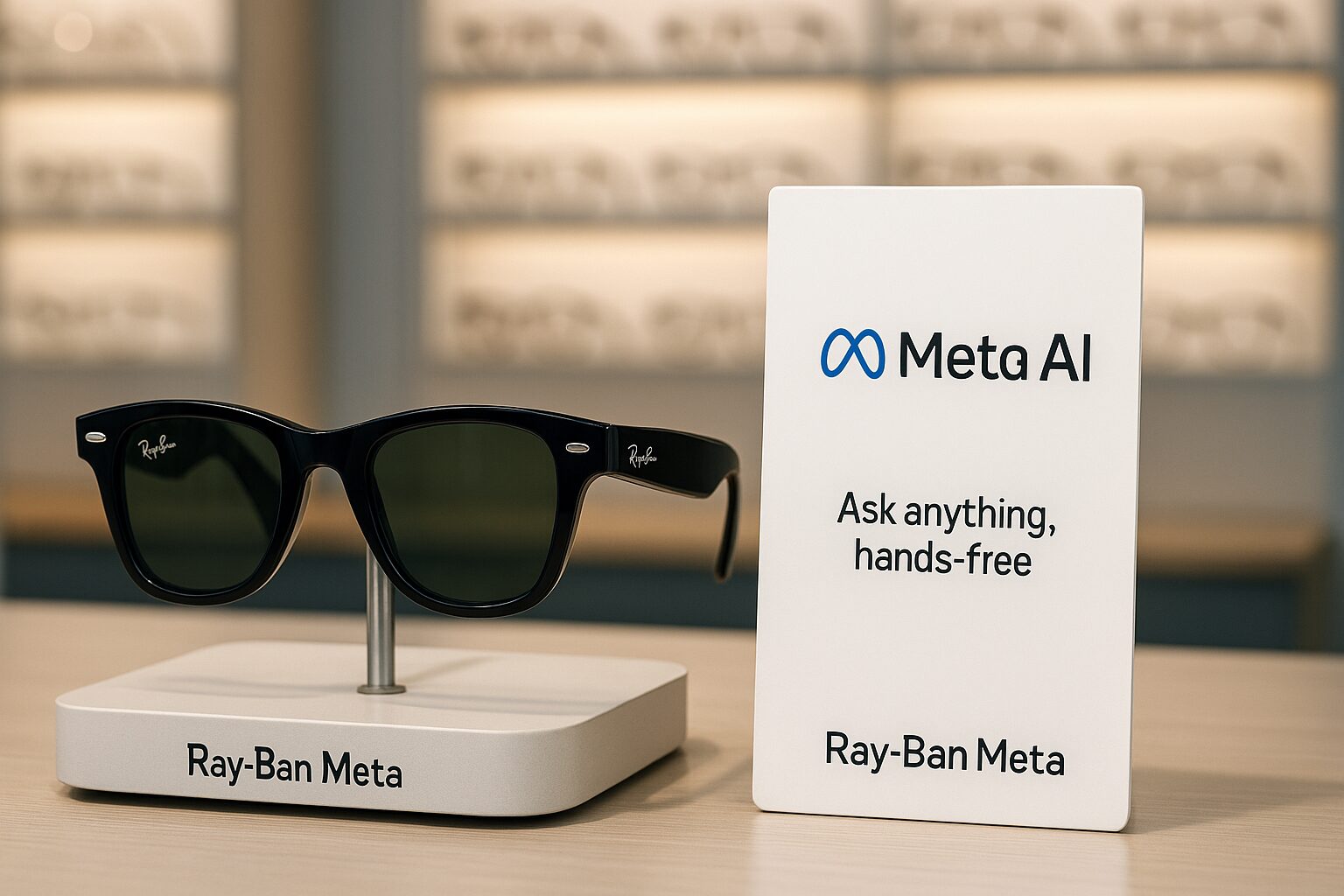
Meta’s partnership with Ray-Ban maker EssilorLuxottica has quietly turned into the most credible “AI glasses” business on earth—and Meta just doubled down by reportedly buying 3% of EssilorLuxottica (€3B/$3.5B). Combined with a long-term product roadmap and global retail reach, this looks less like a side bet and more like Meta’s bid to own the post-smartphone interface.
Why it matters: Ray-Ban Meta glasses have crossed ~2M units sold since launch (Oct 2023), with production capacity targeted at 10M units/year by 2026—and new Oakley and display-equipped variants queuing up. If AI assistants become wearable-first, Meta’s distribution + design + data flywheel gives it pole position (Sources: The VergeUploadVRTom’s Guide+1).
Meta’s Investment & Partnership Footing
- Equity stake: Multiple outlets report Meta acquired just under 3% of EssilorLuxottica; coverage pegs the value near €3B–$3.5B, with chatter about rising to ~5% over time (Sources: Reuters+1bloomberg.com).
- Strategic upside: The stake buys Meta influence over frames, manufacturing, and global retail (Ray-Ban, Oakley, Prada, etc.), supercharging distribution vs. typical gadget rollouts (Sources: Reutersessilorluxottica.com).
- Roadmap: Partnership extended “into the next decade”; Meta AI features keep rolling out in Europe, with real-time translation and multimodal “vision” now live in more EU markets (Sources: essilorluxottica.comReutersabout.fb.com).
Product Traction & What’s Next
- Units & scale: EssilorLuxottica told investors 2M pairs sold by early 2025; target 10M/year by 2026. H1-2025 sales reportedly tripled YoY, shifting Reality Labs momentum from VR to glasses (Sources: The VergeUploadVR).
- Pipeline: Beyond Ray-Ban, the Oakley Meta HSTN pushes into performance/sports; reports point to a “Hypernova” model with a monocular lens display debuting at Meta Connect in September (Sources: Tom’s Guide+1).
- Features now: Camera, livestreaming, open-ear audio, and Meta AI with real-time translation and visual Q&A; availability expanding across the EU (Sources: Reuters).
Market Impact
- Category leadership: Independent trackers credit Ray-Ban Meta as the prime driver of the smart-glasses surge, with the category on a steep multi-year growth curve (Sources: counterpointresearch.com).
- Shift inside Meta: Reality Labs remains loss-making, but management and third-party reports attribute Q2-2025 outperformance within RL to glasses, not VR—a critical narrative turn for investors (Sources: webpronews.comUploadVR).
Opportunities (Bull Case)
- Distribution moat: EssilorLuxottica’s retail & prescription network = built-in scale, fashion credibility, and SKU velocity that consumer tech rivals lack (Sources: essilorluxottica.com).
- AI on-ramp: Glasses can become the sensor + screenless interface for AI assistants (hands-free capture, translation, search), collapsing friction in everyday use. (Analyst inference)
- Brand expansion: Oakley today, Prada tomorrow—multi-brand frames unlock broader demographics and margins without reinventing the electronics (Sources: Tom’s Guide).
- Flywheel data: Always-on, consented multimodal inputs feed Meta’s assistant quality—and, over time, commerce & ads in context (voice queries, instant capture). (Analyst inference)
Risks (Bear Case)
- Regulatory drag: EU GDPR + AI Act scrutiny on public recording, transparency (recording LEDs, notices) and prohibited AI practices (e.g., biometric profiling) could cap features or require geofencing (Sources: ReutersOrrick).
- Privacy optics: Prior EU warnings over Ray-Ban Stories’ tiny indicator light show how fast backlash can move—brand risk for both Meta and Ray-Ban (Sources: TechCrunch).
- Unit economics: RL remains a multi-billion-dollar quarterly loss center; scaling hardware, support, and returns while keeping ASPs attractive is non-trivial (Sources: webpronews.com).
- Competition: Apple/Google/ByteDance/Kering-adjacent plays will push fashion+tech bundles; display-in-lens models raise BOM/complexity and failure modes. (Analyst inference)
Regulatory Context (EU Focus)
- Then vs now: EU DPAs flagged recording-notice adequacy in 2021; today, the EU AI Act overlays transparency, safety, and prohibited-practice rules that directly touch camera-equipped, AI-enhanced wearables. Expect stricter disclosures, on-device controls, and feature gating by jurisdiction (Sources: ReutersOrrick).
FinTelegram Hypothesis
Smart glasses are the first mass-market AI appliance. If assistants migrate from phone screens to face-level presence, the “winner” won’t just sell hardware—it will own the default daily interface for search, capture, navigation, and payments. Meta’s stake in EssilorLuxottica is not financial window dressing; it’s vertical integration by another name. The reward: own the rails of the AI-based cybersociety—literally at eye level. (Analyst inference)
Actionable Takeaways
- META (long-term): Glasses traction + equity stake + retail distribution = credible path to a post-phone interface. Treat the stake as a strategic lock-in to the world’s top eyewear supply chain. Monitor Meta Connect (Sept) for “display-in-lens” SKUs and services.
- ESSILORLUXOTTICA (watch/long-bias): The Meta capital + roadmap can re-rate the category from fashion to connected platform. Watch unit guidance vs. the 10M/yr capacity target and brand expansion (Oakley/Prada frames).
- Risk hedge: Track EU enforcement pulses (GDPR/AI Act) and any geofenced feature rollbacks; privacy headlines can dent sell-through.