



FinTelegram Regulatory Intelligence Brief
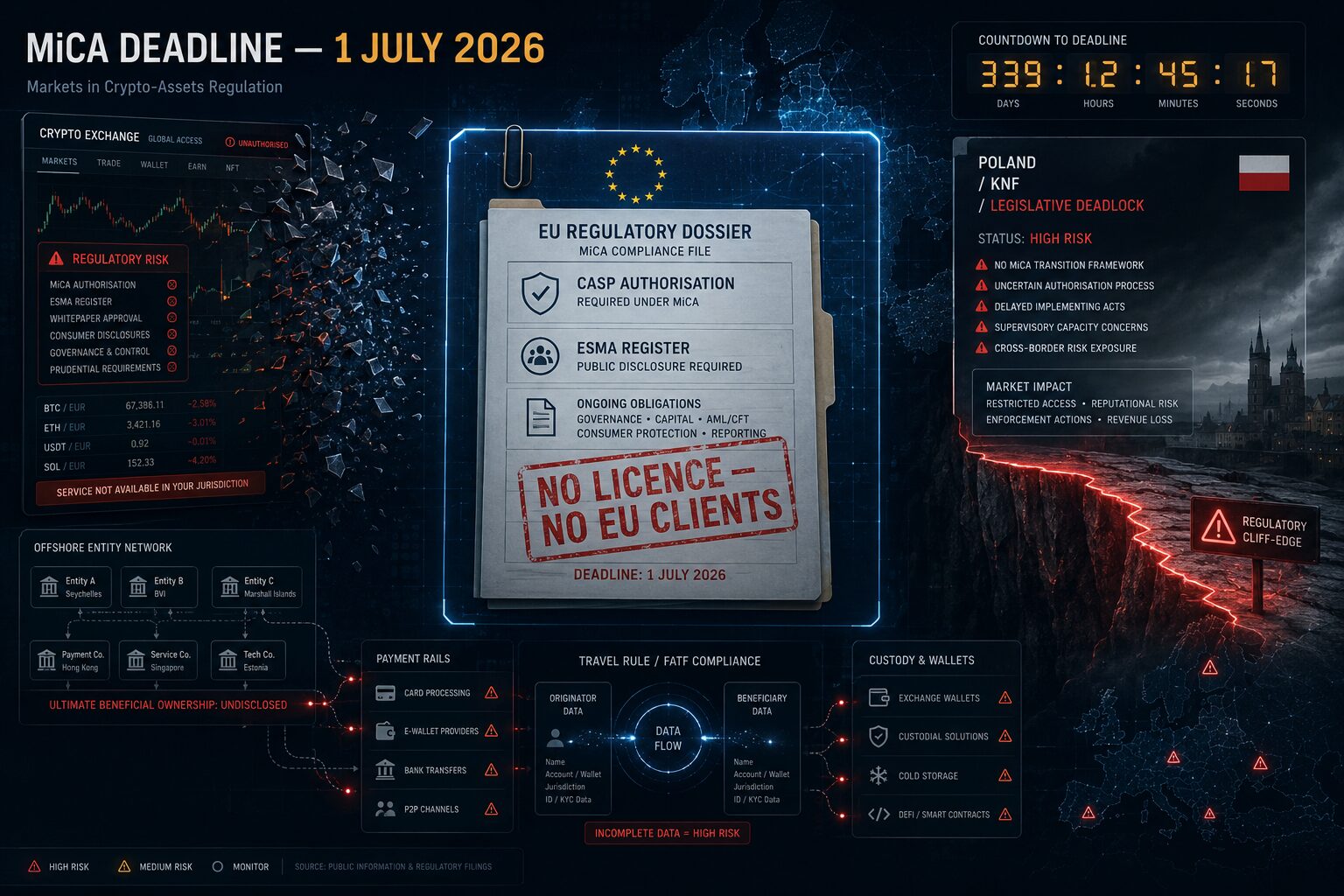
A regulatory earthquake is about to hit the European crypto market. On 1 July 2026, the last major transitional window under the EU’s Markets in Crypto-Assets Regulation (MiCA) closes. The era of national VASP registrations, legal arbitrage, offshore servicing models, and “we are still applying” excuses is over. From that date, crypto-asset service providers serving EU clients need a proper MiCA authorisation as a Crypto-Asset Service Provider (CASP). No authorisation, no business. No informal tolerance. No national grey zone. No magic “reverse solicitation” shield for platforms that are actively hunting European customers.
This is not merely another compliance deadline. It is the regulatory line in the sand between the old European crypto market and the new one.
The End Of The Grandfathering Illusion
When MiCA’s CASP regime became applicable on 30 December 2024, many crypto brokers, exchanges, custodians, and platforms treated the transitional regime as a comfortable waiting room. Under Article 143(3) MiCA, providers already operating lawfully under national regimes before 30 December 2024 could, in certain Member States, continue operating until 1 July 2026 or until they were granted or refused MiCA authorisation, whichever came first.
That waiting room is now closing.
ESMA has made the message brutally clear: after 1 July 2026, an unauthorised CASP providing crypto-asset services to EU clients is in breach of EU law and must stop. Providers that fail to obtain authorisation must not pretend that a pending application, old national VASP registration, group licence, offshore entity, or brand-level reputation is enough.
MiCA authorisation attaches to a specific legal entity. It is not a marketing badge. It is not transferable by logo. It is not inherited by affiliates. It is not a passport for the entire corporate group unless the authorised entity and the notified services actually match the client-facing business.
The New Rule: Get Licensed Or Get Out
From 1 July 2026, the compliance logic becomes brutally simple: No MiCA CASP authorisation means no EU crypto services.
Unauthorised providers must stop onboarding new EU clients, stop opening new client accounts, cease marketing and solicitation, and limit their activity to the orderly closing, transfer, or liquidation of existing positions. Custody can continue only for as long as strictly necessary to execute an orderly wind-down.
This is where the new enforcement phase begins. The question for regulators, banks, payment institutions, compliance officers, victims, and investigators is no longer whether a crypto platform once appeared on a local VASP register. The question is whether the exact legal entity providing the service is authorised under MiCA and properly passported for the relevant EU markets.
That changes everything.
The Offshore Problem: Europe’s Crypto Back Door Is Closing
The biggest impact will not be on the cleanly authorised players. They have spent the last two years preparing. The impact will be on the platforms that built their business on regulatory fog.
Offshore exchanges and brokers using entities in loosely regulated jurisdictions will no longer be able to approach EU clients unless they fall within the very narrow reverse solicitation exception. And that exception is not a marketing strategy. It is a legal defence for genuinely client-initiated contact.
If a platform runs EU-facing ads, uses European languages, works through affiliates targeting EU traffic, pays introducers, runs German-, French-, Polish-, Italian- or Spanish-language funnels, or maintains EU customer acquisition dashboards, the “reverse solicitation” argument becomes a fragile fiction.
In FinTelegram terms: the marketing trail becomes the evidence trail.
The Travel Rule Trap
MiCA is not arriving alone. The EU Transfer of Funds Regulation has already extended Travel Rule obligations to crypto-asset transfers. That means originator and beneficiary information, transaction monitoring, sanctions screening, suspicious activity reporting, and record-keeping are no longer optional compliance theatre.
For unauthorised or semi-authorised crypto platforms, this creates a second pressure point. Even during wind-down, AML/CFT controls must remain effective. Shadow payment rails, opaque third-party processors, nominee merchant structures, and fragmented custody arrangements will become red flags, not operational conveniences.
In other words, after 1 July 2026, “crypto compliance” in Europe is no longer only about the licence. It is about whether the entire transaction chain survives regulatory inspection.
Poland: MiCA On Paper, Regulatory Chaos In Practice
Poland is emerging as the most dramatic case study in the final days before the MiCA deadline. The country did not simply ignore MiCA. In May 2026, Polish lawmakers adopted a crypto-assets bill designed to align the national framework with the EU’s Markets in Crypto-Assets Regulation. But that legislative sprint collapsed into political deadlock when President Karol Nawrocki vetoed the bill on 11 June 2026 — reportedly for the third time.
That makes Poland’s situation especially explosive. On paper, the country moved towards MiCA implementation. In practice, the veto left the domestic supervisory machinery unresolved just days before the EU transitional deadline. The result is a regulatory cliff-edge for Polish legacy VASPs: the EU deadline is fixed, but the national authorisation framework remains politically blocked.
The Polish Financial Supervision Authority, KNF, has already warned that the 1 July 2026 deadline cannot be extended by national law or by a KNF decision. In the absence of a properly designated competent authority and effective national implementation, domestic entities relying on the old Polish VASP framework risk losing the ability to continue providing crypto-asset services after the deadline unless they obtain a valid MiCA authorisation.
That is not a technical delay. It is regulatory trauma in real time.
The irony is hard to miss: EU-authorised CASPs from other Member States may still be able to passport services into Poland, while domestic Polish legacy VASPs may be pushed into suspension, relocation, or forced wind-down. The intended EU single market may therefore arrive in Poland not as a smooth transition, but as a regulatory shock — with foreign licensed players potentially entering while local players are trapped in a politically manufactured licensing vacuum.
Red Flags For Investigators, Banks And Victims
The post-1 July environment creates a new set of forensic indicators.
1. Fake passporting claims.
If a platform claims to be “registered in Poland,” “registered in the Czech Republic,” or “regulated in Europe,” check the ESMA MiCA register. A legacy VASP registration is not the same as MiCA authorisation. A registration in one Member State is not automatically an EU-wide licence.
2. Wrong legal entity.
Many brands operate through multiple entities. The authorised entity may not be the entity contracting with the customer, holding assets, receiving fiat deposits, or operating the exchange interface. Under MiCA, the exact legal entity matters.
3. Reverse solicitation theatre.
A platform cannot aggressively market to EU clients and then claim that every customer arrived by their own exclusive initiative. Affiliate campaigns, geo-targeted landing pages, local-language funnels, and sales scripts are evidence.
4. Offshore custody chains.
ESMA has warned that non-EU entities cannot be used to provide MiCA services to EU clients through the back door. Custody, in particular, cannot simply be outsourced to an unauthorised third-country affiliate.
5. Shadow payment rails.
Unclear merchant descriptors, third-party payment processors, layered bank accounts, and unusual fiat-to-crypto routing patterns should be treated as red flags. Where MiCA authorisation is missing, payment flows often reveal the true operating model.
6. “Application pending” excuses.
A pending CASP application is not a licence. After 1 July 2026, the difference between authorised and unauthorised becomes existential.
The Enforcement Phase Begins
MiCA was often sold as Europe’s attempt to bring legal certainty to crypto. That is true — but legal certainty cuts both ways. It protects authorised providers and clients. It also removes excuses for those who continue to operate outside the perimeter.
For years, Europe’s crypto market lived with a patchwork of national registrations, loosely supervised VASP regimes, offshore group structures, and opportunistic passporting narratives. That structure now collapses into a binary test:
Is the provider MiCA-authorised for the relevant service and client market — yes or no?
From 1 July 2026, that question becomes the first question banks, payment institutions, victims, investigators, regulators, and journalists should ask.
FinTelegram Call For Information
FinTelegram is asking insiders, compliance officers, former employees, payment processors, victims, and market participants to provide information on crypto exchanges, brokers, custodians, wallet operators, OTC desks, payment processors, and affiliate networks that continue to target EU clients after 1 July 2026 without valid MiCA authorisation.
We are particularly interested in:
- platforms claiming EU access through legacy VASP registrations;
- offshore entities servicing EU clients through EU-facing brands;
- payment processors facilitating unauthorised crypto services;
- misleading passporting claims;
- reverse-solicitation abuse;
- forced client migration, blocked withdrawals, or opaque wind-down procedures;
- Polish legacy VASPs attempting to continue operations after the deadline without authorisation.
Please submit documents, screenshots, payment records, customer communications, legal entity names, merchant descriptors, affiliate materials, and internal compliance information via Whistle42. The European crypto grey zone is closing. The next scandal will not be about who failed to apply for a licence. It will be about who kept taking European clients after the licence deadline had already passed.