



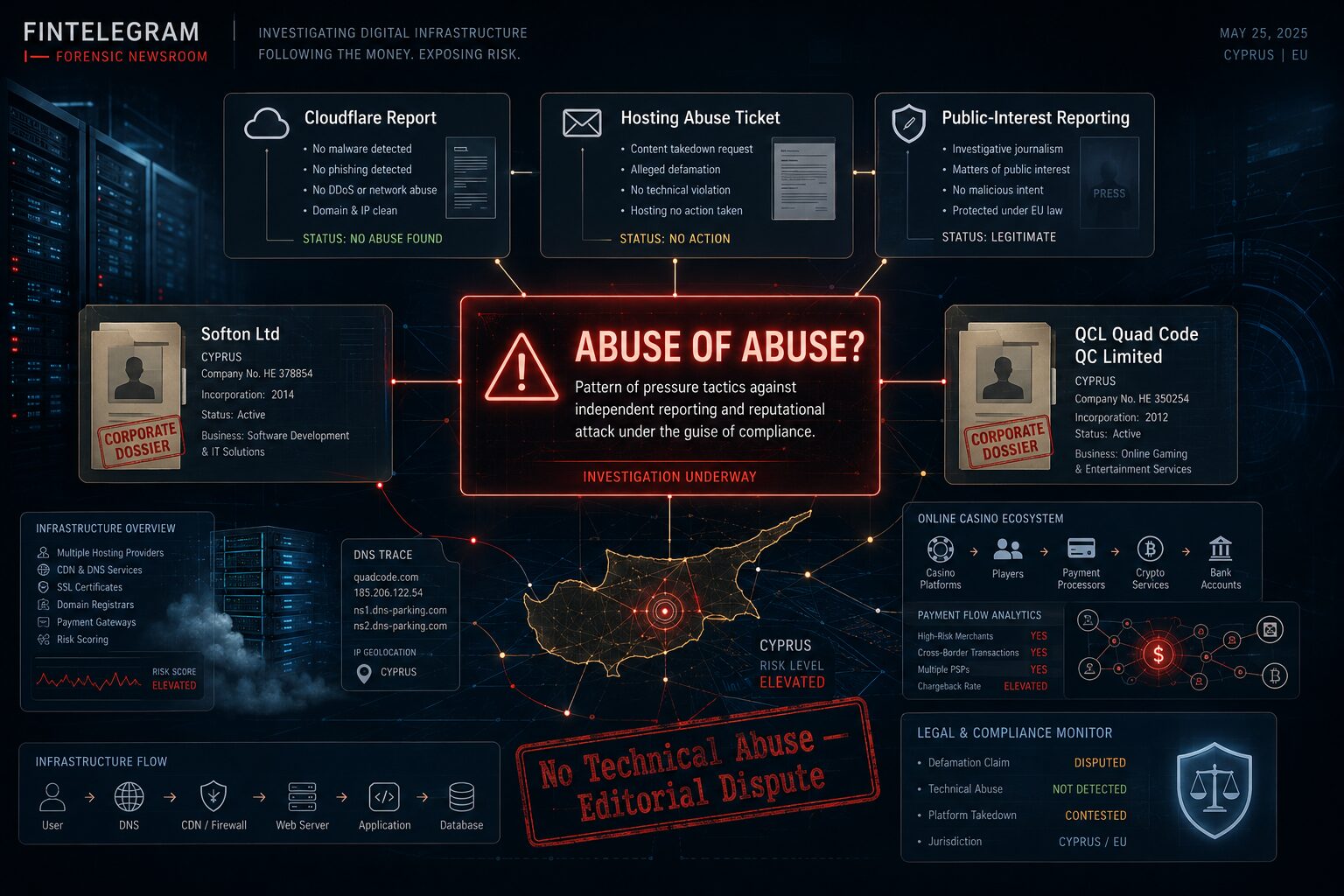
FinTelegram has recently observed a familiar — and troubling — escalation pattern around its ongoing casino/payment investigations: when direct engagement with the publisher does not lead to removal of a public-interest report, the next step appears to be an “abuse” complaint to internet infrastructure providers.
Two cases now stand out: Softon Ltd and QCL Quad Code CY Limited.
In the Softon case, FinTelegram was first approached through Azlan Alliance and Darwin John in relation to our report on Softon Ltd and the Cyprus casino infrastructure concerns raised by whistleblowers. FinTelegram engaged, responded, and invited concrete answers to the open factual questions. That communication was then effectively discontinued without substantive answers to the core issues raised.
Instead, a new escalation arrived through the infrastructure route: a complaint submitted to Cloudflare and forwarded to FinTelegram’s hosting provider. The complaint was filed by InteliumLaw FZ LLE, a UAE-registered legal consultancy acting for Softon Ltd, and alleged defamation, reputational harm, unauthorized disclosure concerns, confidentiality risks, and potential misuse of whistleblower materials.
That is noteworthy. Softon Ltd is a Cyprus company. InteliumLaw publicly presents itself as an international legal consultancy with a strong profile in gaming, crypto, regulatory, banking, and business-structuring services, with public contact points in the UAE and Cyprus. FinTelegram does not suggest that there is anything improper in Softon choosing such advisers. But the choice is relevant in context: the complaint did not answer the editorial questions raised by FinTelegram. It attempted to reframe a disputed investigative report as hosting “abuse.”
In parallel, QCL Quad Code CY Limited (website) — another Cyprus-linked entity featured in FinTelegram’s Zentoria / Spinsopotamia reporting — also escalated through a similar abuse-channel route. After sending cease-and-desist-style letters directly to FinTelegram, QCL Quad Code did not substantively address FinTelegram’s preserved LinkedIn evidence concerning the Vavilova / Quadcode profile issue. Instead, a complaint was routed through Cloudflare and the hosting-abuse channel, seeking removal or blocking of the article.
Read our Zentoria reports here.
The timing, Cyprus nexus, casino/payment context, and shared use of abuse-channel escalation are striking. Whether these parallel complaints reflect coordination, shared advisers, or simply similar crisis-management playbooks remains an open question. What can be said is that the method is the same: take a contested editorial and reputational dispute and try to push it into the infrastructure-abuse pipeline.
FinTelegram’s hosting provider reviewed the matter and confirmed that no punitive action, suspension, blocking, or content removal would be taken in connection with the complaints. The provider correctly recognized that these were disputed editorial and reputational matters — not technical abuse such as malware, phishing, spam, impersonation, or illegal hosting activity. No court order, injunction, or binding legal determination was presented.
That distinction is important.
A defamation complaint is not a DMCA notice. A reputational objection is not malware. A subject’s denial is not a court order. And a whistleblower call in a public-interest investigation is not, by itself, infrastructure abuse.
FinTelegram does not ask sources to hack systems, steal documents, bypass security controls, violate legal privilege, or disclose materials they are not legally entitled to share. FinTelegram does invite whistleblowers, insiders, victims, compliance professionals, and informed sources to provide information relevant to matters of public interest. Submissions are reviewed editorially and may be redacted or withheld where confidentiality, privacy, privilege, source protection, or safety concerns require it.
FinTelegram will continue to review complaints, publish corrections where justified, include denials and right-of-reply statements where appropriate, and update reports when new evidence emerges. But FinTelegram will not remove public-interest reporting merely because subjects of investigations repackage disputed reputational complaints as “abuse” notices to infrastructure providers.
This is not only a FinTelegram issue. It is a broader media-freedom and investigative-reporting issue. If infrastructure providers were to remove lawful public-interest reporting every time a powerful subject labels a reputational dispute as “abuse,” the result would be private censorship without court review.
The message from this episode is clear: If Softon, QCL Quad Code, or any other subject of FinTelegram reporting believes a specific factual statement is wrong, the appropriate route is simple — identify the exact passage, provide documentary evidence, request a correction, and engage in a proper right-of-reply process.
The abuse channel is not a shortcut around editorial accountability.
Whistleblower Notice
FinTelegram welcomes information from insiders, victims, compliance officers, payment professionals, former employees, contractors, regulators, and other informed sources concerning online casino structures, payment flows, licensing, beneficial ownership, merchant descriptors, and related regulatory risks.
FinTelegram does not ask sources to obtain information unlawfully, bypass security systems, breach legal privilege, or disclose material they are not legally entitled to share. Submissions are reviewed editorially and may be redacted or withheld where confidentiality, privacy, privilege, source protection, or safety concerns require it.