



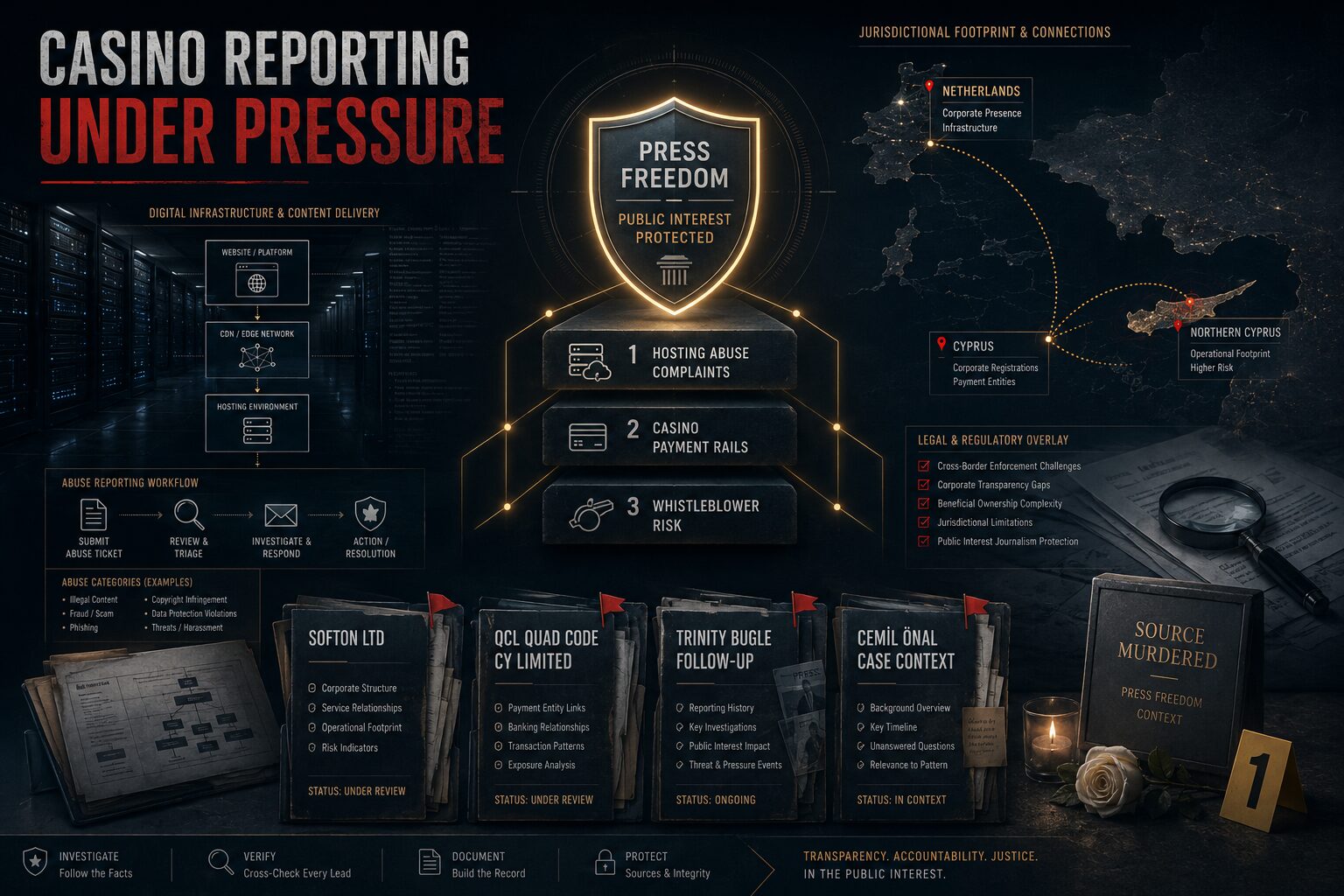
The online casino and payment sector around Cyprus is not merely a regulatory grey zone. It is also becoming a pressure zone for investigative journalism. After FinTelegram published its report “Abuse of Abuse? Softon and Quadcode Try the Infrastructure Route Against FinTelegram Reporting,” Trinity Bugle picked up the story and framed the matter in a broader press-freedom context. The issue is simple but important: when subjects of investigative reporting cannot secure removal of a report through direct communication, cease-and-desist letters, or reputational pressure, they may try another route — the infrastructure-abuse pipeline.
The Abuse-Pipeline Pattern
FinTelegram recently faced two parallel infrastructure complaints routed through Cloudflare and its hosting provider. One concerned Softon Ltd and FinTelegram’s reporting on Cyprus-linked casino/payment infrastructure issues. The other concerned QCL Quad Code CY Limited and FinTelegram’s Zentoria / Spinsopotamia reporting.
In both cases, the complaints attempted to characterize disputed editorial and reputational matters as “abuse.” In both cases, no court order, injunction, judgment, or binding legal determination was presented. In both cases, the issue was not malware, phishing, spam, impersonation, illegal hosting activity, or other technical abuse.
FinTelegram’s hosting provider reviewed the matter and confirmed that it would not take punitive action, suspend, block, or remove content. The reason was exactly the point FinTelegram had made: these were disputed editorial and reputational matters, not technical abuse. That decision matters beyond FinTelegram. If infrastructure providers were to remove investigative reporting every time an investigated party files an “abuse” complaint, public-interest journalism would become hostage to private pressure campaigns.
Trinity Bugle’s Follow-Up
Trinity Bugle’s June 28 report picked up this pattern and highlighted the risk that infrastructure-abuse channels can be weaponized against investigative journalism. Its framing is pointed: Softon Ltd and QCL Quad Code CY Limited are presented as examples of entities attempting to use the abuse pipeline to silence FinTelegram’s casino/payment reporting.
FinTelegram agrees with the core press-freedom concern. However, precision is essential. The parallel timing, Cyprus nexus, casino/payment context, and similar use of abuse-channel escalation are legitimate matters of journalistic interest. They do not, by themselves, prove coordination between Softon and QCL Quad Code. Whether the parallel complaints reflect coordination, shared advisers, similar playbooks, or coincidence remains an open question.
The Cemil Önal Context: Why The Stakes Are Real
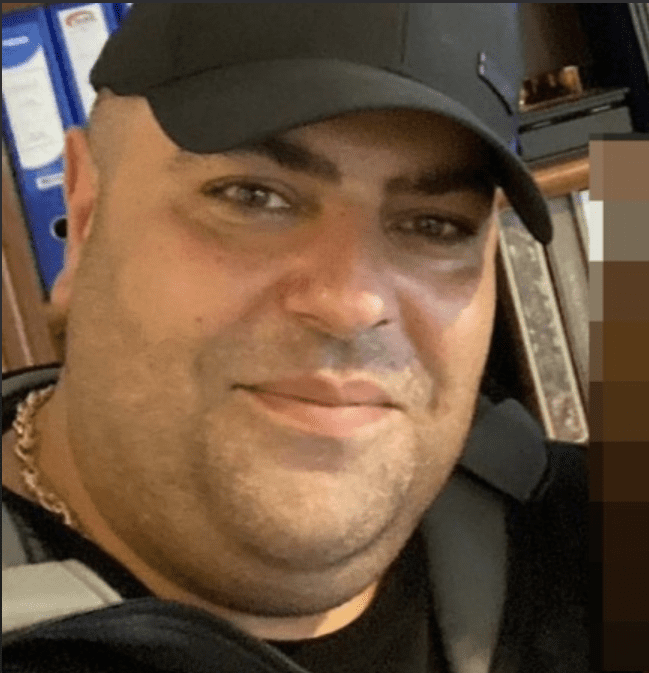
Trinity Bugle also placed the matter into a darker regional context: the murder of Cemil Önal and the threats against Turkish Cypriot journalist Ayşemden Akın.
That context must be handled carefully. FinTelegram does not suggest that Softon Ltd, QCL Quad Code CY Limited, or any person connected to them had any involvement in the Cemil Önal murder or threats against journalists. There is no basis for such an allegation.
But the Önal/Akın case does show why casino/payment investigations around Cyprus, Northern Cyprus, Turkey, offshore gambling, payment rails, and alleged money-laundering structures cannot be treated as ordinary commercial disputes.
Cemil Önal, a former finance figure linked to the late Turkish Cypriot casino businessman Halil Falyalı, was shot dead in the Netherlands in May 2025. Before his murder, Önal had reportedly warned authorities and journalists that he feared for his life because of what he knew about alleged payments, betting operations, and political corruption. OCCRP had earlier published a major investigation into the alleged global online betting empire of Halil Falyalı, based partly on extensive interviews with Önal and supported by records and cross-border reporting.
At around the same time, Ayşemden Akın, editor-in-chief of Bugün Kıbrıs, received death threats after publishing investigations based on Önal’s statements. Press-freedom organizations including CPJ and RSF called for stronger protection for Akın. RSF described “multiple and serious warning signs” and urged permanent protection after Akın’s source was murdered.
This is the relevant context: investigative reporting into casino, betting, payment, and political-protection networks in the Cyprus/Northern Cyprus/Turkey corridor can trigger serious retaliation risks — ranging from legal threats and hosting-abuse pressure to threats against sources and journalists.
No Technical Abuse — Editorial Dispute
FinTelegram’s position is straightforward. A defamation complaint is not a DMCA notice. A reputational objection is not malware. A denial is not a court order. And a whistleblower call in a public-interest investigation is not, by itself, infrastructure abuse.
FinTelegram does not ask sources to hack systems, steal documents, bypass security controls, violate legal privilege, or disclose material they are not legally entitled to share. FinTelegram does invite whistleblowers, insiders, victims, compliance professionals, and informed sources to submit information relevant to matters of public interest. Such submissions are reviewed editorially and may be redacted or withheld where confidentiality, privacy, privilege, source protection, or safety concerns require it.
FinTelegram will continue to review complaints, publish corrections where justified, include denials and right-of-reply statements where appropriate, and update reports when new evidence emerges. But FinTelegram will not remove public-interest reporting simply because investigated parties attempt to repackage contested reputational disputes as “abuse” complaints to infrastructure providers.
FinTelegram Take
The Softon and QCL Quad Code complaints demonstrate a growing tactical problem for investigative media: infrastructure pressure is becoming part of the crisis-management toolkit. The objective is not necessarily to win a legal argument. It is to create enough perceived risk for a hoster, CDN provider, registrar, or platform to remove content without a court ever assessing the facts.
That should concern everyone who cares about investigative journalism, consumer protection, and financial-crime reporting.
If companies believe FinTelegram has made a factual error, the appropriate route is clear: identify the exact passage, provide documentary evidence, request a correction, and engage in a right-of-reply process.
The abuse channel is not a shortcut around editorial accountability.
Whistleblower Notice
FinTelegram welcomes information from insiders, victims, compliance officers, payment professionals, former employees, contractors, regulators, and other informed sources concerning online casino structures, payment flows, licensing, beneficial ownership, merchant descriptors, infrastructure links, and related regulatory risks.
FinTelegram does not ask sources to obtain information unlawfully, bypass security systems, breach legal privilege, or disclose material they are not legally entitled to share. Submissions are reviewed editorially and may be redacted or withheld where confidentiality, privacy, privilege, source protection, or safety concerns require it.