




On 5 March 2026, Hungarian counter-terrorism commandos ambushed two Oschadbank armoured vehicles on the M0 ring road near Budapest, seizing $40 million, €35 million, and nine kilograms of gold — a total haul of roughly $82 million. The man escorting the cash? A former SBU intelligence general. Zelensky’s response was to threaten Viktor Orbán‘s life. This was just one of several such money and gold transports from Austria via Hungary to Ukraine.
KEY FINDINGS
- $82 million in mixed cash and gold seized from two Oschadbank armoured vehicles on the Hungarian M0 ring road on 5 March 2026.
- Among the seven detainees: a former general of Ukraine’s SBU (Security Service), Gennady Kuznetsov — not a typical bank courier profile.
- Hungary opened formal money-laundering criminal proceedings; Orbán ordered a 60-day asset freeze via emergency government decree.
- Hungarian minister János Lázár publicly admitted the raid was deliberate and tied to Ukraine’s suspension of Druzhba oil pipeline transit — a geopolitical act disguised as law enforcement.
- Zelensky publicly threatened Orbán, implying he would give the PM’s address to Ukrainian armed forces so they could “speak to him in their own language.”
- The EU rebuked Zelensky’s threat as “not acceptable” — but EU-country media largely buried or downplayed it.
- In 2026 alone, over $900 million, €420 million, and 146 kg of gold bars transited Hungary into Ukraine — all by road, all in cash.
- The cash originated from Austria’s Raiffeisen Bank International (RBI) — raising questions about RBI’s role in Ukraine’s parallel cash economy.
Read more about the role of RBI in this case here.
ANALYSIS: WHY WIRE TRANSFERS DON’T LIE — AND CASH DOESN’T HAVE TO
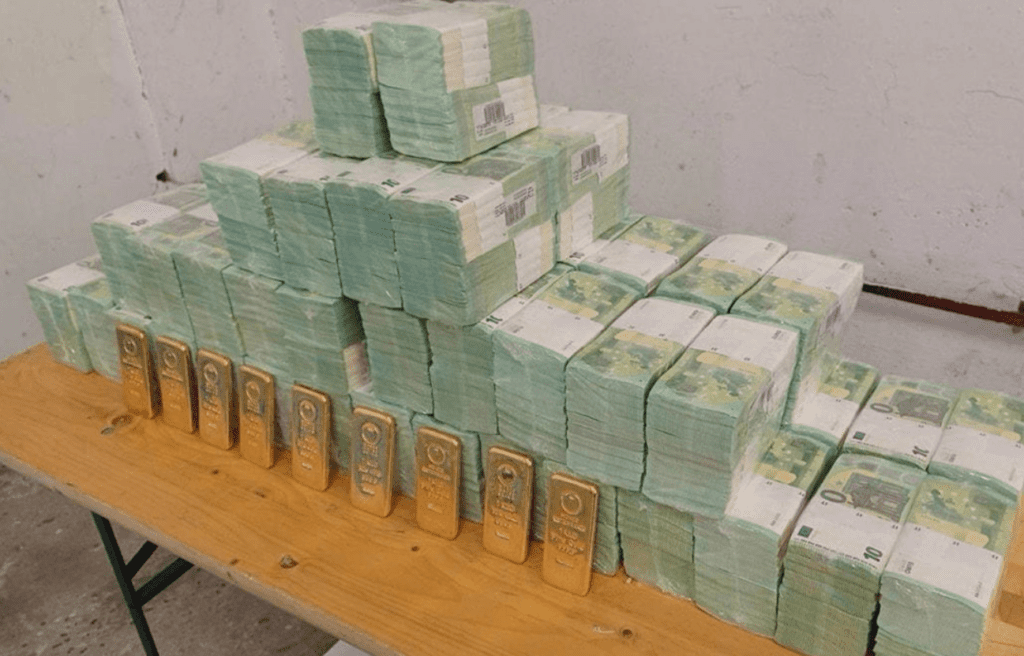
Ukraine’s Oschadbank — the state-owned national savings bank — insists the shipment was routine. Since Russia’s full-scale invasion in February 2022, Ukraine’s airspace closure has forced banks to repatriate foreign currency by armoured road convoy rather than air freight or SWIFT transfer. Bloomberg sources confirm such runs occur weekly.
This explanation, however, does not survive basic AML scrutiny. The FATF framework and EU’s 6AMLD are unambiguous: when a legitimate financial institution needs to move large sums of foreign currency, the instrument of choice is a SWIFT interbank transfer, a central bank-to-central bank settlement, or at minimum a documented correspondent banking arrangement — not a physical cash convoy. The question that neither Oschadbank nor its apologists have answered is elementary: why cash, not wire?
AML red flags are stacked high. Physical cash — by definition — leaves no automatic audit trail. A former SBU counter-terrorism general serving as a cash courier is operationally indefensible for a routine bank transfer. The sheer scale ($82 million in a single run, with $900M+ transited in just the first two months of 2026) is far beyond any plausible retail liquidity requirement. The involvement of Raiffeisen Bank International (RBI) as the Austrian originator adds another layer: RBI has faced sustained regulatory scrutiny for its continued Russia exposure and has been under pressure from the ECB to exit the Russian market. Austria is also home to some of Europe’s most opaque private banking structures.
Ukrainian investigative journalist Anatoliy Shariy, citing sources, alleged the funds did not belong to Oschadbank at all, but to “very specific people” — figures embedded in the Kyiv political establishment with links to Brussels. Hungarian Foreign Minister Péter Szijjártó was even blunter, raising the spectre of a “Ukrainian war mafia.” These are allegations, not proven facts — but the presence of an intelligence general at the wheel of a cash truck worth $82 million demands a credible counter-narrative that has not materialised.
The geopolitical context is equally telling. Hungary seized the convoy on the same day Zelensky threatened Orbán. Budapest admitted the operation was deliberate retaliation for the Druzhba pipeline suspension. This collision of raw power politics and financial crime enforcement creates a legal no-man’s land: Hungary’s seizure may be politically motivated yet legally defensible on AML grounds. The money remains frozen, with Orbán holding it as collateral. Poland’s foreign minister called it theft. The EU called Zelensky’s death threat “unacceptable” — and then largely moved on.
THE SILENCE OF EU MEDIA
That a sitting head of state — a recipient of billions in EU and NATO military support — publicly implied he would send armed soldiers to the private address of an EU member state’s prime minister is, by any standard, an extraordinary event. It is precisely the kind of story that should dominate European front pages for days. Instead, Der Spiegel buried Zelensky’s threat in the penultimate paragraph of an article focused on Orbán. French, Italian, and Spanish outlets barely covered it. The narrative architecture of the European press — in which Zelensky is the heroic victim and Orbán the Kremlin’s useful idiot — left no editorial room for the inconvenient truth that Kyiv just threatened an EU capital.
CONCLUSION
Whether the $82 million seized in Budapest is war-chest funding for Ukrainian oligarchs, legitimate Oschadbank liquidity, or something murkier, the case exposes a critical gap in Europe’s financial crime architecture: billions in physical cash are moving through EU territory without triggering the oversight mechanisms that SWIFT transfers would automatically generate. The legality of Hungary’s seizure remains contested, but the AML questions raised are entirely legitimate — and they deserve serious answers, not diplomatic deflection and media silence.
WHISTLEBLOWER APPEAL
Do you have information about cash transfers between Ukrainian banks and European financial institutions? Do you know who the beneficial owners of these convoys really are? FinTelegram urges insiders, bank employees, compliance officers, or government officials with relevant knowledge to come forward. Submit information securely and anonymously via Whistle42 — our encrypted whistleblower platform. Your information protects European financial integrity.