



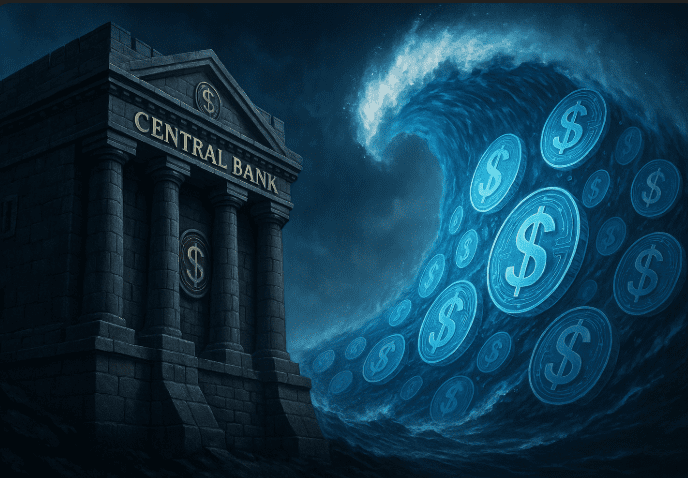
Bank of England Governor Andrew Bailey used a high-profile speech at the ECB’s Sintra forum to warn that fast-growing stablecoins “threaten the public’s trust in money.” His remarks echo a widening chorus—from the BIS to the FSB—arguing that privately issued, dollar-pegged tokens could fracture the “singleness of money,” trigger runs on reserves, and export systemic risk into the traditional banking stack.
Key Points
- Monetary sovereignty under siege. Stablecoins let Big Tech and crypto platforms mint quasi-money outside central-bank control, undermining policy transmission and lender-of-last-resort backstops (Source: reuters.com).
- Run-risk déjà vu. Bailey compared stablecoin issuers to shadow banks; if collateral quality or transparency slips, redemptions could force fire-sales of Treasuries—amplifying volatility in the very instruments banks use as “risk-free” capital (Source: bis.org
- Regulatory dragnet tightening. The BIS 2025 Annual Report and the FSB’s high-level recommendations both call for bank-grade capital, liquidity, and disclosure rules for “global stablecoin arrangements” (Sources: bis.org, fsb.org)
- Political tailwinds. In the U.S., a populist push to “dollarize the internet” via stablecoins is gaining traction—putting central bankers on the defensive (Source: reuters.com)
- Market share milestones. Combined circulation of USDT, USDC, PYUSD and emerging bank-backed tokens now tops $220 billion—already larger than the entire U.S. prime money-market-fund sector pre-GFC. (FinTelegram estimate; on-chain and issuer filings, July 2025).
Short Narrative (core facts)
- Event. On 3 July 2025, Bailey told policymakers that stablecoins must “prove they can hold nominal value at par in all conditions” before being treated as money equivalents (Source: ainvest.com).
- Backdrop. Stablecoin supply has tripled since 2023, with >70 % now held on DeFi lending venues that offer yields higher than bank deposits, siphoning liquidity away from traditional banks.
- Central-bank reaction. Christine Lagarde dubbed the phenomenon a “privatisation of money,” while BIS staff highlighted risks of “fire-sales of safe assets” if redemptions spike (Sources: reuters.com, bis.org)
- Regulatory path. The EU’s MiCA regime (in force June 2024) already caps non-euro stablecoins at €200 million daily transactions; the FSB wants G20 adoption of similar guardrails by end-2025 (Source: fsb.org)
Extended Analysis (market & legal consequences)
Market plumbing. A BIS working paper finds that a two-sigma inflow to dollar-backed stablecoins depresses 3-month U.S. T-bill yields by up to 2.5 bps within ten days; outflows have a >2× opposite effect. Translation: stablecoin runs could transmit instantly to the world’s risk-free benchmark and, by extension, to bank funding costs.
Balance-sheet arbitrage. Large banks now earn spread by warehousing stablecoin cash reserves; if strict segregation or 100 % T-bill mandates are enforced, that income stream shrinks, altering ROE profiles for custody heavyweights (think BNY Mellon, JPM, State Street).
Legal clarity vs. innovation. MiCA treats issuers as e-money institutions—requiring prospectuses, redemption rights, and a 30 % cap on non-bank deposits—effectively turning stablecoins into regulated narrow banks. U.S. proposals range from OCC-chartered “payment stablecoin banks” to outright SEC oversight if tokens look like securities. Fragmented regimes invite regulatory arbitrage, complicating cross-border AML/KYC enforcement.
CBDC wildcard. Central banks may counter with retail CBDCs—but face adoption hurdles and privacy backlash. A protracted CBDC rollout leaves a window where well-regulated stablecoins could entrench network effects and crowd out public money.
Investment Implications
| Angle | Upside | Downside | Who’s Exposed |
|---|---|---|---|
| Treasury-rich issuers | Earn float; de-facto shadow money-funds | Duration mismatch, run risk, new capital rules | Tether, Circle, PayPal |
| Custody & trust banks | Stablecoin reserves boost fee income | MiCA-style deposit caps cut balances | BNY, State Street |
| Payment rails | Stablecoin settlement lowers costs | Interchange erosion triggers pushback from card networks | Stripe, Visa, Mastercard |
| Legacy banks | Tokenised deposits could widen reach | Lose low-cost checking deposits to wallets | JPM, HSBC |
| Short sellers | Opportunities in thin-reserve issuers or custody banks with shrinking float | Regulatory rescues could cap downside | Crypto-native hedge funds |
Recommendation / Warning
FinTelegram Takeaway: Treat the stablecoin surge as a structural threat to fractional-reserve banking, not a passing crypto sideshow. Allocate exposure only to issuers with transparent, daily-attested reserves and plan hedges around potential “stable-run” scenarios—particularly during macro stress. For traditional bank equity: overweight well-capitalised custodians but underweight deposit-funded regional lenders vulnerable to disintermediation.