



FinTelegram Compliance Report | Status: July 27, 2026
2-Minutes Briefing
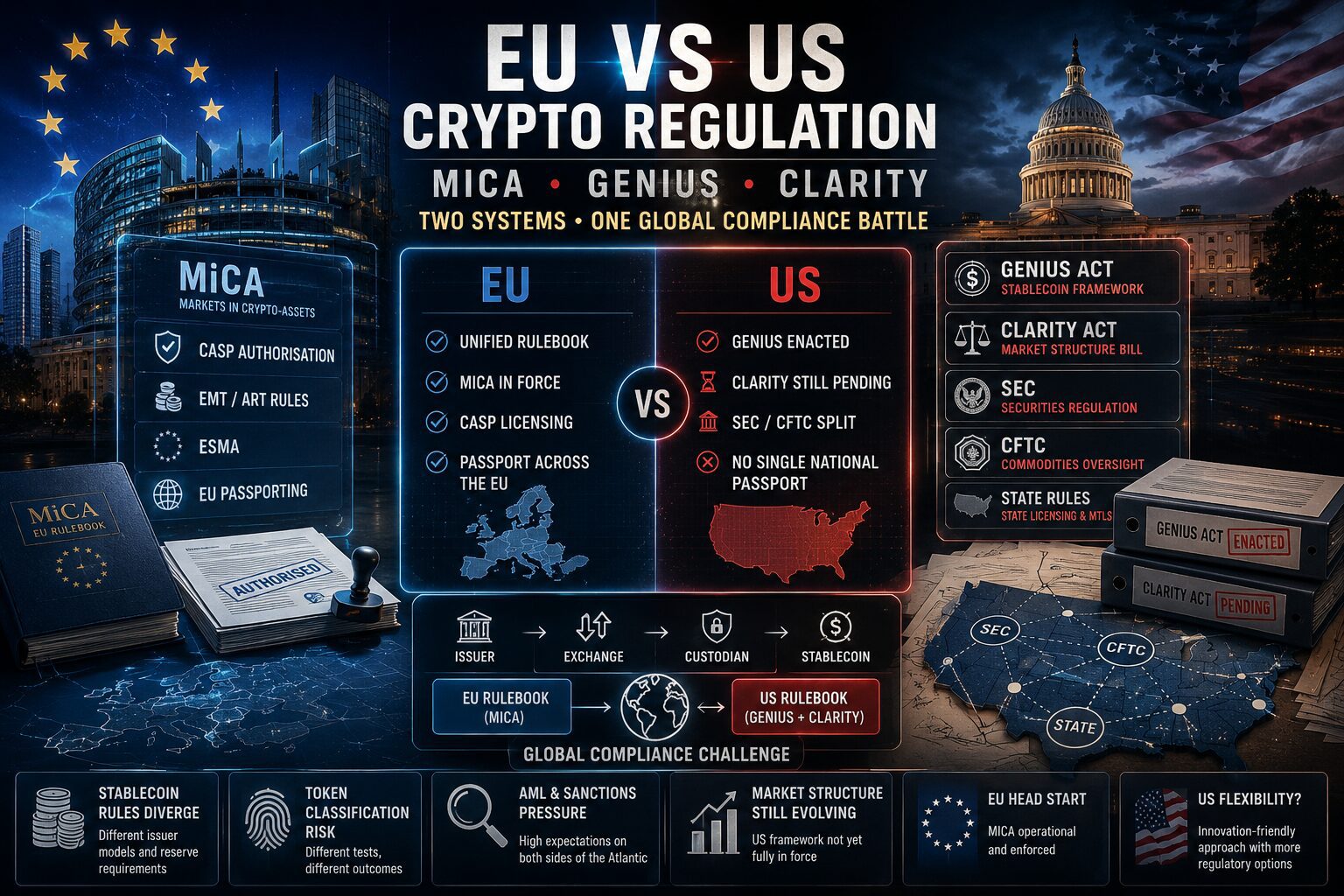
The frequently repeated claim that the US CLARITY Act is about to enter into force requires legal qualification. Although the bill has made significant progress, it has not yet been approved by the full US Senate and therefore has not become law. Even the current Senate version would generally become applicable only 360 days after being signed into law, while provisions requiring implementing regulations could take effect even later.
The position regarding the GENIUS Act also requires clarification. President Donald Trump signed the stablecoin legislation into law on July 18, 2025. However, the core regulatory regime becomes effective only on the earlier of the following dates:
- 18 months after enactment, meaning no later than January 18, 2027; or
- 120 days after the relevant final implementing regulations are issued.
As of July 2026, important rules involving the OCC, FDIC, FinCEN, and OFAC remain within the implementation process. This reveals a significant transatlantic difference:
The European Union already operates a largely harmonized crypto regulatory framework under MiCA. The United States is still constructing its federal system.
Regulatory Reality Check
GENIUS Act: Enacted, but Not Yet Fully Operational
The GENIUS Act is the first comprehensive US federal law specifically governing payment stablecoins. It generally limits the issuance of such stablecoins to authorized issuers and establishes a dual federal and state supervisory framework.
Its principal requirements include:
- reserves of at least one-to-one against outstanding stablecoins;
- clearly identifiable and segregated reserve assets;
- separation of reserves from the issuer’s other assets;
- published redemption policies;
- monthly reserve disclosures or attestations;
- priority claims for stablecoin holders in insolvency proceedings;
- AML, sanctions, and transaction-monitoring obligations;
- a prohibition on issuers paying interest or comparable returns merely for holding a payment stablecoin.
Authorized issuers may include subsidiaries of insured banks, federally authorized non-bank issuers, and qualified state-regulated issuers.
State-supervised non-bank issuers with more than $10 billion in outstanding stablecoins would generally have to transition to stronger federal supervision unless an exemption is granted.
The GENIUS Act is therefore already part of US federal law, but the licensing, supervisory, and enforcement framework is not yet fully operational.
CLARITY Act: Market Structure Legislation Still Pending
The CLARITY Act is intended to address the broader regulatory gap covering crypto exchanges, brokers, token issuers, custodians, and digital-asset spot markets. The US House of Representatives approved a version of the bill in July 2025. A revised version was reported in the Senate on June 1, 2026. However, the full Senate has not yet passed the legislation. The remaining political disputes reportedly concern issues including:
- stablecoin rewards;
- AML and KYC requirements;
- decentralized finance;
- token fundraising;
- conflicts of interest involving political officeholders.
The proposed regulatory structure is based on a functional division of responsibilities:
- The SEC would continue to supervise securities, tokenized securities, and certain fundraising transactions.
- The CFTC would receive broader authority over spot markets and intermediaries dealing in so-called digital commodities.
- The SEC and CFTC would be expected to develop coordinated classification and implementation rules.
- Exchanges, brokers, dealers, and custodians would be subject to registration, disclosure, customer-asset segregation, and conflict-of-interest requirements.
- Software developers and genuine peer-to-peer activity would receive protections, while centrally controlled DeFi access points could fall within the regulatory perimeter.
The CLARITY Act may therefore become a major component of the future US crypto framework. At present, however, it remains proposed legislation rather than enforceable law.
European Union and United States Compared
| Area | European Union | United States |
|---|---|---|
| Regulatory architecture | MiCA is a horizontal framework covering crypto-asset issuers and Crypto-Asset Service Providers. Existing financial instruments remain governed by MiFID II and other capital-markets legislation. | A sector-based system combining securities, commodities, payments, AML, banking, and state law. GENIUS regulates payment stablecoins; CLARITY is intended to add a broader market-structure framework. |
| Current status | MiCA’s stablecoin provisions have applied since June 2024, while the wider regime has applied since December 2024. The maximum transitional period for existing providers ended on July 1, 2026. | GENIUS has been enacted but is not yet fully operational. CLARITY remains a bill. |
| Stablecoins | MiCA distinguishes between E-Money Tokens referencing a single official currency and Asset-Referenced Tokens referencing other assets or combinations of assets. EMT issuers must generally be banks or electronic-money institutions. | GENIUS creates the category of payment stablecoin. Issuance is permitted through authorized bank subsidiaries, federally authorized non-banks, or qualified state issuers. |
| Reserves and redemption | Reserve, liquidity-management, and redemption requirements apply. EMTs must generally be redeemable at par value, and interest payments are prohibited. | One-to-one reserves, asset segregation, monthly transparency, and preferred insolvency claims apply. Issuers may not pay passive yield merely for holding the stablecoin. |
| Exchanges and intermediaries | Crypto services may generally be provided only by an authorized CASP or an appropriately notified regulated financial institution. | There is not yet one comprehensive federal regime for all crypto spot markets. The CFTC has broad derivatives authority but currently has more limited fraud and manipulation powers in spot markets. |
| Cross-border access | A MiCA authorization enables cross-border services throughout the EU. Third-country firms can rely on reverse solicitation only in very limited circumstances. | There is no equivalent national passport. Federal requirements coexist with state licensing systems, including the New York BitLicense regime. |
| AML and Travel Rule | CASPs are subject to AML and KYC obligations. Information on originators and beneficiaries must accompany crypto transfers, including specific requirements for transfers involving self-hosted wallets. | FinCEN already treats many crypto exchanges and exchangers as Money Services Businesses. GENIUS expressly extends Bank Secrecy Act and sanctions obligations to authorized stablecoin issuers. |
| DeFi | Services provided in a fully decentralized manner without an intermediary may fall outside MiCA. Where a controlling operator or intermediary exists, CASP authorization may be required. | CLARITY follows a “control rather than code” approach: developers and peer-to-peer users would receive protection, while controlled or centralized access points could be regulated. |
| Tokenized securities | Financial instruments remain outside MiCA and continue to fall under MiFID II and existing EU securities law. | The SEC has clarified that tokenization does not remove an asset’s status as a security. |
Two Fundamentally Different Regulatory Philosophies
Europe: Regulation Before Market Access
MiCA follows a traditional European ex-ante regulatory model. Before a company may provide crypto services in the European Union, it must generally obtain authorization. The competent authority assesses areas including:
- governance;
- ownership and qualifying shareholders;
- management suitability;
- capital requirements;
- custody arrangements;
- conflicts of interest;
- complaints handling;
- outsourcing;
- operational resilience.
Once authorized, a CASP can generally provide services across the European Economic Area through the MiCA passporting system.
MiCA also establishes harmonized rules for:
- crypto-asset white papers;
- marketing communications;
- trading platforms;
- custody;
- client protection;
- market abuse;
- issuer disclosures.
ESMA now maintains registers covering authorized CASPs, stablecoin issuers, crypto-asset white papers, and non-compliant entities. The European system therefore emphasizes formal authorization before market entry, followed by ongoing regulatory supervision.
United States: Regulation by Activity and Asset Classification
The United States traditionally divides authority according to the nature of the asset, institution, and activity.
- Securities activities fall under SEC jurisdiction.
- Derivatives and certain commodity activities fall under the CFTC.
- Money transmission and AML obligations are supervised through FinCEN and state regulators.
- Banking and stablecoin activities fall under federal and state banking authorities and, in the future, the GENIUS framework.
The SEC has developed a more detailed crypto taxonomy distinguishing between categories such as:
- digital commodities;
- digital tools;
- collectibles;
- stablecoins;
- digital securities.
However, regulatory interpretation alone does not create a comprehensive federal spot-market framework. That is the principal gap the CLARITY Act is intended to close. The US model is therefore likely to remain more fragmented and classification-dependent than MiCA, even after the new legislation becomes effective.
Where GENIUS and MiCA Converge
The EU and US stablecoin systems are closer than political rhetoric often suggests. Both MiCA and GENIUS require or contemplate:
- liquid and high-quality reserves;
- clear redemption rights;
- segregation or protection of reserve assets;
- regular public disclosures;
- AML and sanctions controls;
- restrictions on interest-like rewards.
The most important difference concerns the permitted issuer structure. Under MiCA, a token referencing a single official currency is treated as an E-Money Token. Its issuer must generally be authorized as a credit institution or electronic-money institution.
The United States, by contrast, creates a dedicated stablecoin issuer category that can also be available to qualified non-bank companies.
GENIUS may therefore permit a broader class of issuers, while MiCA integrates fiat-referenced stablecoins more directly into the existing European banking and electronic-money architecture.
Compliance Implications for International Crypto Firms
The emerging frameworks do not create transatlantic regulatory equivalence. A GENIUS authorization would not constitute a MiCA license. Similarly, a MiCA CASP authorization would not replace US federal registrations, state money-transmitter licenses, banking approvals, or a New York BitLicense. International firms may therefore need to maintain parallel compliance structures covering:
- corporate entities;
- customer onboarding;
- AML and sanctions systems;
- reserve management;
- custody;
- product classification;
- marketing restrictions;
- complaint procedures;
- regulatory reporting.
The risk is particularly significant for businesses offering stablecoins, yield products, custody, exchange services, or tokenized investments simultaneously in the EU and the United States. A product permitted under one framework may be restricted, differently classified, or subject to additional licensing requirements under the other.
FinTelegram Assessment
The European Union currently has the regulatory head start.
Following the expiry of the maximum MiCA transitional period on July 1, 2026, the European framework provides significantly greater clarity regarding which authorization crypto service providers require and under what conditions they may operate across the EU.
The United States may nevertheless develop the more flexible system.
GENIUS and CLARITY do not create a direct copy of MiCA. Instead, they distribute authority by asset and activity among the SEC, CFTC, federal banking agencies, FinCEN, and state regulators. This structure may prove more innovation-friendly in certain areas, particularly for non-bank stablecoin issuers and decentralized technologies. However, it is also likely to remain more complex and dependent on classification decisions.
There will be no automatic regulatory passport between the two systems.
Claims such as the following should therefore be treated with caution:
- “GENIUS-regulated”;
- “CLARITY-compliant”;
- “approved under the new US crypto regime.”
The GENIUS Act has been enacted, but its complete licensing and supervisory framework is still being implemented. The CLARITY Act is not yet law. Any company using such claims should explain precisely:
- which entity is licensed;
- which regulator issued the authorization;
- which activities are covered;
- whether the firm is relying on transitional provisions;
- whether the relevant framework is already effective.
Otherwise, these statements may create a misleading impression of regulatory approval.